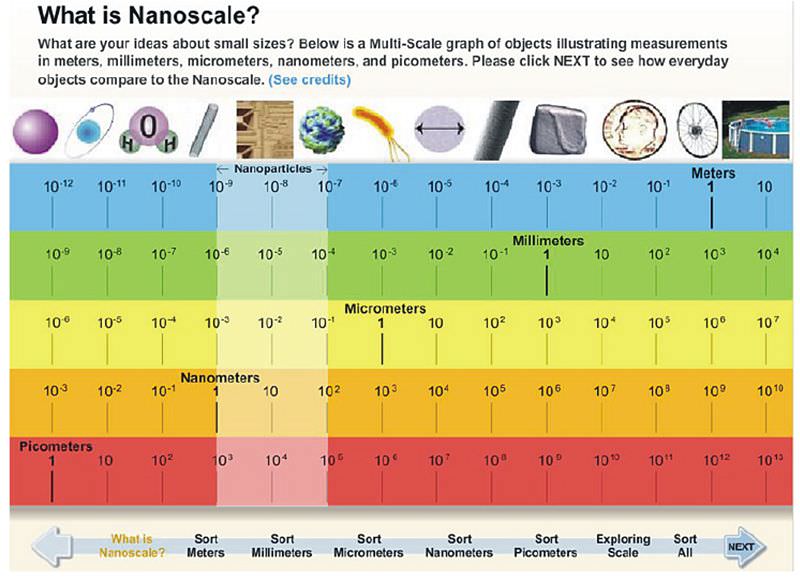
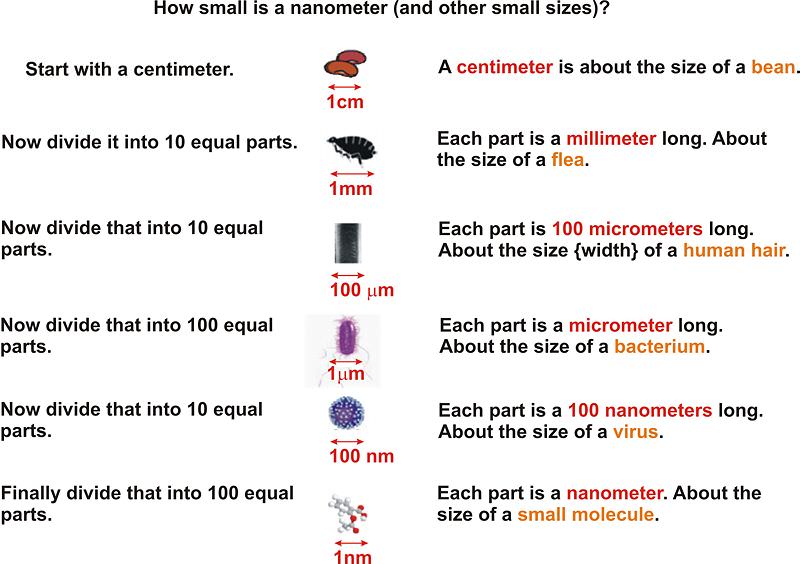
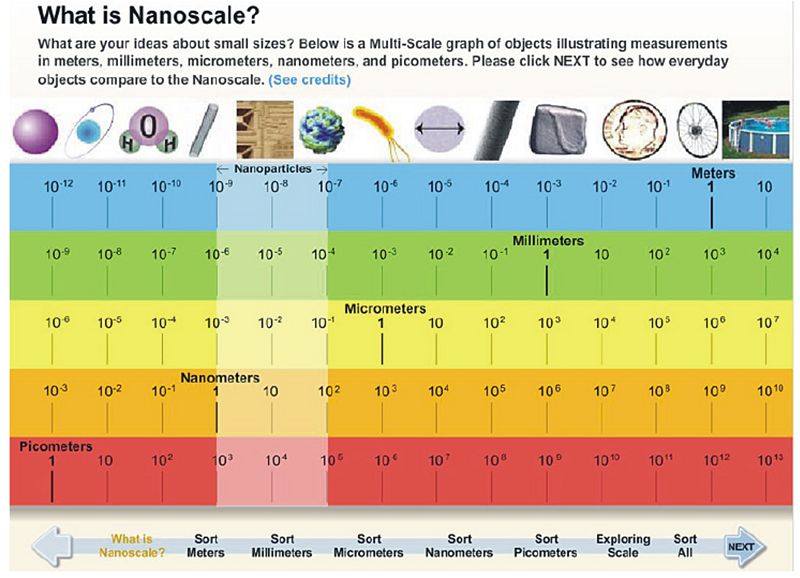
Circle the images that are smaller than a penny. Underline the object that cannot be seen with the unaided eye.
Activity: Image Sort
Click on “sort meters.” First, move your mouse over the images on the screen to find out the name of each one. Next, record your predicted order (largest to smallest) based on the width of each object in the left column. Then, see how well you did by completing the image sort in the interactive and recording the actual size orders in the right column. Once you have completed Image Sort #1, repeat the same steps for Image Sorts 2–5.
Rank from largest to smallest in actual width.
Image Sort #1 (Meter Range)
Write Image Names Below
Write Image Names Below
Predicted Order
Actual Order
1
2
3
4
Write the common instruments and dominant force at this range listed in the interactive.
2. Click “What Is a Power of Ten?” and read the information.
a. When are powers of 10 used? ___________________________________
b. Write 103 as a whole number. ________________________________
c. Write 10−3 as a whole number._________________________________
3. Click “Start” link at the bottom of the page.
4. As you click through the different powers of 10 (both + & -); answer the following questions:
a. What can you observe at 109m?
b. What can you observe at 10−9m?
c. On the (+) scale, between what powers of 10 does the view not change? Why do you think this is?
d. On the (-) scale, between what powers of 10 does the view not change? Why do you think this is?
nanoreisen – ADVENTURES BEYOND THE DECIMAL
1. Type the following Web site address: http:www.nanoreisen.de/
2. Click on the “English Version” link, then click on the pulsating suit case.
3. Navigate through all of the following routes:
Ego-Trip
Bit-Land Route
Bright-Spot Route
4. For the following powers of 10; copy down the stage name for the Ego-Trip and provide a brief description of what you are observing.
SIZE
STAGE
DESCRIPTION
10Meter=1m
10−2Meter=1cm
10−3Meter=1mm
10−6Meter=1μm
10−9Meter=1nm
10−12Meter=1pm
10−15Meter=1fm
What Is Nanotechnology? Essay Assessment
Directions:
While many people have heard of “nanotechnology,” how many can explain exactly what it is or give an example of nanotechnology in our everyday lives? Based on what you have learned in this module so far and incorporating what you learn about specific applications of nanotechnology from readings and some Internet resources, you will write a short essay (no more than one typed page) that enlightens your audience about nanotechnology. Be sure your essay fully addresses the writing prompt below. You may refer to your journal to help you plan your response; however, the writing in the essays should be distinct from your journal and be written in your own words (i.e., no copying).
Writing Prompt
Explain the term “nanotechnology” to someone who has heard of it only on T.V. Then, explain how scientists and the general public should react to the latest research and applications in nanotechnology.
Define Nanotechnology.
Give examples of specific nanoapplications to help illustrate nanotechnology. These should come from the Internet resources you read as well as from what you have learned in this unit.
Describe nanotechnology’s impact on science and how the application involves research from many different science subjects (e.g., biology, chemistry, physics, engineering).
Explain why it is important for scientists to discuss the technology’s positive and negative impacts with each other and with the general public.
Include an explanation for why the general public should stay informed about the progress of nanotechnology.
Refer to the instructional rubric below to learn of the criteria that will be used to evaluate your writing.
Instructional Rubric for Essay Assessment
Criteria
Advanced (4)
Proficient (3)
Partially Proficient (2)
Novice (1)
Writing Style and Mechanics
Concise, clear, and engaging explanations with flawless spelling, punctuation, and grammar.
Concise and clear explanations with minor errors that do not interfere with communication.
Appropriate writing format. Writer does not appear to have carefully proofread.
Demonstrates little or no attention to the writing format. Has great difficulty communicating.
Understanding of Content
Explanations about the impact of nanotechnology applications on science and society are complete∗ and insightful.
Gives detailed examples to help explain points.
Writes in own words.
∗ Responses include answers to all five bullet points in prompt.
Explanations about the impact of nanotechnology applications on science and society are complete ∗ and reasonable.
Gives examples to make points. Could be more detailed.
Writes in own words.
∗ Responses include answers to all five bullet points in prompt.
Explanations about the impact of nanotechnology applications on science and society are obvious.
Does not always write in own words.
Explanations about the impact of nanotechnology applications on science and society are irrelevant.
Copies from the article.
Nanotechnology Articles
Your essay should draw on current information about nanotechnology applications. Your teacher will either assign specific readings below or encourage you to choose the resources that interest you.
Atom Drive discusses a new advancement in nanotechnology—nanocars.
SQ3R Reading Strategy1
SQ3R stands for Survey, Question, Read, Recite, and Review. As you read select nanotechnology resources, you will use this strategy, as outlined below, to guide you.
1. Survey what you are about to read.
Look at the title, subheadings, illustrations, and graphics.
Read over the first and last paragraphs.
What do you already know about this subject?
What do you think you will learn from reading this article?
2. Question. Formulate questions to help guide your reading.
Turn the article title into a question. Write it here:
Turn the subheadings and/or graphics into questions. Write them below.
3. Read actively.
Read to search for answers to the questions you noted above.
What additional questions do you have? For instance, were there any unclear passages, unfamiliar words? Write them below.
1Adapted from R. Billmeyer, & M. L. Barton. (2002). Teaching reading in the content areas: If not me, then who?
(2nd ed.). Alexandria, VA: ASCD.
4. Recite.
Write the answers to the questions you listed in numbers 2 and 3 without looking at the article.
Reread the article for any unanswered questions.
5. Review.
Summarize the information you learned. Include notes below to help you plan your essay.
What is nanotechnology?
What are some nanoapplications discussed in the article?
List the different areas of science involved in specific nanoapplications.
Why is it important to study and communicate both the positive and negative impacts of nanotechnology? Provide examples to illustrate your points.
Do you think nanotechnology has life-changing effects? Why should the general public stay informed about nanotechnology?
Return to your graphic organizer on page 1–1. Update your chart with at least three new ideas that you learned from this assignment.
Investigating Static Forces in Nature: The Mystery of the Gecko


 FlexiA FREE Digital Tutor for Every Student
 FlexBooks 2.0Customizable, digital textbooks in a new, interactive platform
 FlexBooksCustomizable, digital textbooks
 SchoolsFlexBooks from schools and districts near you
 Study GuidesQuick review with key information for each concept
 Adaptive PracticeBuilding knowledge at each student’s skill level
 SimulationsInteractive Physics & Chemistry Simulations
 PLIXPlay. Learn. Interact. eXplore.
 CCSS MathConcepts and FlexBooks aligned to Common Core
 NGSSConcepts aligned to Next Generation Science Standards
 Certified EducatorStand out as an educator. Become CK-12 Certified.
 WebinarsLive and archived sessions to learn about CK-12