Here is a method useful to hikers and scouts. Suppose you want to estimate the distance to some distant landmark --- e.g. a building, tree or water tower.
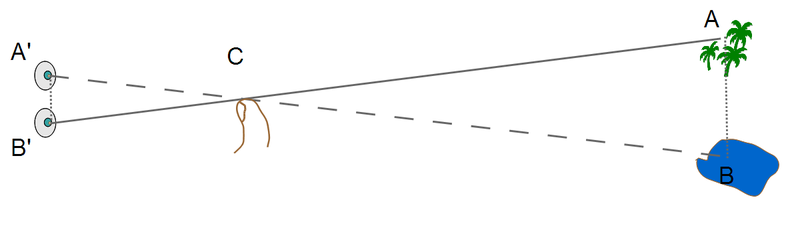
Finding the distance to a faraway point (A) (not to scale).
The drawing shows a schematic view of the situation from above (not to scale). To estimate the distance to the landmark A, you do the following:
Stretch your arm forward and extend your thumb, so that your thumbnail faces your eyes. Close one eye (A') and move your thumb so that, looking with your open eye (B'), you see your thumbnail covering the landmark A.
Then open the eye you had closed (A') and close the one (B') with which you looked before, without moving your thumb. It will now appear that your thumbnail has moved: it is no longer in front of landmark A, but in front of some other point at the same distance, marked as B in the drawing.
Estimate the true distance AB, by comparing it to the estimated heights of trees, widths of buildings, distances between power-line poles, lengths of cars etc. The distance to the landmark is 10 times the distance AB.
Why does this work? Because even though people vary in size, the proportions of the average human body are fairly constant, and for most people, the angle between the lines from the eyes (A',B') to the outstretched thumb is about 6 degrees, for which the ratio 1:10 was found in an earlier part of this section. That angle is the parallax of your thumb, viewed from your eyes. The triangle A'B'C has the same proportions as the much larger triangle ABC, and therefore, if the distance B'C to the thumb is 10 times the distance A'B' between the eyes, the distance AC to the far landmark is also 10 times the distance AB.
NOTES / HIGHLIGHTS
Please Sign In to create your own Highlights / Notes
Notes/Highlights
Color
Highlighted Text
Notes
Please Sign In to create your own Highlights / Notes
Currently there are no resources to be displayed.
Description
An introduction to astronomy written with a historical perspective.


 FlexiA FREE Digital Tutor for Every Student
 FlexBooks 2.0Customizable, digital textbooks in a new, interactive platform
 FlexBooksCustomizable, digital textbooks
 SchoolsFlexBooks from schools and districts near you
 Study GuidesQuick review with key information for each concept
 Adaptive PracticeBuilding knowledge at each student’s skill level
 SimulationsInteractive Physics & Chemistry Simulations
 PLIXPlay. Learn. Interact. eXplore.
 CCSS MathConcepts and FlexBooks aligned to Common Core
 NGSSConcepts aligned to Next Generation Science Standards
 Certified EducatorStand out as an educator. Become CK-12 Certified.
 WebinarsLive and archived sessions to learn about CK-12