We live at a time when emotions and feelings count more than truth, and there is a vast ignorance of science.
James Lovelock
David Goodstein’s Out of Gas (2004).
I recently read two books, one by a physicist, and one by an economist. In Out of Gas, Caltech physicist David Goodstein describes an impending energy crisis brought on by The End of the Age of Oil. This crisis is coming soon, he predicts: the crisis will bite, not when the last drop of oil is extracted, but when oil extraction can’t meet demand – perhaps as soon as 2015 or 2025. Moreover, even if we magically switched all our energy-guzzling to nuclear power right away, Goodstein says, the oil crisis would simply be replaced by a nuclear crisis in just twenty years or so, as uranium reserves also became depleted.
Bjørn Lomborg’s The Skeptical Environmentalist (2001).
In The Skeptical Environmentalist, Bjørn Lomborg paints a completely different picture. “Everything is fine.” Indeed, “everything is getting better.” Furthermore, “we are not headed for a major energy crisis,” and “there is plenty of energy.”
How could two smart people come to such different conclusions? I had to get to the bottom of this.
Energy made it into the British news in 2006. Kindled by tidings of great climate change and a tripling in the price of natural gas in just six years, the flames of debate are raging. How should Britain handle its energy needs? And how should the world?
“Wind or nuclear?”, for example. Greater polarization of views among smart people is hard to imagine. During a discussion of the proposed expansion of nuclear power, Michael Meacher, former environment minister, said “if we’re going to cut greenhouse gases by 60%... by 2050 there is no other possible way of doing that except through renewables;” Sir Bernard Ingham, former civil servant, speaking in favour of nuclear expansion, said “anybody who is relying upon renewables to fill the [energy] gap is living in an utter dream world and is, in my view, an enemy of the people.”
Similar disagreement can be heard within the ecological movement. All agree that something must be done urgently, but what? Jonathon Porritt, chair of the Sustainable Development Commission, writes: “there is no justification for bringing forward plans for a new nuclear power programme at this time, and... any such proposal would be incompatible with [the Government’s] sustainable development strategy;” and “a non-nuclear strategy could and should be sufficient to deliver all the carbon savings we shall need up to 2050 and beyond, and to ensure secure access to reliable sources of energy.” In contrast, environmentalist James Lovelock writes in his book, The Revenge of Gaia: “Now is much too late to establish sustainable development.” In his view, power from nuclear fission, while not recommended as the long-term panacea for our ailing planet, is “the only effective medicine we have now.” Onshore wind turbines are “merely... a gesture to prove [our leaders’] environmental credentials.”
This heated debate is fundamentally about numbers. How much energy could each source deliver, at what economic and social cost, and with what risks? But actual numbers are rarely mentioned. In public debates, people just say “Nuclear is a money pit” or “We have a huge amount of wave and wind.” The trouble with this sort of language is that it’s not sufficient to know that something is huge: we need to know how the one “huge” compares with another “huge,” namely our huge energy consumption. To make this comparison, we need numbers, not adjectives.
Where numbers are used, their meaning is often obfuscated by enormousness. Numbers are chosen to impress, to score points in arguments, rather than to inform. “Los Angeles residents drive 142 million miles – the distance from Earth to Mars – every single day.” “Each year, 27 million acres of tropical rainforest are destroyed.” “14 billion pounds of trash are dumped into the sea every year.” “British people throw away 2.6 billion slices of bread per year.” “The waste paper buried each year in the UK could fill 103448 double-decker buses.”
If all the ineffective ideas for solving the energy crisis were laid end to end, they would reach to the moon and back.... I digress.
The result of this lack of meaningful numbers and facts? We are inundated with a flood of crazy innumerate codswallop. The BBC doles out advice on how we can do our bit to save the planet – for example “switch off your mobile phone charger when it’s not in use;” if anyone objects that mobile phone chargers are not actually our number one form of energy consumption, the mantra “every little helps” is wheeled out. Every little helps? A more realistic mantra is:
if everyone does a little, we’ll achieve only a little.
For the benefit of readers who speak American, rather than English, the translation of “every little helps” into American is “every little bit helps.”
Companies also contribute to the daily codswallop as they tell us how wonderful they are, or how they can help us “do our bit.” BP’s website, for example, celebrates the reductions in carbon dioxide (CO2) pollution they hope to achieve by changing the paint used for painting BP’s ships. Does anyone fall for this? Surely everyone will guess that it’s not the exterior paint job, it’s the stuff inside the tanker that deserves attention, if society’s CO2 emissions are to be significantly cut? BP also created a web-based carbon absolution service, “targetneutral.com,” which claims that they can “neutralize” all your carbon emissions, and that it “doesn’t cost the earth” – indeed, that your CO2 pollution can be cleaned up for just £40 per year. How can this add up? – if the true cost of fixing climate change were £40 per person then the government could fix it with the loose change in the Chancellor’s pocket!
Even more reprehensible are companies that exploit the current concern for the environment by offering “water-powered batteries,” “biodegradable mobile phones,” “portable arm-mounted wind-turbines,” and other pointless tat.
Campaigners also mislead. People who want to promote renewables over nuclear, for example, say “offshore wind power could power all UK homes;” then they say “new nuclear power stations will do little to tackle climate change” because 10 new nuclear stations would “reduce emissions only by about 4%.” This argument is misleading because the playing field is switched half-way through, from the “number of homes powered” to “reduction of emissions.” The truth is that the amount of electrical power generated by the wonderful windmills that “could power all UK homes” is exactly the same as the amount that would be generated by the 10 nuclear power stations! “Powering all UK homes” accounts for just 4% of UK emissions.
Perhaps the worst offenders in the kingdom of codswallop are the people who really should know better – the media publishers who promote the codswallop – for example, New Scientist with their article about the “water-powered car.”∗
In a climate where people don’t understand the numbers, newspapers, campaigners, companies, and politicians can get away with murder.
We need simple numbers, and we need the numbers to be comprehensible, comparable, and memorable.
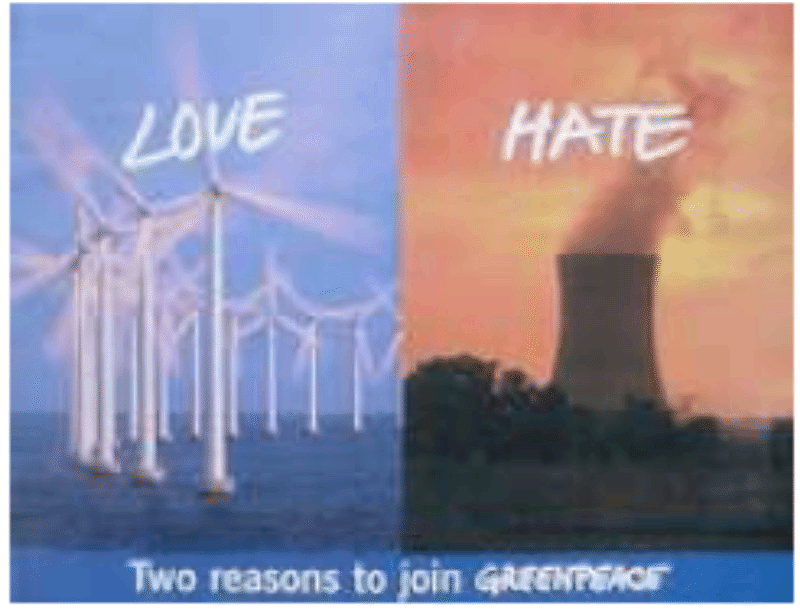
Figure 1.1: This Greenpeace leaflet arrived with my junk mail in May 2006. Do beloved windmills have the capacity to displace hated cooling towers?
With numbers in place, we will be better placed to answer questions such as these:
Can a country like Britain conceivably live on its own renewable energy sources?
If everyone turns their thermostats one degree closer to the outside temperature, drives a smaller car, and switches off phone chargers when not in use, will an energy crisis be averted?
Should the tax on transportation fuels be significantly increased? Should speed-limits on roads be halved?
Is someone who advocates windmills over nuclear power stations “an enemy of the people”?
If climate change is “a greater threat than terrorism,” should governments criminalize “the glorification of travel” and pass laws against “advocating acts of consumption”?
Will a switch to “advanced technologies” allow us to eliminate carbon dioxide pollution without changing our lifestyle?
Should people be encouraged to eat more vegetarian food?
Is the population of the earth six times too big?
Why are we discussing energy policy?
Three different motivations drive today’s energy discussions.
First, fossil fuels are a finite resource. It seems possible that cheap oil (on which our cars and lorries run) and cheap gas (with which we heat many of our buildings) will run out in our lifetime. So we seek alternative energy sources. Indeed given that fossil fuels are a valuable resource, useful for manufacture of plastics and all sorts of other creative stuff, perhaps we should save them for better uses than simply setting fire to them.
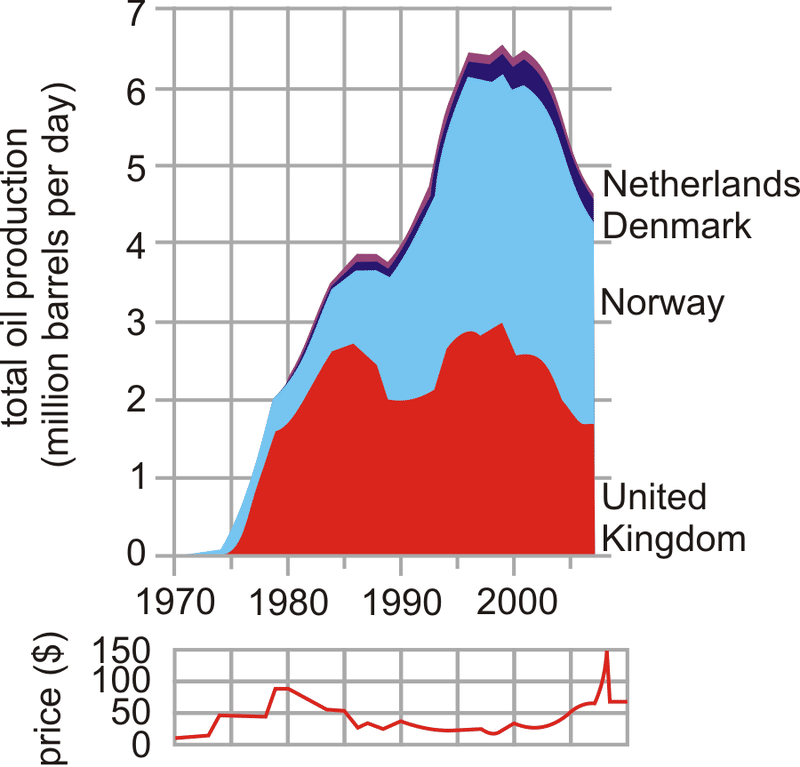
Figure 1.2: Are “our” fossil fuels running out? Total crude oil production from the North Sea, and oil price in 2006 dollars per barrel.
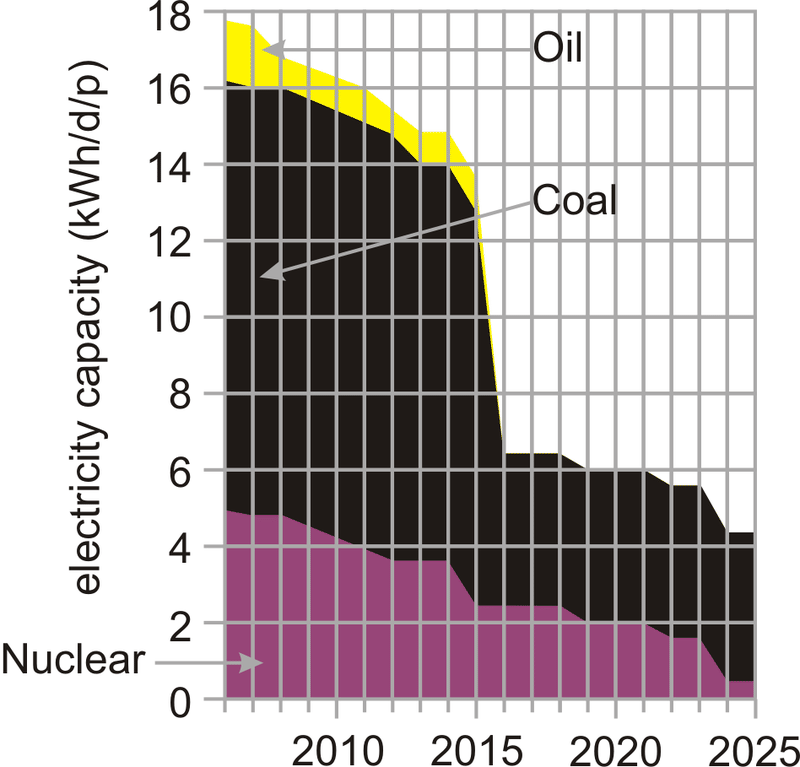
Second, we’re interested in security of energy supply. Even if fossil fuels are still available somewhere in the world, perhaps we don’t want to depend on them if that would make our economy vulnerable to the whims of untrustworthy foreigners. (I hope you can hear my tongue in my cheek.) Going by figure 1.2, it certainly looks as if “our” fossil fuels have peaked. The UK has a particular security-of-supply problem looming, known as the “energy gap.” A substantial number of old coal power stations and nuclear power stations will be closing down during the next decade (figure 1.3), so there is a risk that electricity demand will sometimes exceed electricity supply, if adequate plans are not implemented.
Figure 1.3: The energy gap created by UK power station closures, as projected by energy company EdF. This graph shows the predicted capacity of nuclear, coal, and oil power stations, in kilowatt-hours per day per person. The capacity is the maximum deliverable power of a source.
Third, it’s very probable that using fossil fuels changes the climate. Climate change is blamed on several human activities, but the biggest contributor to climate change is the increase in greenhouse effect produced by carbon dioxide (CO2). Most of the carbon dioxide emissions come from fossil-fuel burning. And the main reason we burn fossil fuels is for energy. So to fix climate change, we need to sort out a new way of getting energy. The climate problem is mostly an energy problem.
Whichever of these three concerns motivates you, we need energy numbers, and policies that add up.
The first two concerns are straightforward selfish motivations for drastically reducing fossil fuel use. The third concern, climate change, is a more altruistic motivation – the brunt of climate change will be borne not by us but by future generations over many hundreds of years. Some people feel that climate change is not their responsibility. They say things like “What’s the point in my doing anything? China’s out of control!” So I’m going to discuss climate change a bit more now, because while writing this book I learned some interesting facts that shed light on these ethical questions. If you have no interest in climate change, feel free to fast-forward to the next section.
The climate-change motivation
The climate-change motivation is argued in three steps: one: human fossil-fuel burning causes carbon dioxide concentrations to rise; two: carbon dioxide is a greenhouse gas; three: increasing the greenhouse effect increases average global temperatures (and has many other effects).
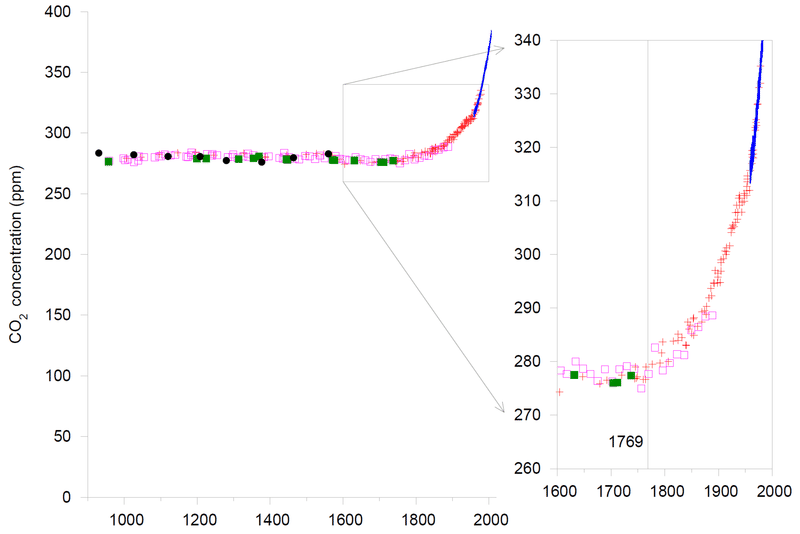
Figure 1.4: Carbon dioxide (CO2) concentrations (in parts per million) for the last 1100 years, measured from air trapped in ice cores (up to 1977) and directly in Hawaii (from 1958 onwards). I think something new may have happened between 1800AD and 2000AD. I’ve marked the year 1769, in which James Watt patented his steam engine. (The first practical steam engine was invented 70 years earlier in 1698, but Watt’s was much more efficient.)
We start with the fact that carbon dioxide concentrations are rising. Figure 1.4 shows measurements of the CO2 concentration in the air from the year 1000 AD to the present. Some “sceptics” have asserted that the recent increase in CO2 concentration is a natural phenomenon. Does “sceptic” mean “a person who has not even glanced at the data”? Don’t you think, just possibly, something may have happened between 1800 AD and 2000AD? Something that was not part of the natural processes present in the preceding thousand years?
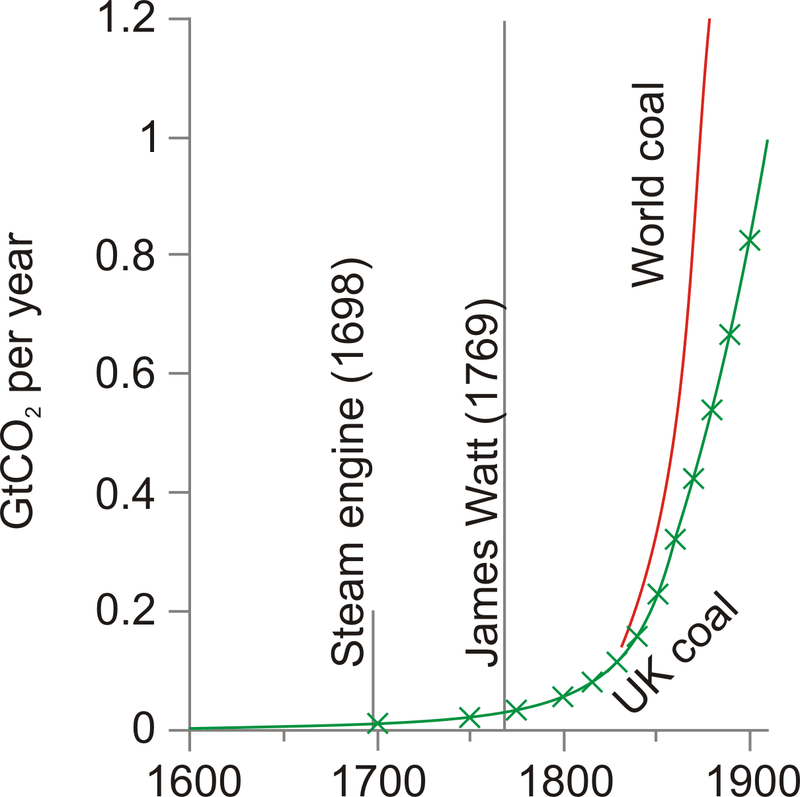
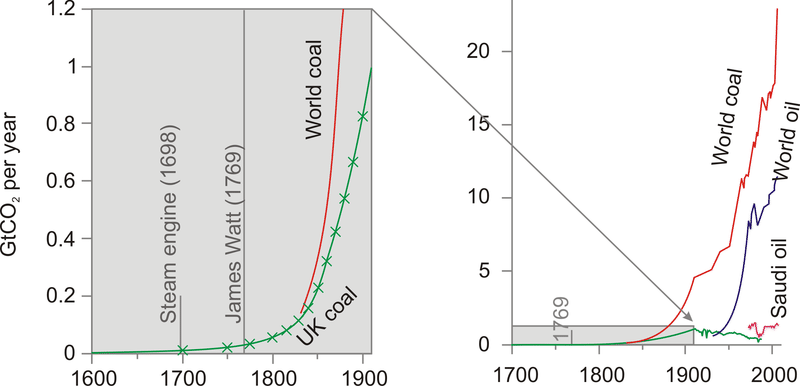
Figure 1.5: The history of UK coal production and world coal production from 1600 to 1910. Production rates are shown in billions of tons of CO2 – an incomprehensible unit, yes, but don’t worry: we’ll personalize it shortly.
Something did happen, and it was called the Industrial Revolution. I’ve marked on the graph the year 1769, in which James Watt patented his steam engine. While the first practical steam engine was invented in 1698, Watt’s more efficient steam engine really got the Industrial Revolution going. One of the steam engine’s main applications was the pumping of water out of coal mines. Figure 1.5 shows what happened to British coal production from 1769 onwards. The figure displays coal production in units of billions of tons of CO2 released when the coal was burned. In 1800, coal was used to make iron, to make ships, to heat buildings, to power locomotives and other machinery, and of course to power the pumps that enabled still more coal to be scraped up from inside the hills of England and Wales. Britain was terribly well endowed with coal: when the Revolution started, the amount of carbon sitting in coal under Britain was roughly the same as the amount sitting in oil under Saudi Arabia.
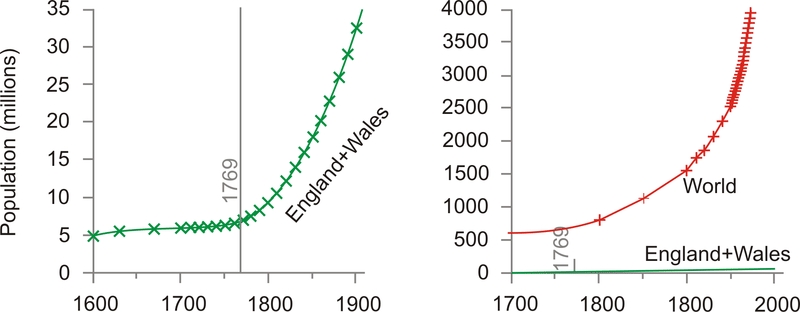
In the 30 years from 1769 to 1800, Britain’s annual coal production doubled. After another 30 years (1830), it had doubled again. The next doubling of production-rate happened within 20 years (1850), and another doubling within 20 years of that (1870). This coal allowed Britain to turn the globe pink. The prosperity that came to England and Wales was reflected in a century of unprecedented population growth:
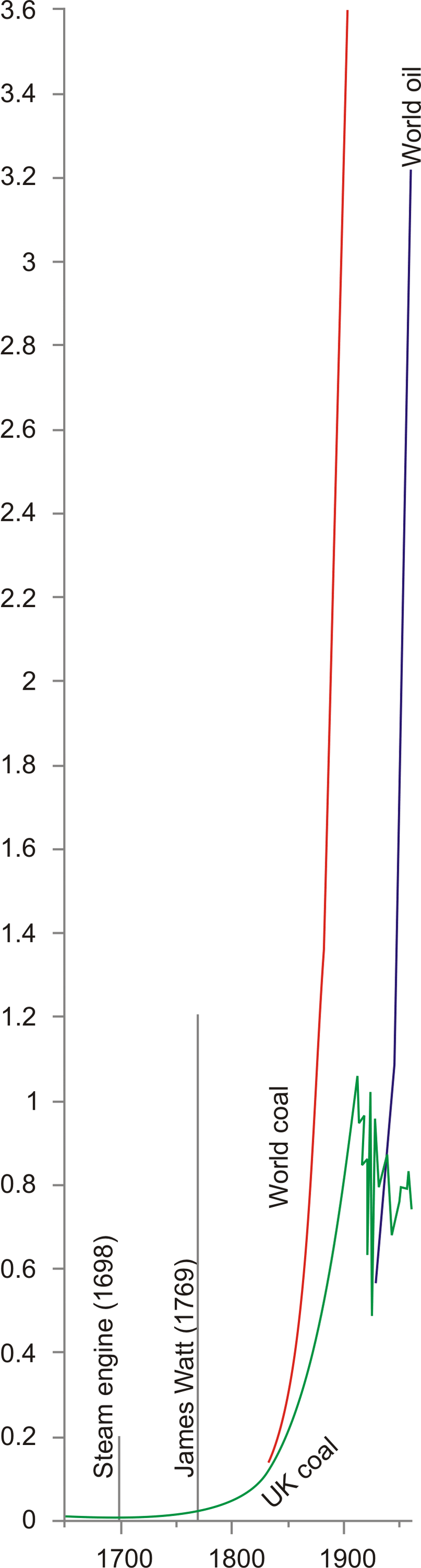
Eventually other countries got in on the act too as the Revolution spread. Figure 1.6 shows British coal production and world coal production on the same scale as figure 1.5, sliding the window of history 50 years later. British coal production peaked in 1910, but meanwhile world coal production continued to double every 20 years. It’s difficult to show the history of coal production on a single graph. To show what happened in the next 50 years on the same scale, the book would need to be one metre tall! To cope with this difficulty, we can either scale down the vertical axis:
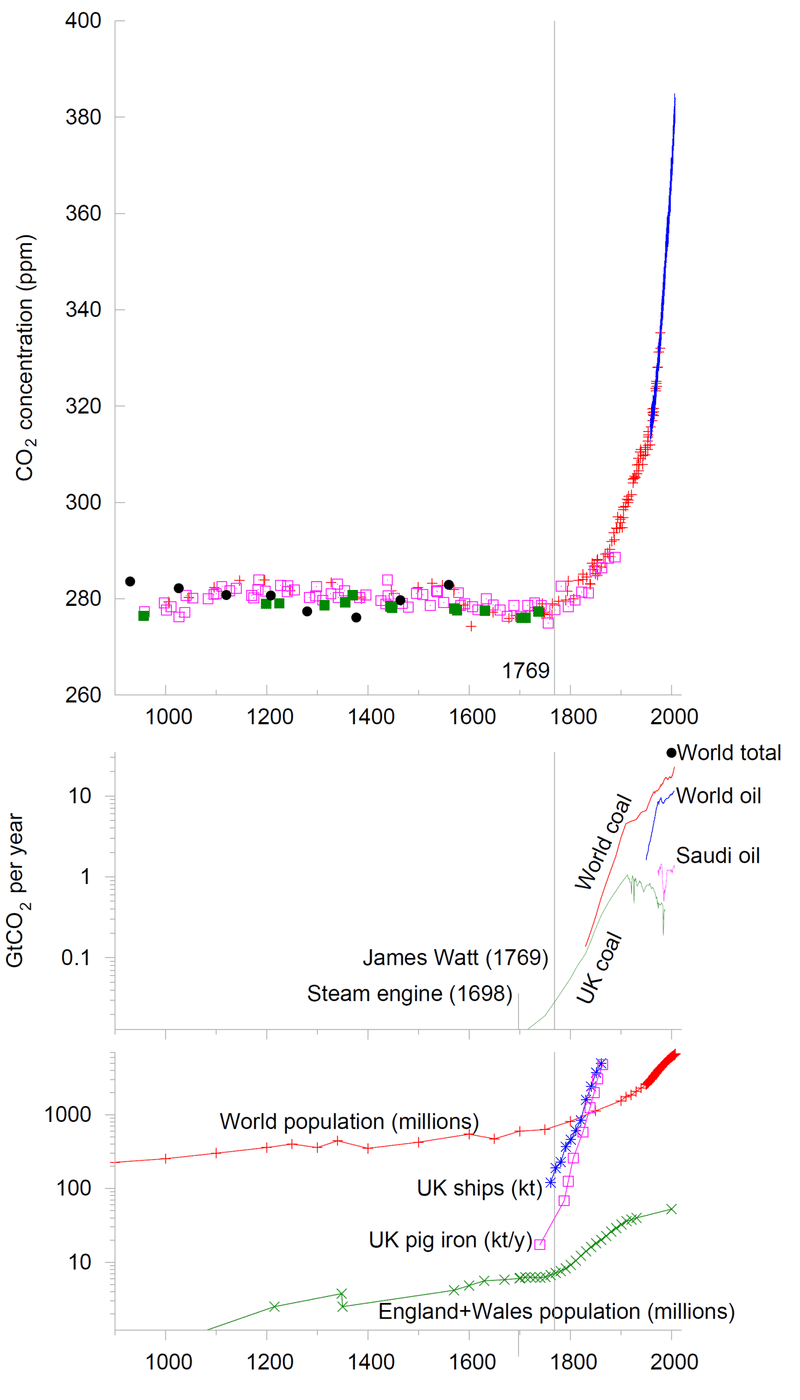
or we can squish the vertical axis in a non-uniform way, so that small quantities and large quantities can be seen at the same time on a single graph. A good way to squish the axis is called a logarithmic scale, and that’s what I’ve used in the bottom two graphs of figure 1.7. On a logarithmic scale, all ten-fold increases (from 1 to 10, from 10 to 100, from 100 to 1000) are represented by equal distances on the page. On a logarithmic scale, a quantity that grows at a constant percentage per year (which is called “exponential growth”) looks like a straight line. Logarithmic graphs are great for understanding growth. Whereas the ordinary graphs in the figures on pages 6 and 7 convey the messages that British and world coal production grew remarkably, and that British and world population grew remarkably, the relative growth rates are not evident in these ordinary graphs. The logarithmic graphs allow us to compare growth rates. Looking at the slopes of the population curves, for example, we can see that the world population’s growth rate in the last 50 years was a little bigger than the growth rate of England and Wales in 1800.
Figure 1.6: What happened next. The history of UK coal production and world coal production from 1650 to 1960, on the same scale as figure 1.5.
From 1769 to 2006, world annual coal production increased 800-fold. Coal production is still increasing today. Other fossil fuels are being extracted too – the middle graph of figure 1.7 shows oil production for example – but in terms of CO2 emissions, coal is still king.
The burning of fossil fuels is the principal reason why CO2 concentrations have gone up. This is a fact, but, hang on: I hear a persistent buzzing noise coming from a bunch of climate-change inactivists. What are they saying? Here’s Dominic Lawson, a columnist from the Independent:
“The burning of fossil fuels sends about seven gigatons of CO2 per year into the atmosphere, which sounds like a lot. Yet the biosphere and the oceans send about 1900 gigatons and 36000 gigatons of CO2 per year into the atmosphere –... one reason why some of us are sceptical about the emphasis put on the role of human fuel-burning in the greenhouse gas effect. Reducing man-made CO2 emissions is megalomania, exaggerating man’s significance. Politicians can’t change the weather.”
Now I have a lot of time for scepticism, and not everything that sceptics say is a crock of manure – but irresponsible journalism like Dominic Lawson’s deserves a good flushing.
The first problem with Lawson’s offering is that all three numbers that he mentions (seven, 1900, and 36000) are wrong! The correct numbers are 26, 440, and 330. Leaving these errors to one side, let’s address Lawson’s main point, the relative smallness of man-made emissions.
Yes, natural flows of CO2are larger than the additional flow we switched on 200 years ago when we started burning fossil fuels in earnest. But it is terribly misleading to quantify only the large natural flows into the atmosphere, failing to mention the almost exactly equal flows out of the atmosphere back into the biosphere and the oceans. The point is that these natural flows in and out of the atmosphere have been almost exactly in balance for millenia. So it’s not relevant at all that these natural flows are larger than human emissions. The natural flows cancelled themselves out. So the natural flows, large though they were, left the concentration of CO2 in the atmosphere and ocean constant, over the last few thousand years. Burning fossil fuels, in contrast, creates a new flow of carbon that, though small, is not cancelled. Here’s a simple analogy, set in the passport-control arrivals area of an airport. One thousand passengers arrive per hour, and there are exactly enough clockwork officials to process one thousand passengers per hour. There’s a modest queue, but because of the match of arrival rate to service rate, the queue isn’t getting any longer. Now imagine that owing to fog an extra stream of flights is diverted here from a smaller airport. This stream adds an extra 50 passengers per hour to the arrivals lobby – a small addition compared to the original arrival rate of one thousand per hour. Initially at least, the authorities don’t increase the number of officials, and the officials carry on processing just one thousand passengers per hour. So what happens? Slowly but surely, the queue grows. Burning fossil fuels is undeniably increasing the CO2 concentration in the atmosphere and in the surface oceans. No climate scientist disputes this fact. When it comes to CO2 concentrations, man is significant.
Figure 1.7: The upper graph shows carbon dioxide (CO2) concentrations (in parts per million) for the last 1100 years – the same data that was shown in figure 1.4.
Here’s a portrait of James Watt and his 1769 steam engine.
The middle graph shows (on a logarithmic scale) the history of UK coal production, Saudi oil production, world coal production, world oil production, and (by the top right point) the total of all greenhouse gas emissions in the year 2000. All production rates are expressed in units of the associated CO2 emissions.
The bottom graph shows (on a logarithmic scale) some consequences of the Industrial Revolution: sharp increases in the population of England, and, in due course, the world; and remarkable growth in British pig-iron production (in thousand tons per year); and growth in the tonnage of British ships (in thousand tons).
In contrast to the ordinary graphs on the previous pages, the logarithmic scale allows us to show both the population of England and the population of the World on a single diagram, and to see interesting features in both.
OK. Fossil fuel burning increases CO2 concentrations significantly. But does it matter? “Carbon is nature!”, the oilspinners remind us, “Carbon is life!” If CO2 had no harmful effects, then indeed carbon emissions would not matter. However, carbon dioxide is a greenhouse gas. Not the strongest greenhouse gas, but a significant one nonetheless. Put more of it in the atmosphere, and it does what greenhouse gases do: it absorbs infrared radiation (heat) heading out from the earth and reemits it in a random direction; the effect of this random redirection of the atmospheric heat traffic is to impede the flow of heat from the planet, just like a quilt. So carbon dioxide has a warming effect. This fact is based not on complex historical records of global temperatures but on the simple physical properties of CO2 molecules. Greenhouse gases are a quilt, and CO2 is one layer of the quilt.
So, if humanity succeeds in doubling or tripling CO2 concentrations (which is where we are certainly heading, under business as usual), what happens? Here, there is a lot of uncertainty. Climate science is difficult. The climate is a complex, twitchy beast, and exactly how much warming CO2-doubling would produce is uncertain. The consensus of the best climate models seems to be that doubling the CO2 concentration would have roughly the same effect as increasing the intensity of the sun by 2%, and would bump up the global mean temperature by something like 3∘C. This would be what historians call a Bad Thing. I won’t recite the whole litany of probable drastic effects, as I am sure you’ve heard it before. The litany begins “the Greenland icecap would gradually melt, and, over a period of a few 100 years, sea-level would rise by about 7 metres.” The brunt of the litany falls on future generations. Such temperatures have not been seen on earth for at least 100000 years, and it’s conceivable that the ecosystem would be so significantly altered that the earth would stop supplying some of the goods and services that we currently take for granted.
Climate modelling is difficult and is dogged by uncertainties. But uncertainty about exactly how the climate will respond to extra greenhouse gases is no justification for inaction. If you were riding a fast-moving motorcycle in fog near a cliff-edge, and you didn’t have a good map of the cliff, would the lack of a map justify not slowing the bike down?
So, who should slow the bike down? Who should clean up carbon emissions? Who is responsible for climate change? This is an ethical question, of course, not a scientific one, but ethical discussions must be founded on facts. Let’s now explore the facts about greenhouse gas emissions. First, a word about the units in which they are measured. Greenhouse gases include carbon dioxide, methane, and nitrous oxide; each gas has different physical properties; it’s conventional to express all gas emissions in “equivalent amounts of carbon dioxide,” where “equivalent” means “having the same warming effect over a period of 100 years.” One ton of carbon-dioxide-equivalent may be abbreviated as “1tCO2e,” and one billion tons (one thousand million tons) as “1GtCO2e” (one gigaton). In this book 1 t means one metric ton (1000 kg). I’m not going to distinguish imperial tons, because they differ by less than 10% from the metric ton or tonne.
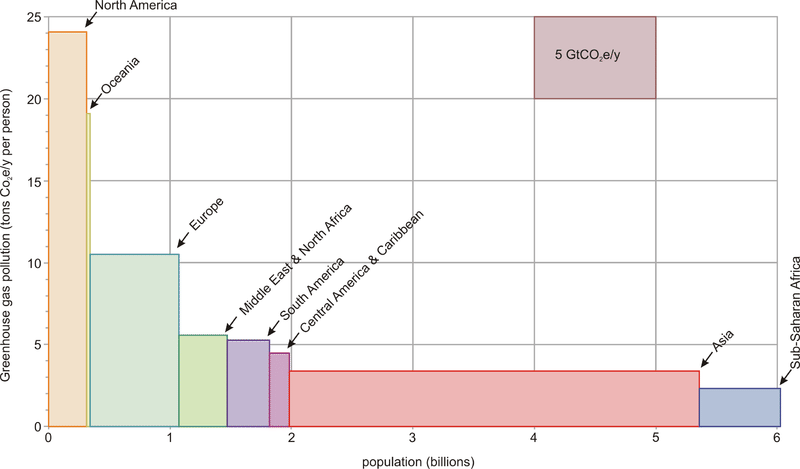
In the year 2000, the world’s greenhouse gas emissions were about 34 billion tons of CO2-equivalent per year. An incomprehensible number. But we can render it more comprehensible and more personal by dividing by the number of people on the planet, 6 billion, so as to obtain the greenhouse-gas pollution per person, which is about 512 tons CO2e per year per person. We can thus represent the world emissions by a rectangle whose width is the population (6 billion) and whose height is the percapita emissions.
Now, all people are created equal, but we don’t all emit 512 tons of CO2 per year. We can break down the emissions of the year 2000, showing how the 34-billion-ton rectangle is shared between the regions of the world:
This picture, which is on the same scale as the previous one, divides the world into eight regions. Each rectangle’s area represents the greenhouse gas emissions of one region. The width of the rectangle is the population of the region, and the height is the average per-capita emissions in that region.
In the year 2000, Europe’s per-capita greenhouse gas emissions were twice the world average; and North America’s were four times the world average.
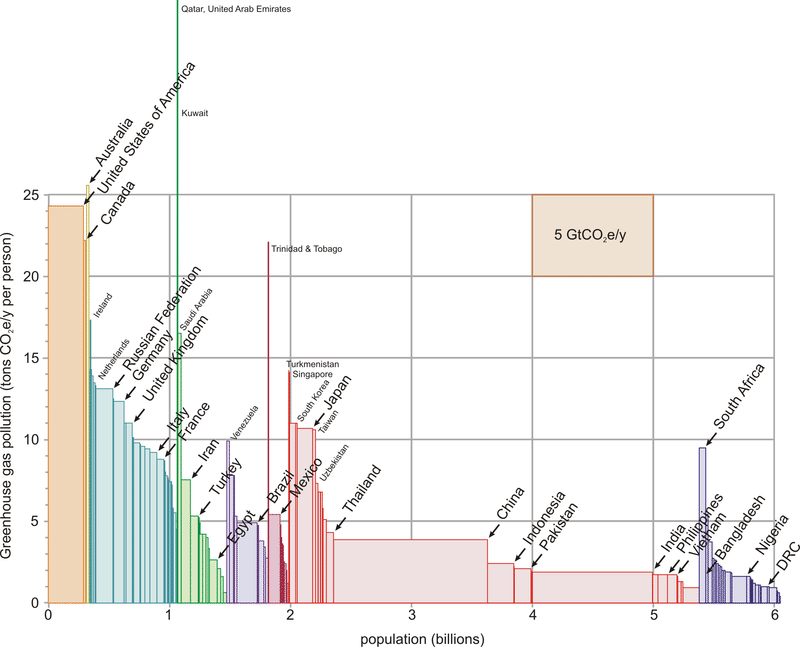
We can continue subdividing, splitting each of the regions into countries. This is where it gets really interesting:
The major countries with the biggest per-capita emissions are Australia, the USA, and Canada. European countries, Japan, and South Africa are notable runners up. Among European countries, the United Kingdom is resolutely average. What about China, that naughty “out of control” country? Yes, the area of China’s rectangle is about the same as the USA’s, but the fact is that their per-capita emissions are below the world average. India’s per-capita emissions are less than half the world average. Moreover, it’s worth bearing in mind that much of the industrial emissions of China and India are associated with the manufacture of stuff for rich countries.
So, assuming that “something needs to be done” to reduce greenhouse gas emissions, who has a special responsibility to do something? As I said, that’s an ethical question. But I find it hard to imagine any system of ethics that denies that the responsibility falls especially on the countries to the left hand side of this diagram – the countries whose emissions are two, three, or four times the world average. Countries that are most able to pay. Countries like Britain and the USA, for example.
Historical responsibility for climate impact
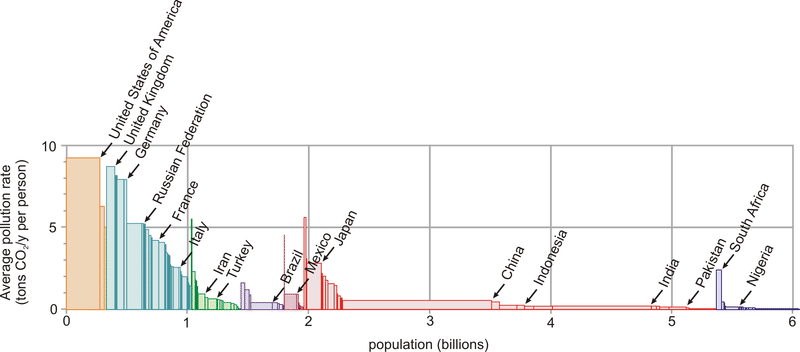
If we assume that the climate has been damaged by human activity, and that someone needs to fix it, who should pay? Some people say “the polluter should pay.” The preceding pictures showed who’s doing the polluting today. But it isn’t the rate of CO2 pollution that matters, it’s the cumulative total emissions; much of the emitted carbon dioxide (about one third of it) will hang around in the atmosphere for at least 50 or 100 years. If we accept the ethical idea that “the polluter should pay” then we should ask how big is each country’s historical footprint. The next picture shows each country’s cumulative emissions of CO2, expressed as an average emission rate over the period 1880–2004.
Congratulations, Britain! The UK has made it onto the winners’ podium. We may be only an average European country today, but in the table of historical emitters, per capita, we are second only to the USA.
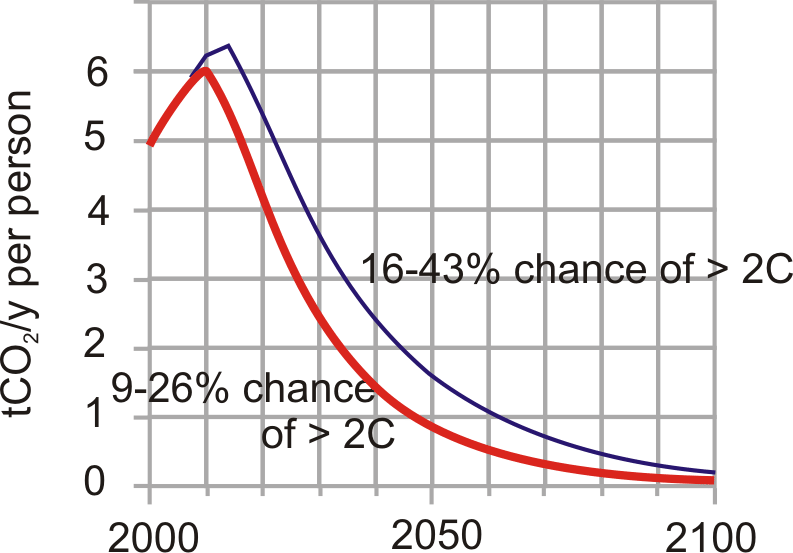
OK, that’s enough ethics. What do scientists reckon needs to be done, to avoid a risk of giving the earth a 2∘C temperature rise (2∘C being the rise above which they predict lots of bad consequences)? The consensus is clear. We need to get off our fossil fuel habit, and we need to do so fast. Some countries, including Britain, have committed to at least a 60% reduction in greenhouse-gas emissions by 2050, but it must be emphasized that 60% cuts, radical though they are, are unlikely to cut the mustard. If the world’s emissions were gradually reduced by 60% by 2050, climate scientists reckon it’s more likely than not that global temperatures will rise by more than 2∘C. The sort of cuts we need to aim for are shown in figure 1.8. This figure shows two possibly-safe emissions scenarios presented by Baer and Mastrandrea (2006) in a report from the Institute for Public Policy Research. The lower curve assumes that a decline in emissions started in 2007, with total global emissions falling at roughly 5% per year. The upper curve assumes a brief delay in the start of the decline, and a 4% drop per year in global emissions. Both scenarios are believed to offer a modest chance of avoiding a 2∘C temperature rise above the pre-industrial level. In the lower scenario, the chance that the temperature rise will exceed2∘C is estimated to be 9–26%. In the upper scenario, the chance of exceeding 2∘C is estimated to be 16–43%. These possibly-safe emissions trajectories, by the way, involve significantly sharper reductions in emissions than any of the scenarios presented by the Intergovernmental Panel on Climate Change (IPCC), or by the Stern Review (2007).
Figure 1.8: Global emissions for two scenarios considered by Baer and Mastrandrea, expressed in tons of CO2 per year per person, using a world population of six billion. Both scenarios are believed to offer a modest chance of avoiding a 2∘C temperature rise above the pre-industrial level.
These possibly-safe trajectories require global emissions to fall by 70% or 85% by 2050. What would this mean for a country like Britain? If we subscribe to the idea of “contraction and convergence,” which means that all countries aim eventually to have equal per-capita emissions, then Britain needs to aim for cuts greater than 85%: it should get down from its current 11 tons of CO2e per year per person to roughly 1 ton per year per person by 2050. This is such a deep cut, I suggest the best way to think about it is no more fossil fuels.
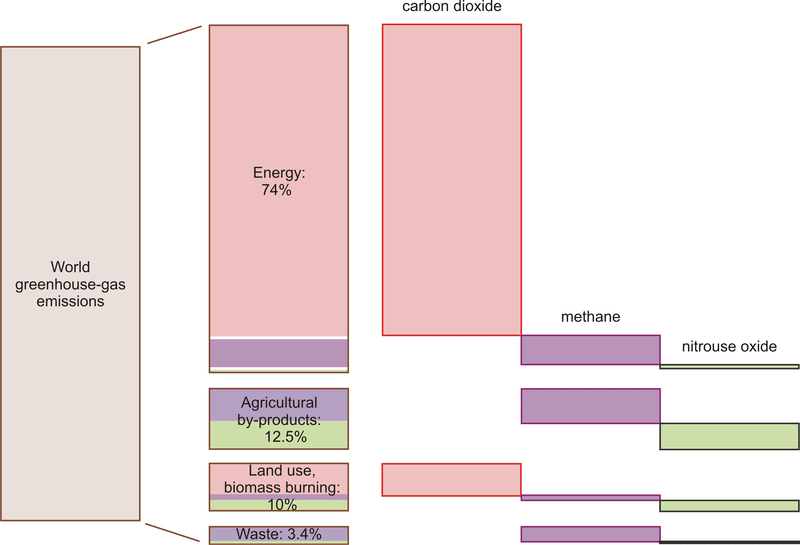
Figure 1.9: Breakdown of world greenhouse-gas emissions (2000) by cause and by gas. “Energy” includes power stations, industrial processes, transport, fossil fuel processing, and energy-use in buildings. “Land use, biomass burning” means changes in land use, deforestation, and the burning of un-renewed biomass such as peat. “Waste” includes waste disposal and treatment. The sizes indicate the 100-year global warming potential of each source. Source: Emission Database for Global Atmospheric Research.
One last thing about the climate-change motivation: while a range of human activities cause greenhouse-gas emissions, the biggest cause by far is energy use. Some people justify not doing anything about their energy use by excuses such as “methane from burping cows causes more warming than jet travel.” Yes, agricultural by-products contributed one eighth of greenhouse-gas emissions in the year 2000. But energy-use contributed three quarters (figure 1.9). The climate change problem is principally an energy problem.
Warnings to the reader
OK, enough about climate change. I’m going to assume we are motivated to get off fossil fuels. Whatever your motivation, the aim of this book is to help you figure out the numbers and do the arithmetic so that you can evaluate policies; and to lay a factual foundation so that you can see which proposals add up. I’m not claiming that the arithmetic and numbers in this book are new; the books I’ve mentioned by Goodstein, Lomborg, and Lovelock, for example, are full of interesting numbers and back-of-envelope calculations, and there are many other helpful sources on the internet too (see the notes at the end of each chapter).
What I’m aiming to do in this book is to make these numbers simple and memorable; to show you how you can figure out the numbers for yourself; and to make the situation so clear that any thinking reader will be able to draw striking conclusions. I don’t want to feed you my own conclusions. Convictions are stronger if they are self-generated, rather than taught. Understanding is a creative process. When you’ve read this book I hope you’ll have reinforced the confidence that you can figure anything out.
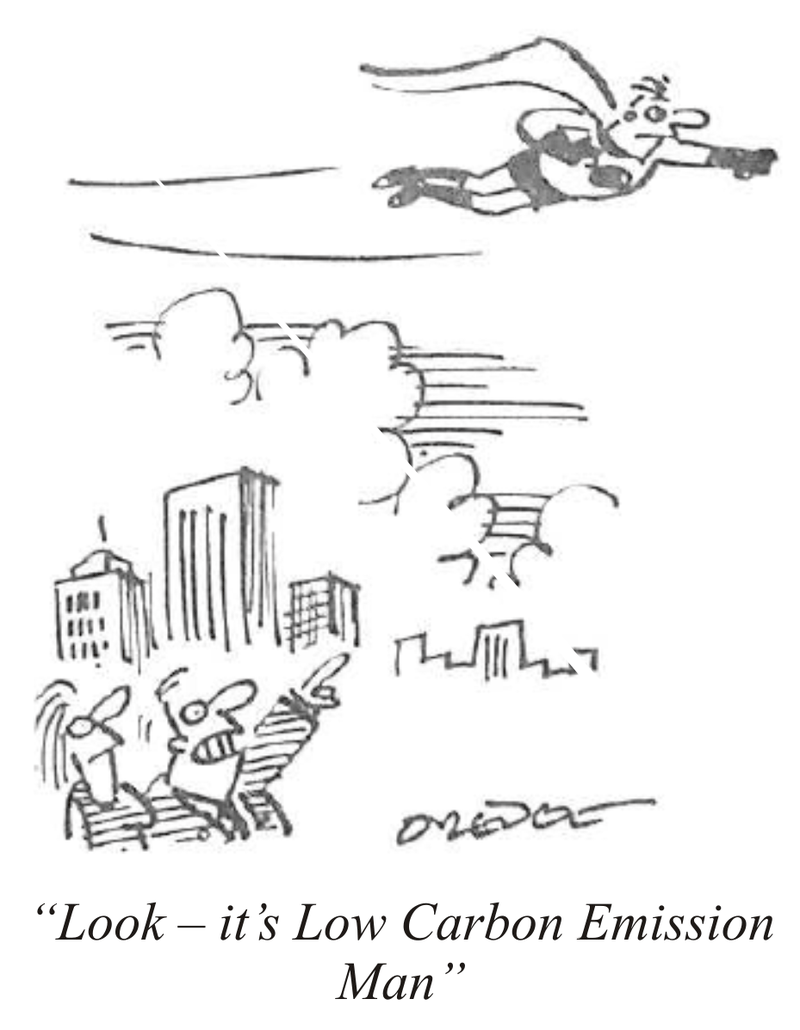
Figure 1.10: Reproduced by kind permission of PRIVATE EYE / Peter Dredge www.private-eye.co.uk.
I’d like to emphasize that the calculations we will do are deliberately imprecise. Simplification is a key to understanding. First, by rounding the numbers, we can make them easier to remember. Second, rounded numbers allow quick calculations. For example, in this book, the population of the United Kingdom is 60 million, and the population of the world is 6 billion. I’m perfectly capable of looking up more accurate figures, but accuracy would get in the way of fluent thought. For example, if we learn that the world’s greenhouse gas emissions in 2000 were 34 billion tons of CO2-equivalent per year, then we can instantly note, without a calculator, that the average emissions per person are 5 or 6 tons of CO2-equivalent per person per year. This rough answer is not exact, but it’s accurate enough to inform interesting conversations. For instance, if you learn that a round-trip intercontinental flight emits nearly two tons of CO2 per passenger, then knowing the average emissions yardstick (5-and-a-bit tons per year per person) helps you realize that just one such plane-trip per year corresponds to over a third of the average person’s carbon emissions.
I like to base my calculations on everyday knowledge rather than on trawling through impersonal national statistics. For example, if I want to estimate the typical wind speeds in Cambridge, I ask “is my cycling speed usually faster than the wind?” The answer is yes. So I can deduce that the wind speed in Cambridge is only rarely faster than my typical cycling speed of 20 km/h. I back up these everyday estimates with other peoples’ calculations and with official statistics. (Please look for these in each chapter’s end-notes.) This book isn’t intended to be a definitive store of super-accurate numbers. Rather, it’s intended to illustrate how to use approximate numbers as a part of constructive consensual conversations.
In the calculations, I’ll mainly use the United Kingdom and occasionally Europe, America, or the whole world, but you should find it easy to redo the calculations for whatever country or region you are interested in.
Let me close this chapter with a few more warnings to the reader. Not only will we make a habit of approximating the numbers we calculate; we’ll also neglect all sorts of details that investors, managers, and economists have to attend to, poor folks. If you’re trying to launch a renewable technology, just a 5% increase in costs may make all the difference between success and failure, so in business every detail must be tracked. But 5% is too small for this book’s radar. This is a book about factors of 2 and factors of 10. It’s about physical limits to sustainable energy, not current economic feasibility. While economics is always changing, the fundamental limits won’t ever go away. We need to understand these limits.
Debates about energy policy are often confusing and emotional because people mix together factual assertions and ethical assertions.
Examples of factual assertions are “global fossil-fuel burning emits 34 billion tons of carbon dioxide equivalent per year;” and “if CO2 concentrations are doubled then average temperatures will increase by 1.5−5.8∘C in the next 100 years;” and “a temperature rise of 2∘C would cause the Greenland ice cap to melt within 500 years;” and “the complete melting of the Greenland ice cap would cause a 7-metre sea-level rise.”
A factual assertion is either true or false; figuring out which may be difficult; it is a scientific question. For example, the assertions I just gave are either true or false. But we don’t know whether they are all true. Some of them are currently judged “very likely.” The difficulty of deciding which factual assertions are true leads to debates in the scientific community. But given sufficient scientific experiment and discussion, the truth or falsity of most factual assertions can eventually be resolved, at least “beyond reasonable doubt.”
Examples of ethical assertions are “it’s wrong to exploit global resources in a way that imposes significant costs on future generations;” and “polluting should not be free;” and “we should take steps to ensure that it’s unlikely that CO2 concentrations will double;” and “politicians should agree a cap on CO2 emissions;” and “countries with the biggest CO2 emissions over the last century have a duty to lead action on climate change;” and “it is fair to share CO2 emission rights equally across the world’s population.” Such assertions are not “either true or false.” Whether we agree with them depends on our ethical judgment, on our values. Ethical assertions may be incompatible with each other; for example, Tony Blair’s government declared a radical policy on CO2 emissions: “the United Kingdom should reduce its CO2 emissions by 60% by 2050;” at the same time Gordon Brown, while Chancellor in that government, repeatedly urged oil-producing countries to increase oil production.
This book is emphatically intended to be about facts, not ethics. I want the facts to be clear, so that people can have a meaningful debate about ethical decisions. I want everyone to understand how the facts constrain the options that are open to us. Like a good scientist, I’ll try to keep my views on ethical questions out of the way, though occasionally I’ll blurt something out – please forgive me.
Figure 1.11: Reproduced by kind permission of PRIVATE EYE / Paul Lowe www.private-eye.co.uk.
Whether it’s fair for Europe and North America to hog the energy cake is an ethical question; I’m here to remind you of the fact that we can’t have our cake and eat it too; to help you weed out the pointless and ineffective policy proposals; and to help you identify energy policies that are compatible with your personal values.
We need a plan that adds up!
Notes and further reading
At the end of each chapter I note details of ideas in that chapter, sources of data and quotes, and pointers to further information.
“...no other possible way of doing that except through renewables”; “anybody who is relying upon renewables to fill the [energy] gap is living in an utter dream world and is, in my view, an enemy of the people.” The quotes are from Any Questions?, 27 January 2006, BBC Radio 4 [ydoobr]. Michael Meacher was UK environment minister from 1997 till 2003. Sir Bernard Ingham was an aide to Margaret Thatcher when she was prime minister, and was Head of the Government Information Service. He is secretary of Supporters of Nuclear Energy.
Jonathon Porritt (March 2006). Is nuclear the answer? Section 3. Advice to Ministers. www.sd-commission.org.uk
“Nuclear is a money pit”, “We have a huge amount of wave and wind.” Ann Leslie, journalist. Speaking on Any Questions?, Radio 4, 10 February 2006.
Los Angeles residents drive... from Earth to Mars – (The Earthworks Group, 1989).
targetneutral.com charges just £4 per ton of CO2 for their “neutralization.” (A significantly lower price than any other “offsetting” company I have come across.) At this price, a typical Brit could have his 11 tons per year “neutralized” for just £44 per year! Evidence that BP’s “neutralization” schemes don’t really add up comes from the fact that its projects have not achieved the Gold Standard www.cdmgoldstandard.org (Michael Schlup, personal communication). Many “carbon offset” projects have been exposed as worthless by Fiona Harvey of the Financial Times [2jhve6].
People who want to promote renewables over nuclear, for example, say “offshore wind power could power all UK homes.” At the end of 2007, the UK government announced that they would allow the building of offshore wind turbines “enough to power all UK homes.” Friends of the Earth’s renewable energy campaigner, Nick Rau, said the group welcomed the government’s announcement. “The potential power that could be generated by this industry is enormous,” he said. [25e59w]. From the Guardian [5o7mxk]: John Sauven, the executive director of Greenpeace, said that the plans amounted to a “wind energy revolution.” “And Labour needs to drop its obsession with nuclear power, which could only ever reduce emissions by about 4% at some time in the distant future.” Nick Rau said: “We are delighted the government is getting serious about the potential for offshore wind, which could generate 25% of the UK’s electricity by 2020.” A few weeks later, the government announced that it would permit new nuclear stations to be built. “Today’s decision to give the go-ahead to a new generation of nuclear power stations... will do little to tackle climate change,” Friends of the Earth warned [5c4olc].
In fact, the two proposed expansions – of offshore wind and of nuclear – would both deliver just the same amount of electricity per year. The total permitted offshore wind power of 33 GW would on average deliver 10 GW, which is 4 kWh per day per person; and the replacement of all the retiring nuclear power stations would deliver 10 GW, which is 4 kWh per day per person. Yet in the same breath, anti-nuclear campaigners say that the nuclear option would “do little,” while the wind option would “power all UK homes.” The fact is, “powering all UK homes” and “only reducing emissions by about 4%” are the same thing.
“water-powered car” New Scientist, 29th July 2006, p.35. This article, headlined “Water-powered car might be available by 2009,” opened thus:
“Forget cars fuelled by alcohol and vegetable oil. Before long, you might be able to run your car with nothing more than water in its fuel tank. It would be the ultimate zero-emissions vehicle.
“While water is not at first sight an obvious power source, it has a key virtue: it is an abundant source of hydrogen, the element widely touted as the green fuel of the future.”
The work New Scientist was describing was not ridiculous – it was actually about a car using boron as a fuel, with a boron/water reaction as one of the first chemical steps. Why did New Scientist feel the urge to turn this into a story suggesting that water was the fuel? Water is not a fuel. It never has been, and it never will be. It is already burned! The first law of thermodynamics says you can’t get energy for nothing; you can only convert energy from one form to another. The energy in any engine must come from somewhere. Fox News peddled an even more absurd story [2fztd3].
Climate change is a far greater threat to the world than international terrorism. Sir David King, Chief Scientific Advisor to the UK government, January, 2004. [26e8z]
the glorification of travel – an allusion to the offence of “glorification” defined in the UK’s Terrorism Act which came into force on 13 April, 2006. [ykhayj]
Figure 1.2. This figure shows production of crude oil including lease condensate, natural gas plant liquids, and other liquids, and refinery processing gain. Sources: EIA, and BP statistical review of world energy.
The first practical steam engine was invented in 1698. In fact, Hero of Alexandria described a steam engine, but given that Hero’s engine didn’t catch on in the following 1600 years, I deem Savery’s 1698 invention the first practical steam engine.
Figures 1.4 and 1.7: Graph of carbon dioxide concentration. The data are collated from Keeling and Whorf (2005) (measurements spanning 1958–2004); Neftel et al. (1994) (1734–1983); Etheridge et al. (1998) (1000–1978); Siegenthaler et al. (2005) (950–1888 AD); and Indermuhle et al. (1999) (from 11000 to 450 years before present). This graph, by the way, should not be confused with the “hockey stick graph”, which shows the history of global temperatures. Attentive readers will have noticed that the climate-change argument I presented makes no mention of historical temperatures. Figures 1.5–1.7: Coal production numbers are from Jevons (1866), Malanima (2006), Netherlands Environmental Assessment Agency (2006), National Bureau of Economic Research (2001), Hatcher (1993), Flinn and Stoker (1984), Church et al. (1986), Supple (1987), Ashworth and Pegg (1986). Jevons was the first “Peak Oil” author. In 1865, he estimated Britain’s easily-accessible coal reserves, looked at the history of exponential growth in consumption, and predicted the end of the exponential growth and the end of the British dominance of world industry. “We cannot long maintain our present rate of increase of consumption.... the check to our progress must become perceptible within a century from the present time.... the conclusion is inevitable, that our present happy progressive condition is a thing of limited duration.” Jevons was right. Within a century British coal production indeed peaked, and there were two world wars.
Dominic Lawson, a columnist from the Independent. My quote is adapted from Dominic Lawson’s column in the Independent, 8 June, 2007.
It is not a verbatim quote: I edited his words to make them briefer but took care not to correct any of his errors. All three numbers he mentions are incorrect. Here’s how he screwed up. First, he says “carbon dioxide” but gives numbers for carbon: the burning of fossil fuels sends 26 gigatonnes of CO2 per year into the atmosphere (not 7 gigatonnes). A common mistake. Second, he claims that the oceans send 36000 gigatonnes of carbon per year into the atmosphere. This is a far worse error: 36000 gigatonnes is the total amount of carbon in the ocean! The annual flow is much smaller – about 90 gigatonnes of carbon per year (330GtCO2/y), according to standard diagrams of the carbon cycle [l6y5g] (I believe this 90 GtC/y is the estimated flow rate, were the atmosphere suddenly to have its CO2 concentration reduced to zero.) Similarly his “1900 gigatonne” flow from biosphere to atmosphere is wrong. The correct figure according to the standard diagrams is about 120 gigatonnes of carbon per year (440GtCO2/y).
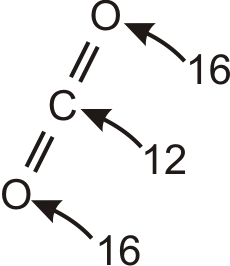
The weights of an atom of carbon and a molecule of CO2 are in the ratio 12 to 44, because the carbon atom weighs 12 units and the two oxygen atoms weigh 16 each. 12+16+16=44.
Incidentally, the observed rise in CO2 concentration is nicely in line with what you’d expect, assuming most of the human emissions of carbon remained in the atmosphere. From 1715 to 2004, roughly 1160 GtCO2 have been released to the atmosphere from the consumption of fossil fuels and cement production (Marland et al., 2007). If all of this CO2 had stayed in the atmosphere, the concentration would have risen by 160ppm (from 280 to 440 ppm). The actual rise has been about 100ppm (from 275 to 377ppm). So roughly 60% of what was emitted is now in the atmosphere.
Carbon dioxide has a warming effect. The over-emotional debate about this topic is getting quite tiresome, isn’t it? “The science is now settled.” “No it isn’t!” “Yes it is!” I think the most helpful thing I can do here is direct anyone who wants a break from the shouting to a brief report written by Charney et al. (1979). This report’s conclusions carry weight because the National Academy of Sciences (the US equivalent of the Royal Society) commissioned the report and selected its authors on the basis of their expertise, “and with regard for appropriate balance.” The study group was convened “under the auspices of the Climate Research Board of the National Research Council to assess the scientific basis for projection of possible future climatic changes resulting from man-made releases of carbon dioxide into the atmosphere.” Specifically, they were asked: “to identify the principal premises on which our current understanding of the question is based, to assess quantitatively the adequacy and uncertainty of our knowledge of these factors and processes, and to summarize in concise and objective terms our best present understanding of the carbon dioxide/climate issue for the benefit of policy-makers.”
The report is just 33 pages long, it is free to download [5qfkaw], and I recommend it. It makes clear which bits of the science were already settled in 1979, and which bits still had uncertainty.
Here are the main points I picked up from this report. First, doubling the atmospheric CO2 concentration would change the net heating of the troposphere, oceans, and land by an average power per unit area of roughly 4W/m2, if all other properties of the atmosphere remained unchanged. This heating effect can be compared with the average power absorbed by the atmosphere, land, and oceans, which is 238W/m2. So doubling CO2 concentrations would have a warming effect equivalent to increasing the intensity of the sun by 4238=1.7%. Second, the consequences of this CO2-induced heating are hard to predict, on account of the complexity of the atmosphere/ocean system, but the authors predicted a global surface warming of between 2∘C and 3.5∘C, with greater increases at high latitudes. Finally, the authors summarize: “we have tried but have been unable to find any overlooked or underestimated physical effects that could reduce the currently estimated global warmings due to a doubling of atmospheric CO2 to negligible proportions or reverse them altogether.” They warn that, thanks to the ocean, “the great and ponderous flywheel of the global climate system,” it is quite possible that the warming would occur sufficiently sluggishly that it would be difficult to detect in the coming decades. Nevertheless “warming will eventually occur, and the associated regional climatic changes... may well be significant.”
The foreword by the chairman of the Climate Research Board, Verner E. Suomi, summarizes the conclusions with a famous cascade of double negatives. “If carbon dioxide continues to increase, the study group finds no reason to doubt that climate changes will result and no reason to believe that these changes will be negligible.”
The litany of probable drastic effects of climate change – I’m sure you’ve heard it before. See [2z2xg7] if not.
Breakdown of world greenhouse gas emissions by region and by country. Data source: Climate Analysis Indicators Tool (CAIT) Version 4.0. (Washington, DC: World Resources Institute, 2007). The first three figures show national totals of all six major greenhouse gases (CO2,CH4,N2O,PFC,HFC,SF6), excluding contributions from land-use change and forestry. The figure shows cumulative emissions of CO2 only.
Congratulations, Britain!... in the table of historical emissions, per capita, we are second only to the USA. Sincere apologies here to Luxembourg, whose historical per-capita emissions actually exceed those of America and Britain; but I felt the winners’ podium should really be reserved for countries having both large per-capita and large total emissions. In total terms the biggest historical emitters are, in order, USA (322GtCO2), Russian Federation (90GtCO2), China (89GtCO2), Germany (78GtCO2), UK (62GtCO2), Japan (43GtCO2), France (30GtCO2), India (25GtCO2), and Canada (24GtCO2). The per-capita order is: Luxembourg, USA, United Kingdom, Czech Republic, Belgium, Germany, Estonia, Qatar, and Canada.
Some countries, including Britain, have committed to at least a 60% reduction in greenhouse-gas emissions by 2050. Indeed, as I write, Britain’s commitment is being increased to an 80% reduction relative to 1990 levels.
Figure 1.8. In the lower scenario, the chance that the temperature rise will exceed 2∘C is estimated to be 9–26%; the cumulative carbon emissions from 2007 onwards are 309 GtC; CO2 concentrations reach a peak of 410ppm, CO2e concentrations peak at 421ppm, and in 2100 CO2 concentrations fall back to 355ppm. In the upper scenario, the chance of exceeding 2∘C is estimated to be 16–43%; the cumulative carbon emissions from 2007 onwards are 415 GtC; CO2 concentrations reach a peak of 425 ppm, CO2e concentrations peak at 435 ppm, and in 2100 CO2 concentrations fall back to 380 ppm. See also hdr.undp.org/en/reports/global/hdr2007-2008/.
there are many other helpful sources on the internet. I recommend, for example: BP’s Statistical Review of World Energy [yyxq2m], the Sustainable Development Commission www.sd-commission.org.uk, the Danish Wind Industry Association www.windpower.org, Environmentalists For Nuclear Energy www.ecolo.org, Wind Energy Department, Risø University www.risoe.dk/vea, DEFRA www.defra.gov.uk/environment/statistics, especially the book Avoiding Dangerous Climate Change [dzcqq], the Pembina Institute www.pembina.org/publications.asp, and the DTI (now known as BERR) www.dti.gov.uk/publications/.
factual assertions and ethical assertions... Ethical assertions are also known as “normative claims” or “value judgments,” and factual assertions are known as “positive claims.” Ethical assertions usually contain verbs like “should” and “must,” or adjectives like “fair,” “right,” and “wrong.” For helpful further reading see Dessler and Parson (2006).
Gordon Brown. On 10th September, 2005, Gordon Brown said the high price of fuel posed a significant risk to the European economy and to global growth, and urged OPEC to raise oil production. Again, six months later, he said “we need... more production, more drilling, more investment, more petrochemical investment” (22nd April, 2006) [y98ys5]. Let me temper this criticism of Gordon Brown by praising one of his more recent initiatives, namely the promotion of electric vehicles and plug-in hybrids. As you’ll see later, one of this book’s conclusions is that electrification of most transport is a good part of a plan for getting off fossil fuels.
NOTES / HIGHLIGHTS
Please Sign In to create your own Highlights / Notes
Notes/Highlights
Color
Highlighted Text
Notes
Please Sign In to create your own Highlights / Notes
Currently there are no resources to be displayed.
Description
This book explores six strategies for eliminating the gap between consumption and renewable production.


 FlexiA FREE Digital Tutor for Every Student
 FlexBooks 2.0Customizable, digital textbooks in a new, interactive platform
 FlexBooksCustomizable, digital textbooks
 SchoolsFlexBooks from schools and districts near you
 Study GuidesQuick review with key information for each concept
 Adaptive PracticeBuilding knowledge at each student’s skill level
 SimulationsInteractive Physics & Chemistry Simulations
 PLIXPlay. Learn. Interact. eXplore.
 CCSS MathConcepts and FlexBooks aligned to Common Core
 NGSSConcepts aligned to Next Generation Science Standards
 Certified EducatorStand out as an educator. Become CK-12 Certified.
 WebinarsLive and archived sessions to learn about CK-12