3.12Energy plans for Europe, America, and the World
Difficulty Level: Basic | Created by: CK-12
Last Modified: Dec 03, 2014
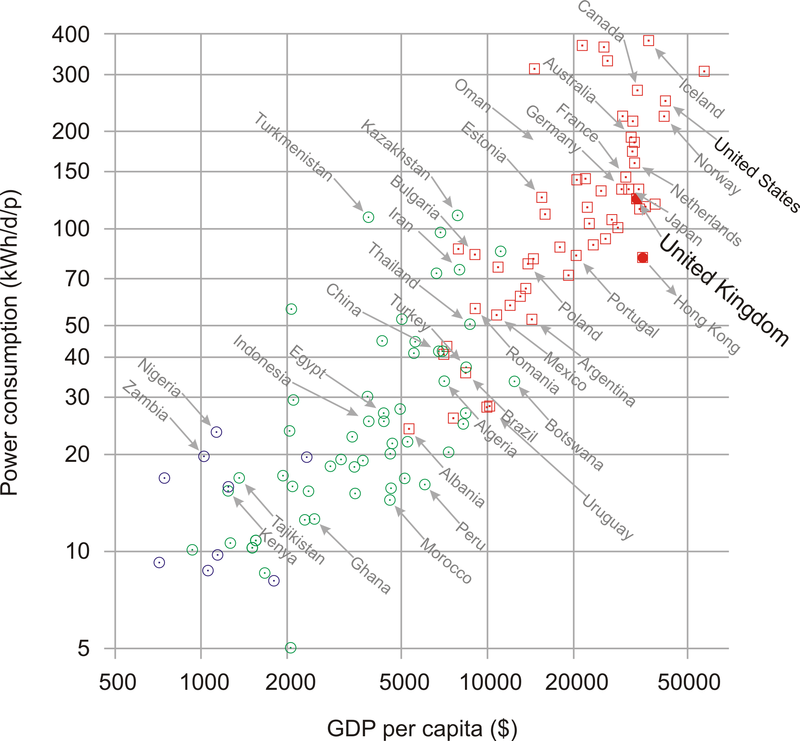
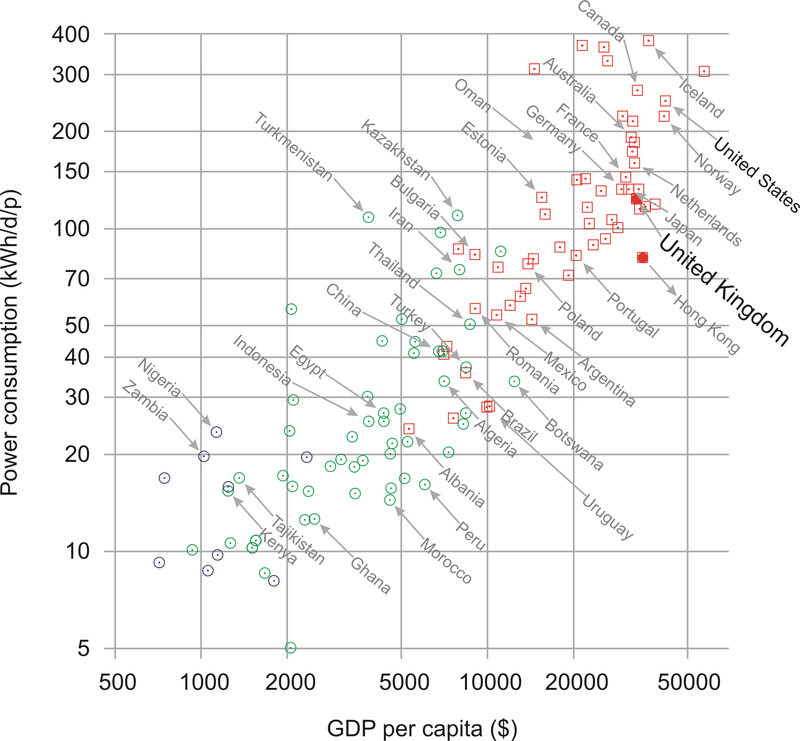
Figure 30.1 shows the power consumptions of lots of countries or regions, versus their gross domestic products (GDPs). It is a widely held assumption that human development and growth are good things, so when sketching world plans for sustainable energy I am going to assume that all the countries with low GDP per capita are going to progress rightwards in figure 30.1. And as their GDPs increase, it’s inevitable that their power consumptions will increase too. It’s not clear what consumption we should plan for, but I think that the average European level (125 kWh per day per person) seems a reasonable assumption; alternatively, we could assume that efficiency measures, like those envisaged in Cartoon Britain in Chapters Every BIG helps–Putting costs in perspective, allow all countries to attain a European standard of living with a lower power consumption. In the consumption plan, Cartoon Britain’s consumption fell to about 68 kWh/d/p. Bearing in mind that Cartoon Britain doesn’t have much industrial activity, perhaps it would be sensible to assume a slightly higher target, such as Hong Kong’s 80 kWh/d/p.
Figure 30.1: Power consumption per capita versus GDP per capita, in purchasing-power-parity US dollars. Data from UNDP Human Development Report, 2007. Squares show countries having “high human development;” circles, “medium” or “low.” Both variables are on logarithmic scales. Figure 18.4 shows the same data on normal scales.
Redoing the calculations for Europe
Can Europe live on renewables?
Europe’s average population density is roughly half of Britain’s, so there is more land area in which to put enormous renewable facilities. The area of the European Union is roughly 9000m2 per person. However, many of the renewables have lower power density in Europe than in Britain: most of Europe has less wind, less wave, and less tide. Some parts do have more hydro (in Scandanavia and Central Europe); and some have more solar. Let’s work out some rough numbers.
Wind
The heart of continental Europe has lower typical windspeeds than the British Isles – in much of Italy, for example, windspeeds are below 4 m/s. Let’s guess that one fifth of Europe has big enough wind-speeds for economical wind-farms, having a power density of 2W/m2, and then assume that we give those regions the same treatment we gave Britain in Chapter Wind, filling 10% of them with wind farms. The area of the European Union is roughly 9000m2 per person. So wind gives
15×10%×9000m2×2W/m2=360W
which is 9 kWh/d per person.
Hydroelectricity
Hydroelectric production in Europe totals 590 TWh/y, or 67 GW; shared between 500 million, that’s 3.2 kWh/d per person. This production is dominated by Norway, France, Sweden, Italy, Austria, and Switzerland. If every country doubled its hydroelectric facilities – which I think would be difficult – then hydro would give 6.4 kWh/d per person.
Wave
Taking the whole Atlantic coastline (about 4000 km) and multiplying by an assumed average production rate of 10 kW/m, we get 2 kWh/d per person. The Baltic and Mediterranean coastlines have no wave resource worth talking of.
Tide
Doubling the estimated total resource around the British Isles (11 kWh/d per person, from Chapter Tide) to allow for French, Irish and Norwegian tidal resources, then sharing between a population of 500 million, we get 2.6 kWh/d per person. The Baltic and Mediterranean coastlines have no tidal resource worth talking of.
Solar photovoltaics and thermal panels on roofs
Most places are sunnier than the UK, so solar panels would deliver more power in continental Europe. 10m2 of roof-mounted photovoltaic panels would deliver about 7 kWh/d in all places south of the UK. Similarly, 2m2 of water-heating panels could deliver on average 3.6 kWh/d of low-grade thermal heat. (I don’t see much point in suggesting having more than 2m2 per person of water-heating panels, since this capacity would already be enough to saturate typical demand for hot water.)
What else?
The total so far is 9+6.4+2+2.6+7+3.6=30.6kWh/d per person. The only resources not mentioned so far are geothermal power, and large-scale solar farming (with mirrors, panels, or biomass).
Geothermal power might work, but it’s still in the research stages. I suggest treating it like fusion power: a good investment, but not to be relied on.
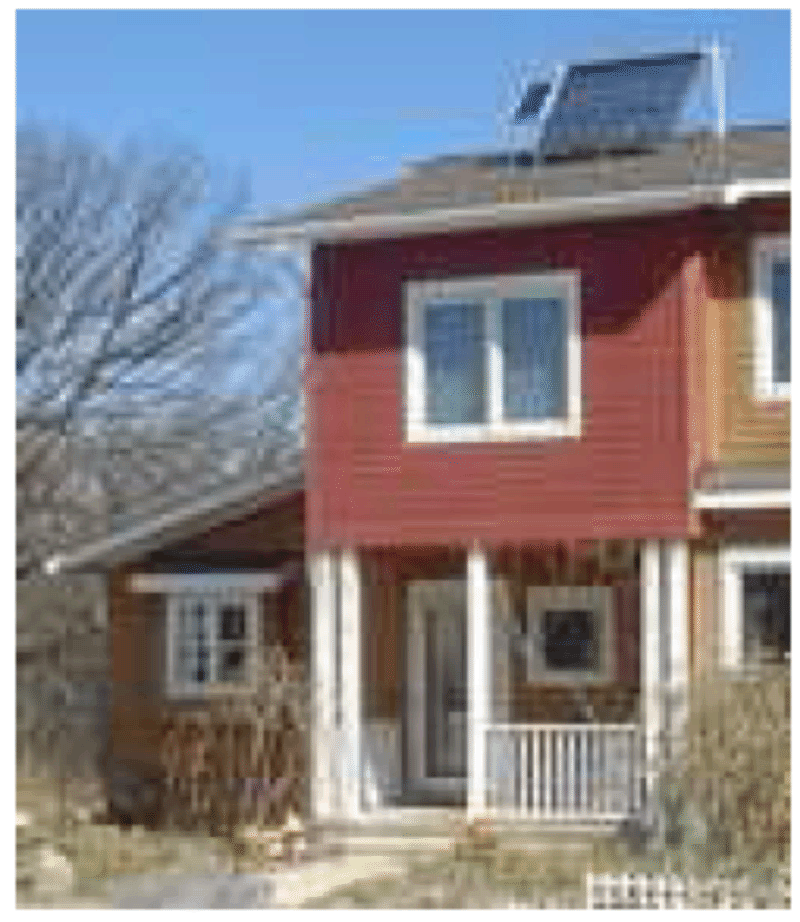
Figure 30.2: A solar water heater providing hot water for a family in Michigan. The system’s pump is powered by the small photovoltaic panel on the left.
So what about solar farming? We could imagine using 5% of Europe (450m2 per person) for solar photovoltaic farms like the Bavarian one in figure 6.7 (which has a power density of 5W/m2). This would deliver an average power of
5W/m2×450m2=54kWh/dper person.
Solar PV farming would, therefore, add up to something substantial. The main problem with photovoltaic panels is their cost. Getting power during the winter is also a concern!
Energy crops? Plants capture only 0.5W/m2 (figure 6.11). Given that Europe needs to feed itself, the non-food energy contribution from plants in Europe can never be enormous. Yes, there will be some oil-seed rape here and some forestry there, but I don’t imagine that the total non-food contribution of plants could be more than 12 kWh/d per person.
The bottom line
Let’s be realistic. Just like Britain, Europe can’t live on its own renewables. So if the aim is to get off fossil fuels, Europe needs nuclear power, or solar power in other people’s deserts (as discussed), or both.
Redoing the calculations for North America
The average American uses 250 kWh/d per day. Can we hit that target with renewables? What if we imagine imposing shocking efficiency measures (such as efficient cars and high-speed electric trains) such that Americans were reduced to the misery of living on the mere 125 kWh/d of an average European or Japanese citizen?
Wind
A study by Elliott et al. (1991) assessed the wind energy potential of the USA. The windiest spots are in North Dakota, Wyoming, and Montana. They reckoned that, over the whole country, 435000km2 of windy land could be exploited without raising too many hackles, and that the electricity generated would be 4600 TWh per year, which is 42 kWh per day per person if shared between 300 million people. Their calculations assumed an average power density of 1.2W/m2, incidentally – smaller than the 2W/m2 we assumed in Chapter Wind. The area of these wind farms, 435000km2, is roughly the same as the area of California. The amount of wind hardware required (assuming a load factor of 20%) would be a capacity of about 2600 GW, which would be a 200-fold increase in wind hardware in the USA.
Offshore wind
If we assume that shallow offshore waters with an area equal to the sum of Delaware and Connecticut (20000km2, a substantial chunk of all shallow waters on the east coast of the USA) are filled with offshore wind farms having a power density of 3W/m2, we obtain an average power of 60 GW. That’s 4.8 kWh/d per person if shared between 300 million people. The wind hardware required would be 15 times the total wind hardware currently in the USA.
Geothermal
I mentioned the MIT geothermal energy study (Massachusetts Institute of Technology, 2006) in Chapter Geothermal. The authors are upbeat about the potential of geothermal energy in North America, especially in the western states where there is more hotter rock. “With a reasonable investment in R&D, enhanced geothermal systems could provide 100 GW(e) or more of cost-competitive generating capacity in the next 50 years. Further, enhanced geothermal systems provide a secure source of power for the long term.” Let’s assume they are right. 100 GW of electricity is 8 kWh/d per person when shared between 300 million.
Hydro
The hydroelectric facilities of Canada, the USA, and Mexico generate about 660 TWh per year. Shared between 500 million people, that amounts to 3.6 kWh/d per person. Could the hydroelectric output of North America be doubled? If so, hydro would provide 7.2 kWh/d per person.
What else?
The total so far is 42+4.8+8+7.2=62kWh/d per person. Not enough for even a European existence! I could discuss various other options such as the sustainable burning of Canadian forests in power stations. But rather than prolong the agony, let’s go immediately for a technology that adds up: concentrating solar power.
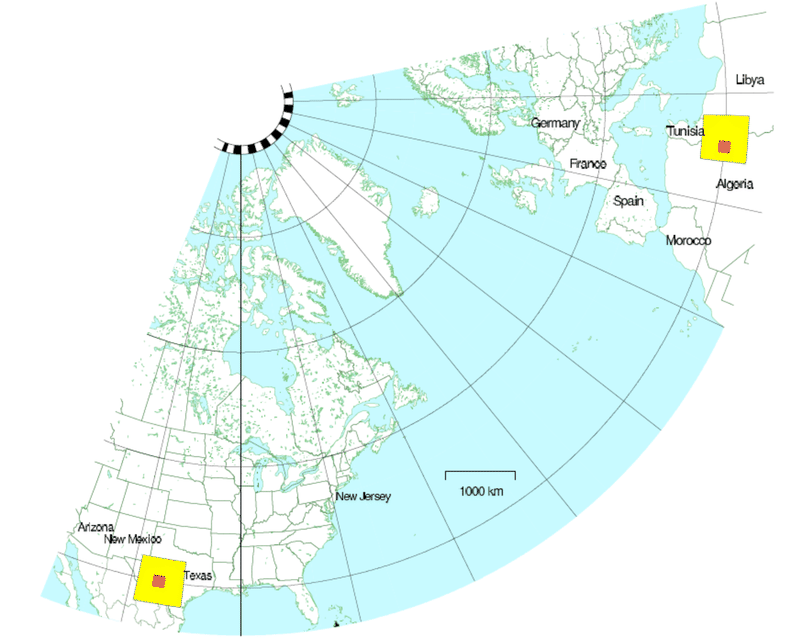
Figure 30.3 shows the area within North America that would provide everyone there (500 million people) with an average power of 250 kWh/d.
The bottom line
North America’s non-solar renewables aren’t enough for North America to live on. But when we include a massive expansion of solar power, there’s enough. So North America needs solar in its own deserts, or nuclear power, or both.
Redoing the calculations for the world
How can 6 billion people obtain the power for a European standard of living – 80 kWh per day per person, say?
Wind
The exceptional spots in the world with strong steady winds are the central states of the USA (Kansas, Oklahoma); Saskatchewan, Canada; the southern extremities of Argentina and Chile; northeast Australia; northeast and northwest China; northwest Sudan; southwest South Africa; Somalia; Iran; and Afghanistan. And everywhere offshore except for a tropical strip 60 degrees wide centred on the equator.
For our global estimate, let’s go with the numbers from Greenpeace and the European Wind Energy Association: “the total available wind resources worldwide are estimated at 53000 TWh per year.” That’s 24 kWh/d per person.
Hydro
Worldwide, hydroelectricity currently contributes about 1.4 kWh/d per person.
Figure 30.3: The little square strikes again. The 600 km by 600 km square in North America, completely filled with concentrating solar power, would provide enough power to give 500 million people the average American’s consumption of 250 kWh/d. This map also shows the square of size 600 km by 600 km in Africa, which we met earlier. I’ve assumed a power density of 15W/m2, as before. The area of one yellow square is a little bigger than the area of Arizona, and 16 times the area of New Jersey. Within each big square is a smaller 145 km by 145 km square showing the area required in the desert – one New Jersey – to supply 30 million people with 250 kWh per day per person.
From the website www.ieahydro.org, “The International Hydropower Association and the International Energy Agency estimate the world’s total technical feasible hydro potential at 14000 TWh/year [6.4 kWh/d per person on the globe], of which about 8000 TWh/year [3.6 kWh/d per person] is currently considered economically feasible for development. Most of the potential for development is in Africa, Asia and Latin America.”
Tide
There are several places in the world with tidal resources on the same scale as the Severn estuary (figure 14.8). In Argentina there are two sites: San José and Golfo Nuevo; Australia has the Walcott Inlet; the USA & Canada share the Bay of Fundy; Canada has Cobequid; India has the Gulf of Khambat; the USA has Turnagain Arm and Knik Arm; and Russia has Tugur.
And then there is the world’s tidal whopper, a place called Penzhinsk in Russia with a resource of 22 GW – ten times as big as the Severn!
Kowalik (2004) estimates that worldwide, 40–80 GW of tidal power could be generated. Shared between 6 billion people, that comes to 0.16–0.32 kWh/d per person.
Wave
We can estimate the total extractable power from waves by multiplying the length of exposed coastlines (roughly 300000 km) by the typical power per unit length of coastline (10 kW per metre): the raw power is thus about 3000 GW.
Assuming 10% of this raw power is intercepted by systems that are 50%-efficient at converting power to electricity, wave power could deliver 0.5 kWh/d per person.
Geothermal
According to D. H. Freeston of the Auckland Geothermal Institute, geothermal power amounted on average to about 4 GW, worldwide, in 1995 – which is 0.01 kWh/d per person.
If we assume that the MIT authors were right, and if we assume that the whole world is like America, then geothermal power offers 8 kWh/d per person.
Solar for energy crops
People get all excited about energy crops like jatropha, which, it’s claimed, wouldn’t need to compete with food for land, because it can be grown on wastelands. People need to look at the numbers before they get excited. The numbers for jatropha. Even if all of Africa were completely covered with jatropha plantations, the power produced, shared between six billion people, would be 8 kWh/d per person (which is only one third of today’s global oil consumption). You can’t fix your oil addiction by switching to jatropha!
Sheffield
28%
Edinburgh
30%
Manchester
31%
Cork
32%
London
34%
Cologne
35%
Copenhagen
38%
Munich
38%
Paris
39%
Berlin
42%
Wellington, NZ
43%
Seattle
46%
Toronto
46%
Detroit, MI
54%
Winnipeg
55%
Beijing 2403
55%
Sydney 2446
56%
Pula, Croatia
57%
Nice, France
58%
Boston, MA
58%
Bangkok, Thailand
60%
Chicago
60%
New York
61%
Lisbon, Portugal
61%
Kingston, Jamaica
62%
San Antonio
62%
Seville, Spain
66%
Nairobi, Kenya
68%
Johannesburg, SA
71%
Tel Aviv
74%
Los Angeles
77%
Upington, SA
91%
Yuma, AZ
93%
Sahara Desert
98%
World sunniness figures. [3doaeg]
Let’s estimate a bound on the power that energy crops could deliver for the whole world, using the same method we applied to Britain in Chapter Solar: imagine taking all arable land and devoting it to energy crops. 18% of the world’s land is currently arable or crop land – an area of 27 million km2. That’s 4500m2 per person, if shared between 6 billion. Assuming a power density of 0.5W/m2, and losses of 33% in processing and farming, we find that energy crops, fully taking over all agricultural land, would deliver 36 kWh/d per person. Now, maybe this is an underestimate since in figure 6.11 we saw that Brazilian sugarcane can deliver a power density of 1.6W/m2, three times bigger than I just assumed. OK, maybe energy crops from Brazil have some sort of future. But I’d like to move on to the last option.
Solar heaters, solar photovoltaics, and concentrating solar power
Solar thermal water heaters are a no-brainer. They will work almost everywhere in the world. China are world leaders in this technology. There’s over 100 GW of solar water heating capacity worldwide, and more than half of it is in China.
Solar photovoltaics were technically feasible for Europe, but I judged them too expensive. I hope I’m wrong, obviously. It will be wonderful if the cost of photovoltaic power drops in the same way that the cost of computer power has dropped over the last forty years.
My guess is that in many regions, the best solar technology for electricity production will be the concentrating solar power that we discussed on pages 178 and 236. On those pages we already established that one billion people in Europe and North Africa could be sustained by country-sized solar power facilities in deserts near the Mediterranean; and that half a billion in North America could be sustained by Arizona-sized facilities in the deserts of the USA and Mexico. I’ll leave it as an exercise for the reader to identify appropriate deserts to help out the other 4.5 billion people in the world.
The bottom line
The non-solar numbers add up as follows. Wind: 24 kWh/d/p; hydro: 3.6 kWh/d/p; tide: 0.3 kWh/d/p; wave: 0.5 kWh/d/p; geothermal: 8 kWh/d/p – a total of 36 kWh/d/p. Our target was a post-European consumption of 80 kWh/d per person. We have a clear conclusion: the non-solar renewables may be “huge,” but they are not huge enough. To complete a plan that adds up, we must rely on one or more forms of solar power. Or use nuclear power. Or both.
North America needs solar in its own deserts, or nuclear power, or both. To read Google’s 2008 plan for a 40% defossilization of the USA, see Jeffery Greenblatt’s article Clean Energy 2030 [3lcw9c]. The main features of this plan are efficiency measures, electrification of transport, and electricity production from renewables. Their electricity production plan includes
10.6kWh/d/p2.7kWh/d/p1.9kWh/d/p1.7kWh/d/pand5.8kWh/d/pof wind power,of solar photovoltaic,of concentrating solar power,of biomass,of geothermal power
by 2030. That’s a total of 23 kWh/d/p of new renewables. They also assume a small increase in nuclear power from 7.2 kWh/d/p to 8.3 kWh/d/p, and no change in hydroelectricity. Natural gas would continue to be used, contributing 4 kWh/d/p.
The world’s total hydro potential...
Source: www.ieahydro.org/faq.htm.
Global coastal wave power resource is estimated to be 3000 GW.
See Quayle and Changery (1981).
Geothermal power in 1995. Freeston (1996).
Energy crops. See Rogner (2000) for estimates similar to mine.
Further reading: Nature magazine has an 8-page article discussing how to power the world (Schiermeier et al., 2008).
NOTES / HIGHLIGHTS
Please Sign In to create your own Highlights / Notes
Notes/Highlights
Color
Highlighted Text
Notes
Please Sign In to create your own Highlights / Notes
Currently there are no resources to be displayed.
Description
This book explores six strategies for eliminating the gap between consumption and renewable production.


 FlexiA FREE Digital Tutor for Every Student
 FlexBooks 2.0Customizable, digital textbooks in a new, interactive platform
 FlexBooksCustomizable, digital textbooks
 SchoolsFlexBooks from schools and districts near you
 Study GuidesQuick review with key information for each concept
 Adaptive PracticeBuilding knowledge at each student’s skill level
 SimulationsInteractive Physics & Chemistry Simulations
 PLIXPlay. Learn. Interact. eXplore.
 CCSS MathConcepts and FlexBooks aligned to Common Core
 NGSSConcepts aligned to Next Generation Science Standards
 Certified EducatorStand out as an educator. Become CK-12 Certified.
 WebinarsLive and archived sessions to learn about CK-12