What follows is a discussion and example of each step of the Glyfada Method. Following the completed example, you will then fill in your own worksheet for your topic. When you reach the last step, you will have a completed worksheet with which you can write your own essay.
The Glyfada Method may look overwhelming, but you will find it simple as you work through the steps. It will provide the structure you need to be confident as you write your essay.
Step-by-Step Explanation of the Glyfada Method
Step 1: Heuristics
You have an essay assignment, and you don’t have a topic. Heuristics will help you through this dilemma. Heuristics means a way of discovering ideas. You go through trial and error to find a subject for your paper. You might think of heuristics as a way of getting into something that is hard to open. Heuristics helps you think about things you can write about.
Getting started can be difficult if you do not know what you want to write about. A good way to start is to think about what has interested you in your reading assignments. Try a free write in your journal on a related topic. Look through the newspaper and see what related topic might make a good essay. You can also surf the Internet for topics that might get you started. Talk to a friend about what you are hoping to do with a topic. Your friend might provide some direction.
Using heuristics, the class in Glyfada came up with these topics.
Example:
Step 1: Heuristics/Topics
scuba diving, military maneuvers, deep sea fishing, culture shock, military social life, military health care, camping in Greece, travel through Germany, Greek elections, anti-American behavior, living in a foreign country, stress on families from frequent moves, and Glyfada.
Review Question
Make a list of possible topics that would work with this assignment.
Step 1: Heuristics/Topics
__________________________________________
Step 2: Topic and Focus
Students chose the topic Glyfada because the class was made up of military personnel stationed in Greece. Glyfada was near the air base. The group chose Glyfada because they all thought it would be fun to convince friends to come to Glyfada for a holiday.
Example:
Step 2: Topic and Focus
Glyfada is a good place to visit.
Review Question
From your list of topics in Step 1, choose one you think you can write about.
Step 2: Topic and Focus
___________________________________________
Step 3: Target Audience
To demonstrate sincerity and conviction, address your audience directly. To whom are you speaking? As you write your essay, pretend you are standing in front of your audience and speaking to them. Be accountable to them. While your teacher will read your paper, you still need to speak directly to your target audience. Your teacher is your evaluator, not the target of your message.
Here is a good example of choosing an audience. The class who chose the Glyfada topic was made up of young, enlisted American military members. They had to target an audience that would be interested in the topic “Glyfada.” After some thought, they decided they would pretend they were writing to their counterparts who were stationed at a military base in Germany. They would try to convince their fellow military members in cold, rainy, snowy Germany to take leave and visit them in hot, sunny Glyfada. To do that, the class would have to come up with relevant reasons why their military counterparts would take leave and travel all the way to Greece.
If the professor of that writing course had chosen an audience, it would have been her counterparts teaching for the University of Maryland European Division in Germany. The American base commander’s wife would have chosen other officer’s wives in Germany.
All three of these audiences in Germany—young enlisted military members, professors, and officer’s wives—would require a different approach to the topic. Therefore, it is very important that you know who your audience is before you decide on your approach to the topic and start gathering your supporting material.
Example:
Step 3: Target Audience
Young military members stationed in Germany
Review Question
Now choose your audience for your topic.
Step 3: Target Audience
____________________________________
Step 4: “So what?”
When you choose a topic, ask yourself the question “so what?” to determine if you have chosen to write about something significant. If you cannot think of an answer to the question “so what?” you need to choose another topic. The “so what?” ensures that the topic is relevant to the reader. It draws your reader into the paper and tells him or her that you have something new and worthwhile to say. Your information could change their views or actions in a particular way. You will provide information your readers do not have or ideas they haven’t thought of.
Here are a series of questions you need to consider. What is new about what you are saying? Has it been said before? Why are you saying it now? Is there a new twist? Why should people have this new information?
The class writing the essay about Glyfada asked themselves a series of “so what?” questions. They knew it would take several tries before they would come up with a good “so what?”.
Example:
Step 4: “So what?”
Come to Greece for holiday. So what? It is a fun place to visit. So what? It has many things to do. So what? Glyfada has a beautiful beach, good restaurants, a lot of entertainment, low prices, friendly people, good transportation, inexpensive hotels, and reasonably priced hotels. So what? It is easy and inexpensive to get to Greece, and one enjoys a relaxing, enjoyable vacation.
Review Question
Now, ask yourself “so what?” Are you saying something new? If not, are you putting a new spin on a familiar subject?
Step 4: “So what?”
________________________________________________
Step 5: Organization
How do you want to organize your paper? You have decided on the purpose of your essay. Is it to tell a story? Make an argument or persuade someone to action? Describe a process? What is the best organization for what you want to say? Is it logical, spatial, or chronological?
There are three types of organization:
a. If you want to persuade or argue, then you should use logical organization. An argument built on logic or reasoning starts with the least important major point and works to the most important major point. You can compare that rule to fireworks: start with the smaller fireworks and end with the biggest bang.
b. You might use a chronological approach. For instance, in persuading someone to visit Glyfada, you might start by describing a daily schedule of shopping early in the morning, going to the beach in the afternoon, having dinner at a local restaurant in the evening, and going to European tavernas late at night. If you wanted to put persuasive information into a story, you could incorporate it into a narrative.
c. A spatial approach means that you describe space. If you are asked to describe your bedroom, where do you start? Where do your eyes focus first? What do they move next? You would use spatial organization to describe a landscape.
When the group decided to make the essay on Glyfada persuasive, they needed to look at the kind of organization that would serve the purpose of the paper. This young American military class wanted to write a persuasive paper by starting with the weakest point and moving to the strongest point.
Example:
Step 5: Organization
Logical; persuasion; weakest to strongest points.
Review Question
Now figure out what the organization will be for the essay you are writing.
Step 5: Organization
______________________________________
Step 6: Appeals (Logos, Pathos, Ethos)
More than 2,000 years ago, the Greek philosopher Aristotle argued that there were three ways to persuade an audience: logos, pathos, and ethos. Taking into consideration audience, topic, and purpose, one would choose one or two of these in selecting supporting material.
a. Logos is an appeal to reason. The speaker uses logic or reason to persuade.
b. Pathos is an appeal to emotions such as love, jealousy, fear, and pity.
c. Ethos is the speaker’s credibility. It is the person’s image. We believe a speaker to be trustworthy if he or she has good character, goodwill, and positive actions.
In selecting material to develop the essay on Glyfada, students had to decide how they intended to appeal to their target audience. The focused appeal would determine what support material they used. For example, students in this class were young military members, and they wanted to appeal to their counterparts in Germany. That meant choosing support that appealed to their friends in a predominately emotional manner, that is, emotions motivating the visiting military members to have a good time on their leave in Greece. Working together on development, students focused on beach fun, inexpensive local food, and trendy evening entertainment.
If the professor of the class had written the essay, the target audience and appeal would have been very different. The professor would have chosen as her target audience her counterparts at the American university in Germany. She would have appealed to logos. She would have developed the essay with examples and information about museums, historical events, literary sites, and places of Greek mythology. In contrast, the base commander’s wife would have appealed with logos and ethos about shopping areas, luxury hotels and restaurants, specialty island cruises, and specific manufacturers and their goods.
The appeal that the Glyfada topic focuses on is pathos.
Example:
Step 6: Appeals (Logos, Pathos, Ethos)
Pathos: tavernas, sandy beaches, scuba diving, sailing, beautiful girls, handsome guys, good Greek food, friendly people, good times
Review Question
Now figure out what appeal you will focus on for your essay.
Step 6: Appeals (Logos, Pathos, Ethos)
______________________________________
Step 7: Development
What kind of support do you need for your topic? You will need details, facts, examples, definitions, and extended definitions. You can include charts, graphs, diagrams, pictures, and illustrations. Supporting material must be appropriate to your topic and audience.
Always quote or paraphrase your source accurately. Your material should be current and credible. Always cite sources.
Choose showing details, not telling ones. Instead of talking about traveling in an old car, describe the rusting sides, noisy engine, and broken back window.
To write about Glyfada, students in the class decided they needed the following information.
Example:
Step 7: Development
Details about activities in Glyfada, examples of products and restaurants, definitions of European bars, and facts about prices of activities and restaurants; photos from websites or camera phones.
Review Question
Now figure out what support will be needed to develop your essay.
Step 7: Development
______________________________________
Step 8: Probable Topic
Your next step is to take an educated guess at what your topic for this essay will be. You can change this as you continue working. You will modify your topic after you go through Steps 9-12. The advantage in taking these gradual steps is that you do not have to make a lot of decisions all at once and get writer’s block for fear of making the wrong choices.
In Step 2 of our example, students listed the subject as Glyfada on the worksheet. In Step 8, they narrowed the topic as much as possible to Glyfada is a good place to visit. Students in the class began to focus their topic on the reasons they thought their counterparts should visit Glyfada.
Example:
Step 8: Probable Topic
Glyfada is a reasonably priced place to visit because...
Review Question
Now figure out what your topic will be for your essay.
Step 8: Probable Topic
______________________________________
Once you complete Steps 1-8, you must follow the rest of the steps in order. You can go back at any point and revise, but you must follow the steps.
Step 9: Inventory
When I was in college, I made money by doing inventories for department stores and discount houses. That meant that my inventory crew counted all the merchandise and recorded it on charts. You will do something similar for your topic. You will inventory all that you have to say about your topic.
When you do an inventory, you list (without editing) anything you can think of about your topic. You do not stop to check spelling, relevancy, or word choice. Think of it as free association—list whatever words come to mind, even though you will not use all of them.
In this class we chose a topic that students were familiar with; they knew they could think of many things about Glyfada. Once those ideas were on paper, their attention focused on the best way to organize and develop the essay. And, once those decisions were made, they had more time to spend on sentence structure, spelling, punctuation, and word choice.
Example:
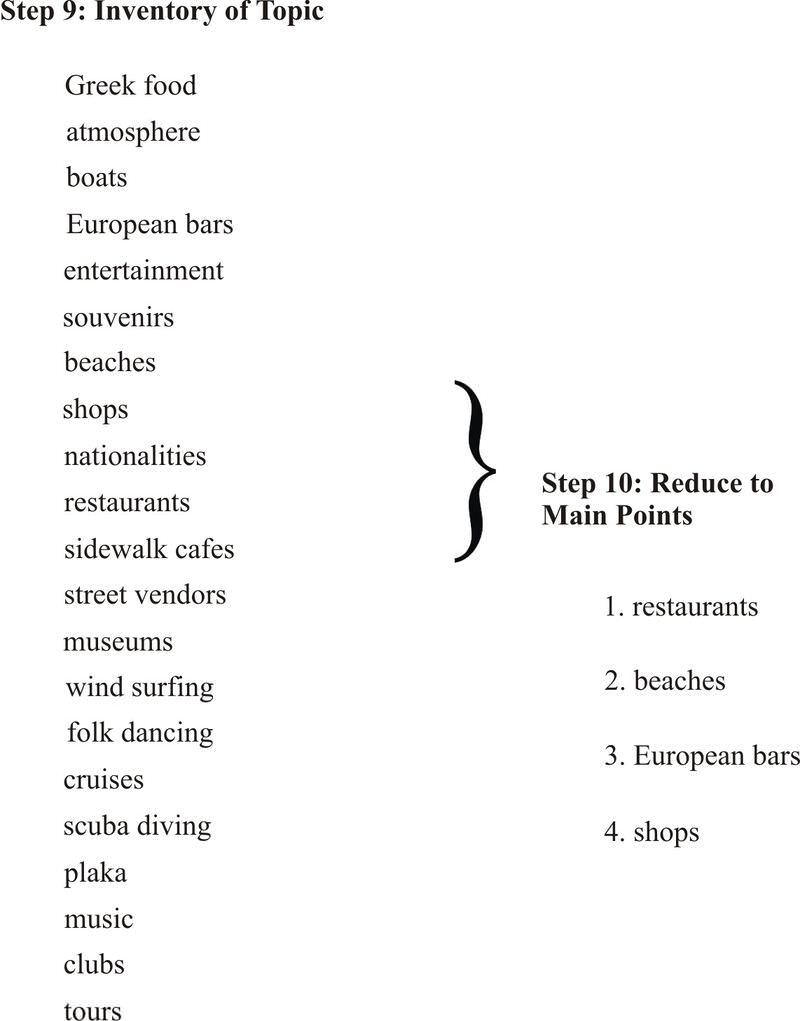
The class came up with this inventory.
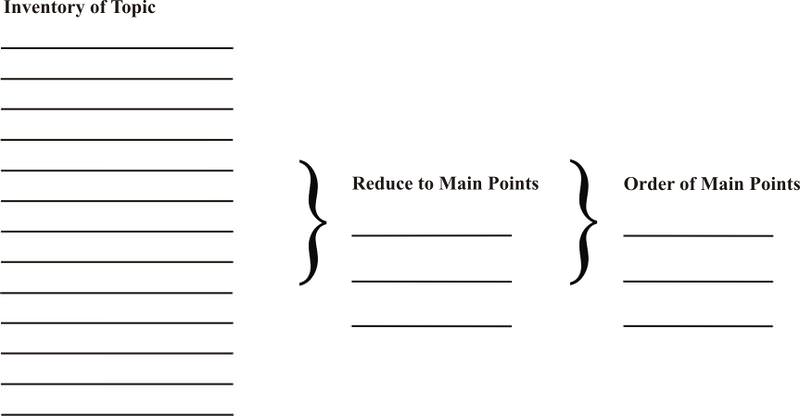
Step 9: Inventory of Topic
Greek food
atmosphere
boats
European bars
entertainment
souvenirs
beaches
shops
nationalities
restaurants
sidewalk cafes
street vendors
museums
wind surfing
folk dancing
cruises
scuba diving
plaka/plaza
music
clubs
tours
Review Question
Now, inventory your topic.
Step 9: Inventory of Topic
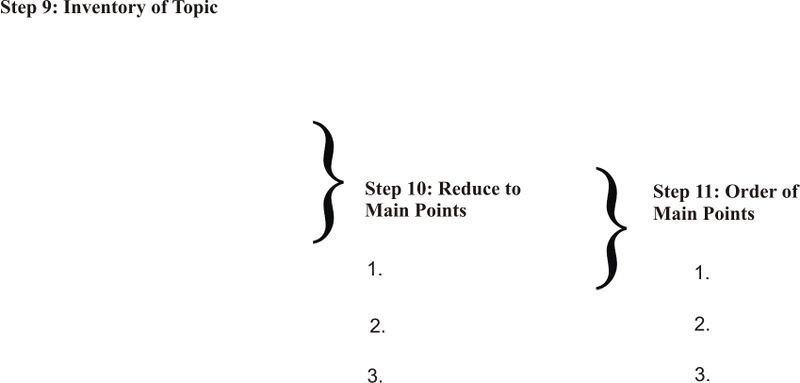
Step 10: Reduce to Main Points
In Step 10, you will look at your list of details and decide how to put them into categories. You do this by identifying key ideas that can serve as main points in your essay.
Some of the words listed in Step 9 are repetitious or irrelevant. In Step 10, you will play the categorizing game. You will figure out what pattern is emerging among the words and then think of three or four general categories to sort the words. These categories will become your main points. You are not restricted to your list; you can add details at any time.
Example:
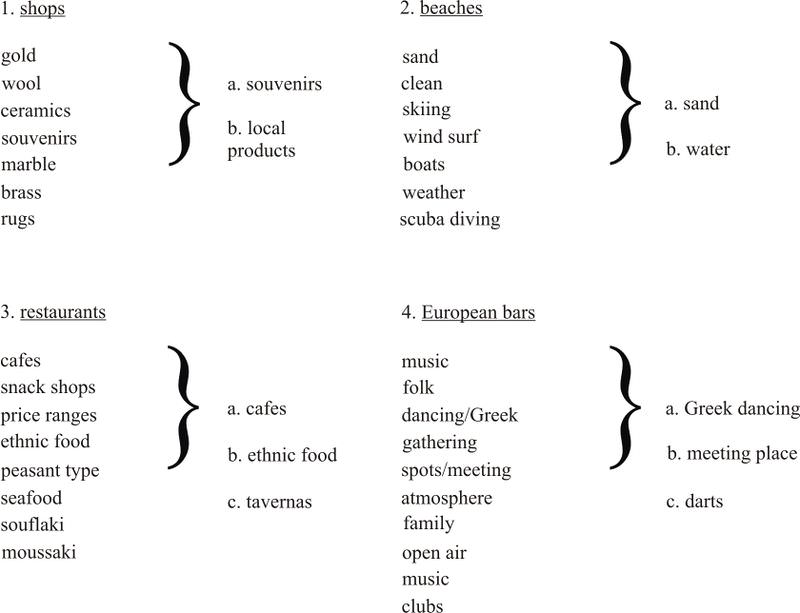
On the sample worksheet, food and sidewalk cafes can be grouped under restaurants. Climate and boats can be placed under beaches, although students could work out any combination here.
Review Question
Use your inventory list to decide on main points.
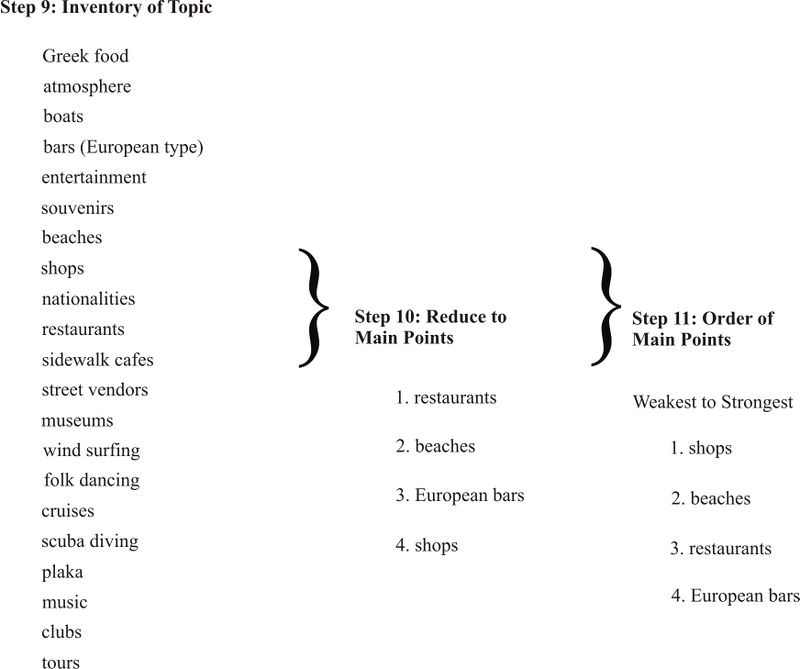
Step 11: Order of Main Points
In Step 11, you will decide how you want to arrange your points. If you are writing a narrative or describing a process, you will want to organize your paper chronologically, that is, in the order of time. If you are describing space, you will organize your main points according to the order in which you want to describe the object, area, or person. If you are presenting an argument or persuading someone, then you will move from the weakest to the strongest points.
When the young American military members chose their main points, they decided to arrange them according to how important they thought the places where and how often they visited the places on the list. They could have also used a spatial order by starting at a particular geographical location of Glyfada and moving to different points of interest in the resort town. Students in the class asked such questions as “Do you think trying to cover all the entertainment in Glyfada and Athens would be too much for your topic on Glyfada?” and “How about trying a narrative approach to your persuasion? You can work your main points into the story line.”
Example:
This example shows that the main points are in a logical order for a persuasion essay. That means starting with the weakest main point and moving to strongest one.
Review Question
Now decide on the order of your main points.
Step 12: Basic Working Thesis
After completing the inventory, reducing the inventory to main points, and deciding on the order of the points, it is time to put everything together. It is easy if you think of it as a formula.
topic + so what? + main points
I call this statement a basic thesis because it is your essay in a nutshell. From it you have your direction, argument, organization, and target audience. Although the basic thesis appears rigid, it forces you to examine the skeleton of your paper. Stating the thesis in a single sentence is a valuable skill. If you cannot condense what you want to say into one sentence, you do not know what you want to say about the topic.
When you can actually put your topic and points on paper, you will begin to form a plan for your essay. A single sentence eliminates the problem of a thesis going in two different directions. If you state your thesis in a compound sentence (two independent clauses), you will find yourself coming to a fork in the road, and the paper will go two directions, e.g., Glyfada is a good place to visit, and people like to buy property there. Does the writer want to talk about Glyfada being a good vacation spot, or does the writer want to discuss real estate? In this example, the writer has two topics.
Another problem to be aware of is parallelism. You must keep your main points parallel as you list them in the basic thesis. For example, you must keep the words of your main points concrete (something you touch like a ball) or abstract (something you cannot touch like sadness or happiness). You must keep your main points in the same grammatical construction (singing, running, swimming; not singing, running, and to swim). Lastly, you must be consistent in the concepts you use (apples, oranges, and bananas; not apples, oranges, and zebras).
Our military members needed to be able to say, “Glyfada is a good place to visit because the prices and the climate are outstanding for shops, beaches, bars, and restaurants.” When they set up their formula, they knew they could write an essay that would fly.
Example:
Step 12: Basic Working Thesis
topic + so what? + main points.
Glyfada is a reasonably priced vacation spot that offers a variety of shops, beautiful beaches, quality restaurants, and European bars.
Review Question
Now, using what you have done with the previous steps, write a basis thesis for your essay.
Step 12: Basic Working Thesis
topic + so what? + main points.
________________________________________________
________________________________________________
Step 13: Mapping
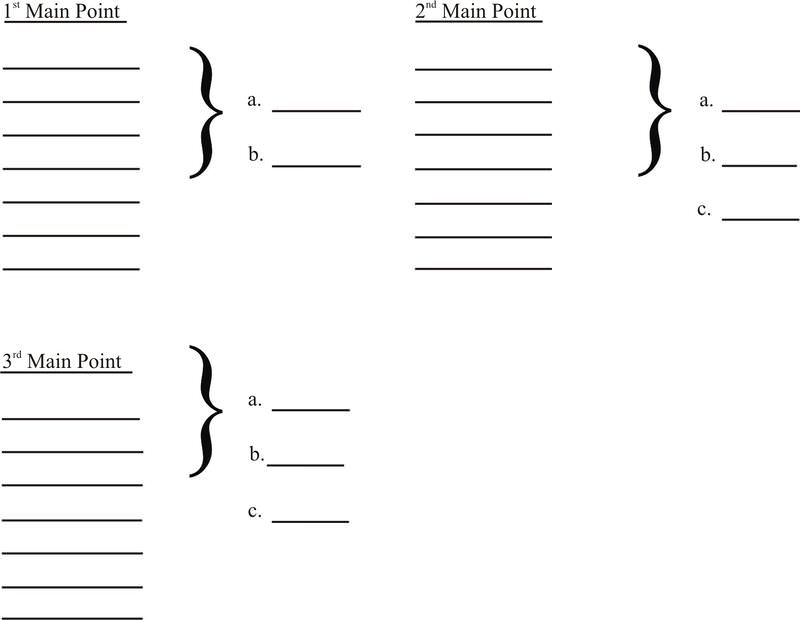
Mapping determines whether or not you have enough material to support your main points. Under each main point, list supporting details. You do not have to use all the words you list, but at least you will have a starting point to develop and support your main ideas.
Step 13: Mapping
Inventory each main point.
1. shops
gold
wool
ceramics
souvenirs
marble
brass
rugs
2. beaches
sand
clean
skiing
wind surf
boats
weather
scuba diving
3. restaurants
cafes
snack shops
price ranges
ethnic food
peasant type
seafood
souflaki
moussaki
4. European bars
music
folk dancing
gathering spots
atmosphere
family
open air
music
clubs
Review Question
Map your main points and determine if you have enough material to talk about each one.
Step 13: Mapping
Inventory each main point.
_________
_________
_________
_________
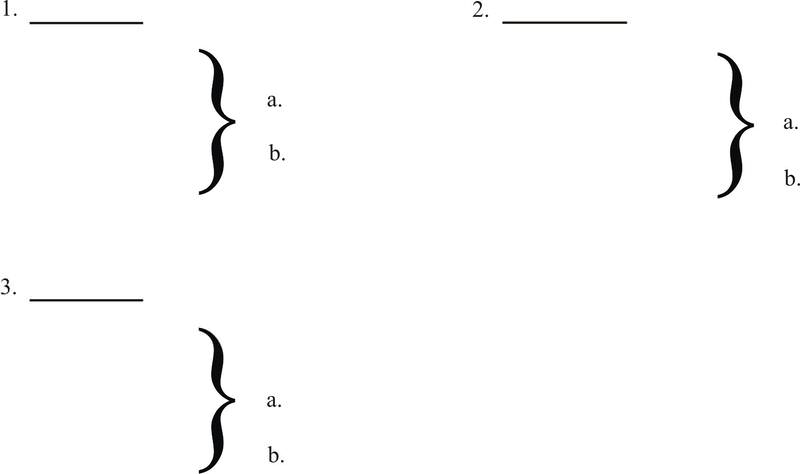
Step 14: Sub-Points
The list under your first mapped main point will produce several categories. These categories will be your sub-points under the main point. Under these categories, you will sort the rest of the listed words. You can add new ones if you wish. Each sub-point will become a separate paragraph to develop and support that main point.
Determine how many sub-points you need to develop each main point. Remember the outlining rule: when you have an “a,” you must have a “b.” You may have a “c,” “d,” and more, depending on how many paragraphs you want for that main point.
If you write your essay without going through the steps of this method, you may put in several frustrating hours on a draft before realizing you do not have a clear plan for writing the paper.
Example:
Step 14: Sub-Points
From the list under mapping, determine your sub-points. Each sub-point will be developed into a paragraph.
Review Question
Step 14: Sub-Points
From the list under mapping, determine your sub-points. Each sub-point will be developed into a paragraph.
Step 15: Sorting (Working Outline)
Using key words from your basic thesis, you must make a short outline using single words or phrases. The key words used for points must be the same ones used in the basic thesis and must follow the same order. Then you must add support for the sub-points.
Your worksheets will tell you whether you are doing the proper amount of planning and whether you understand the writing process. The worksheet also prevents you from spending time on an essay that may be disorganized or incoherent. If you cannot find enough supporting details for your main points, you will not be able to develop your essay satisfactorily.
Example:
Complete the sorting step.
Step 15: Sorting (Working Outline)
I. Introduction
A. General statement
B. So what
C. Working thesis (Glyfada is a reasonably priced vacation spot that offers a variety of shops, beautiful beaches, quality restaurants, and European bars.)
II. Shops
A. Souvenirs
B. Local products
III. Beaches/Activities
A. Sand
B. Water
IV. Restaurants
A. Cafes
B. Ethnic food
C. Tavernas
V. European bars
A. Greek dancing
B. Meeting place (family/friends)
C. Darts
VI. Final paragraph
A. Restate main points if desired
B. Concluding/pulling together
C. Universal/so what statement
Review Question
Complete the sorting step.
Step 15: Sorting (Working Outline)
I. Introduction
A. General statement
B. So what?
C. Working thesis (state it)
II. First Main Point
A. Sub-point
B. Sub-point
III. Second Main Point
A. Sub-point
B. Sub-point
IV. Third Main Point
A. Sub-point
B. Sub-point
C. Sub-point
V. Fourth Main Point (if needed)
A. Sub-point
B. Sub-point
C. Sub-point
VI. Final paragraph
A. Restate main points if desired
B. Concluding/pulling together
C. Universal/so what statement
Step 16: Composition
You are now ready to write your composition. In case you have not figured it out, your essay is already planned out. You now have a clear, succinct, focused roadmap to follow.
Follow these rules when you write your essay.
Keep your main points from your basic thesis in the same order in your paper. Think of it as a contract with your reader. You promised a specific order. In the Glyfada example, the basic thesis at the end of the introductory paragraph has the main points shops, beaches, restaurants, and European bars. In the body of the paper, you would not start with beaches or restaurants as your first main point.
Do not change the main point “key word” the first time you use it in the body of the paper. Keep it the same as it was in the basic thesis. If you use the word “warehouse” in the basic working thesis, do not switch to “discount stores” when you introduce that main point. You may use a similar term within the paragraph, but not in the first sentence.
In the body of the essay (not the introduction or conclusion), you must have this formula at the beginning of paragraphs: transition + main point + sub-point.
You need glue to hold parts together. Glue creates coherence, or clarity, in your essay. You create coherence (glue) in three ways:
Using a transition word. See the sheet of transitions at the end of this chapter.
Repeating the previous main point or sub-point.
Repeating a key word you have been using in the previous paragraph.
Before turning in your final draft, go over the essay with a preflight checklist. If the essay can pass this test, it is ready to fly.
Underline the basic thesis in the introductory paragraph.
Place a wavy line under each transition. Starting with paragraph two, you must have one transition at the beginning of every paragraph. You should have several within the paragraph. See the list of transitions attached to the end of this chapter.
In the body of the essay (not the introduction or conclusion), circle the main points at beginning of each paragraph. They must be in the same order as they are in your basic thesis. Remember that the first time you use the main point, it must be the same word you used in the basic thesis.
After you have circled the main point at the beginning of a paragraph, place a square around the sub-point at the beginning of that paragraph.
Some type of summary or conclusion needs to be stated either in a final sentence or a final paragraph. This pulling together of ideas can be done by a variety of methods: restating key words, summarizing major ideas, or making a concluding statement. The important thing is that the beginning is brought full circle to conclude the topic.
Here is a mock-up of an essay written by one of the young military members writing about Glyfada.
Title of Essay
Topic Sentence
Example
Undefined control sequence \P 1. Introduction. General to specific. Include the “so what?”. Place the working thesis with main points at the end of intro paragraph.
[Write the full introduction after you have written the body and conclusion.]
Undefined control sequence \P 2. Glue + main point 1 (shops). Begin sub-point (souvenirs) with support.
To begin, Glyfada has some of the best shops in Greece. They offer a wide variety of inexpensive souvenirs... [Provide examples.]
Undefined control sequence \P 3. Glue + main point 1 (shops) plus sub-point (local products).
Besides shops with unique souvenirs, the visitor can find many local products.
Undefined control sequence \P 4. Glue + main point 2 (beaches). Begin sub-point (activities for sand).
In addition to shops, the beaches in Glyfada are attractive. They offer many activities on sand.
Undefined control sequence \P 5. Glue + main point 2 (beaches) plus another sub-point (water sports).
Beaches also offer all water sports.
Undefined control sequence \P 6. Glue + main point 3 (restaurants) plus sub-point (sidewalk cafes).
Third, restaurants in Glyfada boast excellent food, especially in sidewalk cafes.
Undefined control sequence \P 7. Glue + main point 3 (restaurants) plus another sub-point (gourmet/ethnic).
Also, ethnic restaurants in Glyfada offer excellent choices.
Undefined control sequence \P 8. Glue + main point 3 (restaurants) plus sub-point (tavernas).
Another restaurant, the taverna, caters to families and friends dining informally.
Undefined control sequence \P 9. Glue + main point 4 (European bars). Begin sub-point (Greek dancing).
We have discussed the available shops, beaches, and restaurants, but what will be most enticing will be the European bars. They offer a taste of local traditions such as traditional Greek dancing.
Undefined control sequence \P 10. Glue + main point 4 (European bars) plus sub-point (meeting place).
European bars are also meeting places for friends new and old.
Undefined control sequence \P 11. Glue + main point 4 (European bars) plus sub-point (darts).
Besides a place for Greek dancing and meeting friends, European bars also offer recreational and competitive dart games.
Undefined control sequence \P 12. Final paragraph.
Restate key words, summarize major ideas, or make a concluding statement.
The final steps are focused on editing and revision.
Step 16: Peer Response. Read your essay for content, organization, coherence, and unity. Have a friend read your essay and respond.
Step 17: Revision 1.
Step 18: Editing Session. Refine (diction, syntax, spelling, punctuation, etc.). Read your essay aloud to a friend or yourself. Have someone read it to you.
Step 19: Revision 2.
Step 20: Final Draft for Grading.
The Glyfada Method makes you a confident writer. It also helps you avoid the temptation of plagiarizing. You will have a plan to guide you through the writing stages, and you will not use someone’s else’s work.
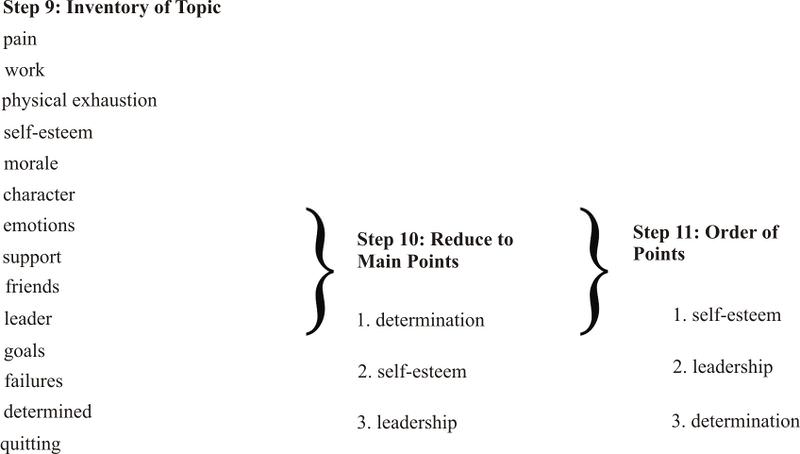
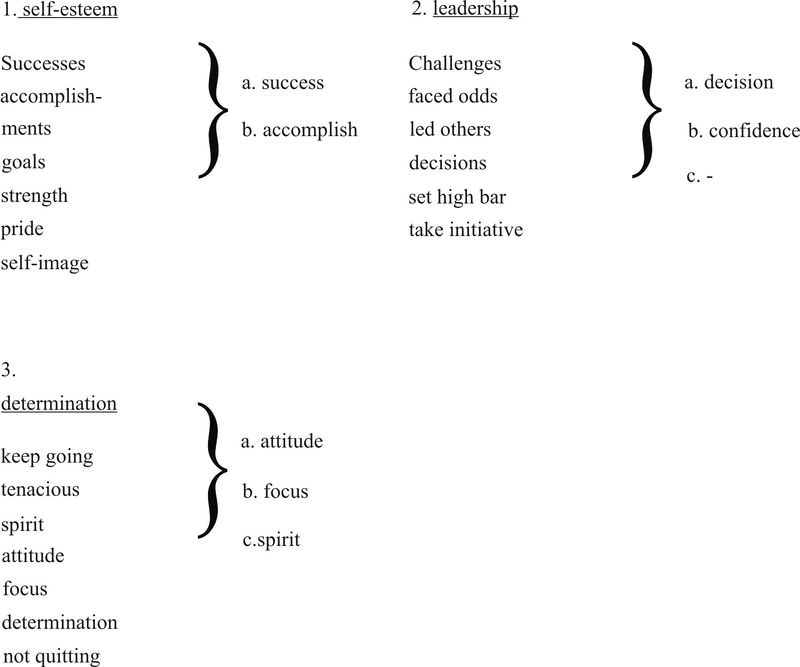
Here is an example of a completed Glyfada worksheet. This student wrote about a defining moment in her life.
Student Worksheet
Step 1: Heuristics
mother’s death, divorce, PhD exam, 1st degree black belt test, tennis tournament loss
Step 2: Topic and Focus
black belt test/challenge
Step 3: Target Audience
anyone interested in trying martial arts; anyone trying to overcome an obstacle
Step 4: So What?
challenge can be met even when we think it’s impossible
Step 5: Organization
logical for persuasion
Step 6: Appeal
pathos; appealing to determination and self-esteem
Step 7: Development
Examples, diagrams, facts, illustrations examples from martial arts class, details of testing, antidotes
Step 8: Probable Topic (educated guess)
Testing for black belt made me grow in character.
Step 12: Working Thesis: topic + so what? + main points. Testing for black belt + was a defining moment in my life + because I built self-esteem, developed leadership qualities, and gained determination.
Step 13: Mapping. Inventory each main point. Each sub-point will be developed into a paragraph.
Step 14: Sorting (Working Outline)
I. Introduction
A. General statement
B. So what
C. Working thesis
II. Self-Esteem
A. Success
B. Accomplishments
III. Leadership
A. Decisions
B. Confidence
IV. Determination
A. Attitude
B. Focus
C. Spirit
V. Final paragraph
A. Restate main points if desired
B. Concluding/pulling together
C. Universal/so what statement
Step 16: The Composition
Title of Essay
Topic Sentence
Example of topic sentences
Undefined control sequence \P 1. Introduction. General to specific. Include the “so what?”. Place the working thesis with main points at the end of intro paragraph.
[Write the full introduction after you have written the body and conclusion.]
Undefined control sequence \P 2. Glue + main point 1 (Self-esteem) + sub-point (Success) + with support.
First, my self esteem improved when I experienced success during the test. [Provide examples.]
Undefined control sequence \P 3. Glue + main point 1 (self-esteem) + sub-point (pride).
My self esteem also improved because I took pride in what I accomplished. [Provide examples.]
Undefined control sequence \P 4. Glue + main point 2 (leadership) + sub-point (decisions).
Besides building self-esteem, I developed stronger leadership skills when I had to make decisions for my group. [Provide examples.]
Undefined control sequence \P 5. Glue + main point 2 (leadership) + sub-point (strength).
Additionally, I learned to be a leader by staying strong. [Provide examples.]
Undefined control sequence \P 6. Glue + main point 3 (determination) + sub-point (attitude).
The third thing I learned was to have determination by keeping a positive attitude. [Provide examples.]
Undefined control sequence \P 7. Glue + main point 3 (determination) + sub-point (focus).
Another way I kept my determination was to keep my focus. [Provide examples.]
Undefined control sequence \P 8. Glue + main point 3 (determination) + sub-point (spirit).
Furthermore, I stayed determined in spirit.
Undefined control sequence \P 9. Final paragraph.
Recap main points—what experience meant to you.
You can print this template of the Glyfada worksheet and use it anytime you are writing a paper for any of your classes. It works for all subjects and courses.
Please Sign In to create your own Highlights / Notes
Currently there are no resources to be displayed.
Description
The Glyfada Method is a formula to help you write essays by focusing on the most difficult part of an assignment—getting started. This method helps you, the writer, discover what your main points are and what you have to say about each main point.


 FlexiA FREE Digital Tutor for Every Student
 FlexBooks 2.0Customizable, digital textbooks in a new, interactive platform
 FlexBooksCustomizable, digital textbooks
 SchoolsFlexBooks from schools and districts near you
 Study GuidesQuick review with key information for each concept
 Adaptive PracticeBuilding knowledge at each student’s skill level
 SimulationsInteractive Physics & Chemistry Simulations
 PLIXPlay. Learn. Interact. eXplore.
 CCSS MathConcepts and FlexBooks aligned to Common Core
 NGSSConcepts aligned to Next Generation Science Standards
 Certified EducatorStand out as an educator. Become CK-12 Certified.
 WebinarsLive and archived sessions to learn about CK-12