




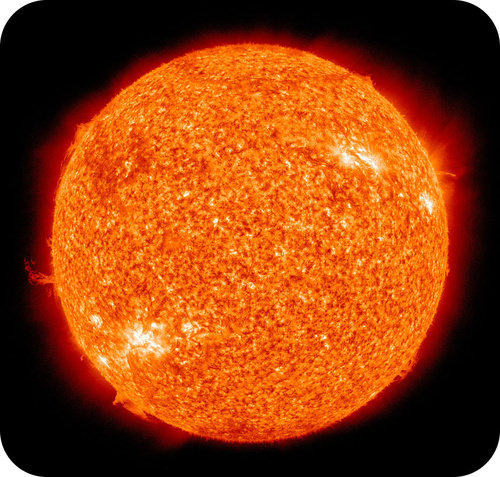
How far is the Sun from Earth?
Astronomers are used to really big numbers. While the moon is only 406,697 kilometers (km) from earth at its maximum distance, the sun is much further away (150 million km). Proxima Centauri, the star second-nearest the earth, is 39, 900, 000, 000, 000 km away and we have just started on long distances. On the other end of the scale, some biologists deal with very small numbers: a typical fungus could be as small as 30 micrometers (μm) (0.000030 meters) in length and a virus might only be 0.03 μm (0.00000003 meters) long.
Scientific Notation
Scientific notation is a way to express numbers as the product of two numbers: a coefficient and the number 10 raised to a power. It is a very useful tool for working with numbers that are either very large or very small. As an example, the distance from Earth to the Sun is about 150,000,000,000 meters – a very large distance indeed. In scientific notation, the distance is written as 1.5 × 10¹¹ m. The coefficient is the 1.5 and must be a number greater than or equal to 1 and less than 10. The power of 10, or exponent, is 11 because you would have to multiply 1.5 by 1011 to get the correct number. Scientific notation is sometimes referred to as exponential notation. A summary of SI units is given in Table below.
| Prefix | Unit Abbrev. | Exponential Factor | Meaning | Example |
| giga | G | 109 | 1,000,000,000 | 1 gigameter (Gm) = 109 m |
| mega | M | 106 | 1,000,000 | 1 megameter (Mm) = 106 m |
| kilo | k | 103 | 1000 | 1 kilometer (km) = 1000 m |
| hecto | h | 102 | 100 | 1 hectometer (hm) = 100 m |
| deka | da | 101 | 10 | 1 dekameter (dam) = 10 m |
| 100 | 1 | 1 meter (m) | ||
| deci | d | 10-1 | 1/10 | 1 decimeter (dm) = 0.1 m |
| centi | c | 10-2 | 1/100 | 1 centimeter (cm) = 0.01 m |
| milli | m | 10-3 | 1/1000 | 1 millimeter (mm) = 0.001 m |
| micro | μ | 10-6 | 1/1,000,000 | 1 micrometer (μm) = 10-6 m |
| nano | n | 10-9 | 1/1,000,000,000 | 1 nanometer (nm) = 10-9 m |
| pico | p | 10-12 | 1/1,000,000,000,000 | 1 picometer (pm) = 10-12 m |
When working with small numbers, we use a negative exponent. So 0.1 meters is 1 × 10⁻¹ meters, 0.01 is 1 × 10⁻² and so forth. Table above gives examples of smaller units. Note the use of the leading zero (the zero to the left of the decimal point). That digit is there to help you see the decimal point more clearly. The figure 0.01 is less likely to be misunderstood than .01 where you may not see the decimal.
Summary
- Scientific notation allows us to express very large or very small numbers in a convenient way.
- This notation uses a coefficient (a number between 1 and 10) and a power of ten sufficient for the actual number.
Review
- What is scientific notation?
- What do we use scientific notation for?
- What is a leading zero?
- Express 150,000,000 in scientific notation.
- Express 0.000043 in scientific notation.


