





If you found this feature while out in the field, could you find it again?
If you’re going to make observations of Earth systems, you’re going to need to know the location where you are so you can mark it on a map. If you find a rock formation filled with gold, you’ll want to be able to find the location again! You may need to tell someone when your truck gets stuck when you’re in the field so you’ll need a direction to give them.
The photo above is of Old Faithful Geyser in Yellowstone National Park. Let’s explore just a few of the ways we can pinpoint the location of this famous geological icon.
Location
How would you find Old Faithful? One way is by using latitude and longitude. Any location on Earth’s surface — or on a map — can be described using these coordinates. Latitude and longitude are expressed as degrees that are divided into 60 minutes. Each minute is divided into 60 seconds.

Latitude
A look on a reliable website shows us that Old Faithful Geyser is located at N44o27’ 43’’. What does this mean?
Latitude tells the distance north or south of the Equator. Latitude lines start at the Equator and circle around the planet. The North Pole is 90oN, with 90 degree lines in the Northern Hemisphere. Old Faithful is at 44 degrees, 27 minutes and 43 seconds north of the Equator. That’s just about exactly half way between the Equator and the North Pole!
Longitude
The latitude mentioned above does not locate Old Faithful exactly, since a circle could be drawn that latitude north of the Equator. To locate Old Faithful we need another point – longitude. At Old Faithful the longitude is W110o49’57’’.
Longitude lines are circles that go around the Earth from north to south, like the sections of an orange. Longitude is measured perpendicular to the Equator. The Prime Meridian is 0o longitude and passes through Greenwich, England. The International Date Line is the 180o meridian. Old Faithful is in the Western Hemisphere, between the Prime Meridian in the east and the International Date Line in the west.
Elevation
An accurate location must take into account the third dimension. Elevation is the height above or below sea level. Sea level is the average height of the ocean’s surface or the midpoint between high and low tide. Sea level is the same all around Earth.
Old Faithful is higher above sea level than most locations at 7,349 ft (2240 m). Of course, the highest point on Earth, Mount Everest, is much higher at 29,029 ft (8848 m).
Global Positioning System
Satellites continually orbit Earth and can be used to indicate location. A global positioning system receiver detects radio signals from at least four nearby GPS satellites. The receiver measures the time it takes for radio signals to travel from a satellite and then calculates its distance from the satellite using the speed of radio signals. By calculating distances from each of the four satellites the receiver can triangulate to determine its location. You can use a GPS meter to tell you how to get to Old Faithful.
Direction
Direction is important if you want to go between two places. Directions are expressed as north (N), east (E), south (S), and west (W), with gradations in between. The most common way to describe direction in relation to the Earth’s surface is with a compass, a device with a floating needle that is actually a small magnet. The compass needle aligns itself with the Earth’s magnetic north pole. Since the magnetic north pole is 11.5 degrees offset from its geographic north pole on the axis of rotation, you must correct for this discrepancy.
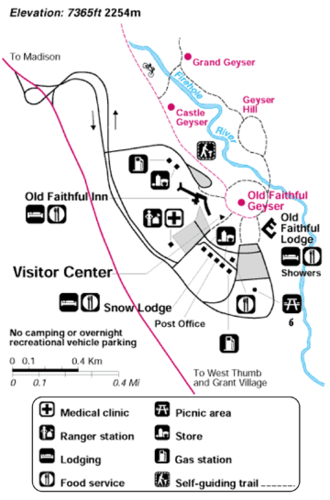
Map of the Visitor Center at Old Faithful, Yellowstone National Park, Wyoming.
Without using a compass, we can say that to get to Old Faithful, you enter Yellowstone National Park at the South Entrance, drive north-northeast to West Thumb, and then drive west-northwest to Old Faithful.
Summary
- Latitude is the distance north or south of the Equator and is expressed as a number between 0 and 90 degrees north or south.
- Longitude is the distance east or west of the Prime Meridian and is expressed as a number between 0 and 180 degrees east or west.
- Elevation is the height above sea level.
- Direction is expressed as north, south, east, or west, or some gradation between them.
Review
- Where would a feature at N44o 27’ 43’’and W110o49’57’’be located?
- How else might you describe where Old Faithful is?
- Define latitude and longitude.
Explore More
Use this resource to answer the questions that follow.
1. What are lines of latitude?
2. How far apart are the lines of latitude, in degrees, in miles?
3. What are the latitudes of the Equator, the Tropic of Cancer, and the Tropic of Capricorn? What are the characteristics of the regions found between the Tropic of Cancer and Tropic of Capricorn?
4. Where are the Arctic and Antarctic circle? What are the characteristics of the regions that are found poleward of these circles?
5. What are lines of longitude?
6. Where do the meridians meet?
7. What is the Prime Meridian? Where is it located?
8. How are longitude and latitude measured?


