
Lunar Phases
Lesson

Can the Moon cast shadows?
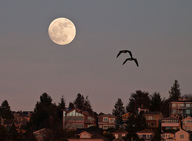
Of course! A full moon is very bright. It is bright enough to cast shadows. If you are out away from city lights and the Moon is full you might cast your own Moon shadow.
The Phases of the Moon
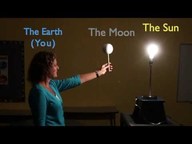
The Moon does not produce any light of its own. It only reflects light from the Sun. The Moon has phases because it orbits around Earth. One orbit takes about 28 days. As the moon moves around Earth, different parts of it appear to be lit up by the Sun. The Moon sometimes appears fully lit and sometimes completely dark. Sometimes it is partially lit. The different appearances of the Moon are referred to as phases of the Moon (Figure below).

A new moon occurs when the lit side is facing away from Earth. This happens when the Moon is between the Earth and the Sun. Sometimes you can just barely make out the outline of the new moon in the sky. This is because some sunlight reflects off the Earth and hits the Moon.
The moon grows as a waxing crescent. During the crescent moon phase, the Moon is less than half-lit. About one week later, the Moon enters the first quarter-moon phase. Only half of the Moon’s lit surface is visible from Earth, so it appears as a half circle.
The moon grows through the waxing gibbous phase. During the gibbous moon phase, the Moon is more than half-lit. After another week, the Moon reaches the far side of the Earth from the Sun. The side of the Moon facing Earth is completely lit. This is called a full moon.
The moon then passes through the waning gibbous phase for another week until the Moon is in the third quarter-moon phase. Finally, after a week as a waning crescent, the Moon is back to new.
The Moon undergoes a complete cycle of phases about every 29.5 days. This is slightly longer than the amount of time it takes the Moon to orbit the Earth because the Earth and Moon are also moving in their orbit around the Sun.
Summary
- The appearance of the Moon from Earth has distinct phases.
- A full moon is completely lit; a new moon is completely dark.
- A gibbous moon is more than half lit; a crescent moon is less than half lit.
Review
- Describe how the Sun, Moon, and Earth are aligned during a full moon.
- Describe how the Sun, Moon, and Earth are aligned during a new moon.
- Draw and label pictures of the Moon in its phases.
Explore More
Use the resource below to answer the questions that follow.
- Why does the moon have phases?
- What are the four main phases of the moon? How long does it take to change from one to another?
- What is the name for a moon that is less than half full? More than half full?
- What is the name for a moon that is getting larger? Getting smaller?
- What causes a lunar eclipse? Why doesn't a lunar eclipse occur during each full moon?
NOTES / HIGHLIGHTS
Asked by Students
Overview
- As the Moon orbits around the Earth, different parts of it appear to be lit up by the Sun, creating the phases of the Moon.
- The four main phases of the Moon are the new moon, first quarter-moon, full moon, and third quarter-moon. The complete cycle of phases occurs every 29.5 days.
- A moon that is less than half full is referred to as a waxing crescent, while a moon that is more than half full is known as a waxing gibbous.
- The term for a moon that is getting larger is 'waxing', while a moon that is getting smaller is referred to as 'waning'.
- A lunar eclipse occurs when the Earth comes between the Sun and the Moon, blocking the Sun's light from reaching the Moon.
Notable Images
Vocabulary
Test Your Knowledge
When the Moon is between the Earth and the Sun, a _________ appears.
Gibbous moon
Full moon
Quarter moon
New moon
Another week later, the Moon moves between Earth and the Sun. The side of the Moon facing Earth is completely dark. This is called a new moon. Sometimes you can just barely make out the outline of the new moon in the sky. This is because some sunlight reflects off the Earth and hits the Moon.
Which of these terms describes a moon that is less than half-lit?
Quarter
Crescent
Gibbous
Full
The moon grows as a waxing crescent. During the crescent moon phase, the Moon is less than half-lit. About one week later, the Moon enters the first quarter-moon phase. Only half of the Moon’s lit surface is visible from Earth, so it appears as a half circle.
Asked by Students

| Image | Reference | Attributions |
|---|---|---|
| Credit: Ian Carroll Source: http://www.flickr.com/photos/iancarroll/4316797211/ License: CC BY 2.0 | |
 | Credit: Flickr:OliBac Source: http://www.flickr.com/photos/olibac/4140353704/ License: CC BY 2.0 |