




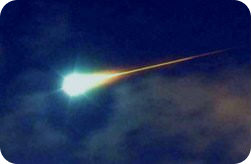
Is a shooting star really a star flying across the sky?
When a meteor shoots through the atmosphere it burns and glows. When we look up and see one, we call it a shooting star. When Earth travels through the debris left by a comet's tail, we see a meteor shower.
Meteors
A meteor, such as in Figure below, is a streak of light across the sky. People call them shooting stars but they are actually small pieces of matter burning up as they enter Earth’s atmosphere from space.
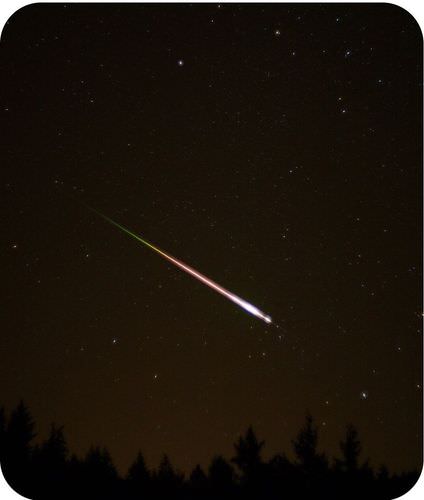
A meteor streaks across the sky.
Meteors are called meteoroids before they reach Earth’s atmosphere. Meteoroids are smaller than asteroids and range from the size of boulders down to the size of tiny sand grains. Still smaller objects are called interplanetary dust. When Earth passes through a cluster of meteoroids, there is a meteor shower. These clusters are often remnants left behind by comet tails.
Meteorites
Although most meteors burn up in the atmosphere, larger meteoroids may strike the Earth’s surface to create a meteorite. Meteorites are valuable to scientists because they provide clues about our solar system. Many meteorites are from asteroids that formed when the solar system formed (Figure below). A few meteorites are made of rocky material that is thought to have come from Mars when an asteroid impact shot material off the Martian surface and into space.
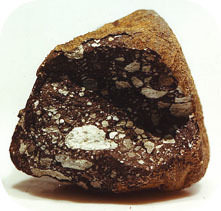
A lunar meteorite originates on the Moon and strikes Earth.
Summary
- A meteor that strikes Earth's surface is a meteorite.
- Many meteorites are remnants of the earliest material that formed in the solar system.
- Shooting stars are meteors that burn up in Earth's atmosphere.
Review
- The Perseid meteor shower appears every August. Why is the shower so regular in its appearance?
- What are the similarities and differences between meteors, meteoroids, and meteorites?
- Why are meteors known as shooting stars?


