




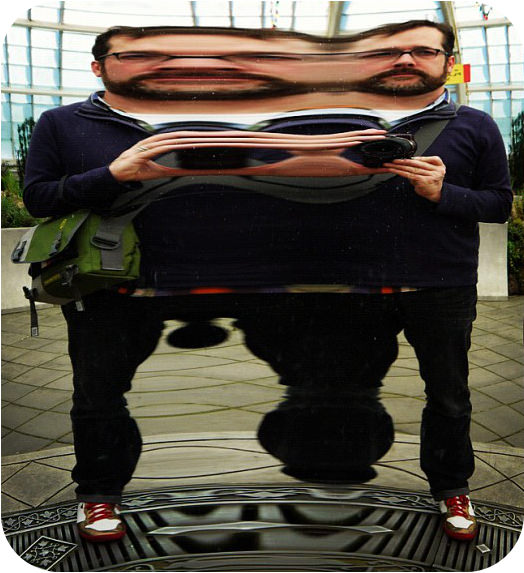
Did you ever look at your reflection in a funhouse mirror? That’s what the person in this picture is doing. This type of mirror distorts your features in silly ways. Do you know how a mirror like this one works? Physics, which is a branch of physical science, can explain it.
The Scope of Physics
Physics is the study of energy, matter, and their interactions. It’s a very broad field because it is concerned with matter and energy at all levels—from the most fundamental particles of matter to the entire universe. Some people would even argue that physics is the study of everything! Important concepts in physics include motion, forces such as magnetism and gravity, and forms of energy such as light, sound, and electrical energy.
Q: How do you think physics explains the distorted images formed by a funhouse mirror?
A: Physics explains how energy interacts with matter. In this case, for example, physics explains how visible light reflects from mirrors to form images. Most mirrors, such as bathroom mirrors, have a flat surface. Light reflected from a flat mirror forms an image that looks the same as the object in front of it. Funhouse mirrors, like the one pictured above, are different. They have a curved surface that reflects light at different angles. This explains why the images they form are distorted.
CK-12 Interactive
Physics in the World Around You
Physics can help you understand just about everything in the world around you. That’s because everything around you consists of matter and energy. Several examples of matter and energy interacting are pictured in the Figure below. Read how physics explains each example.
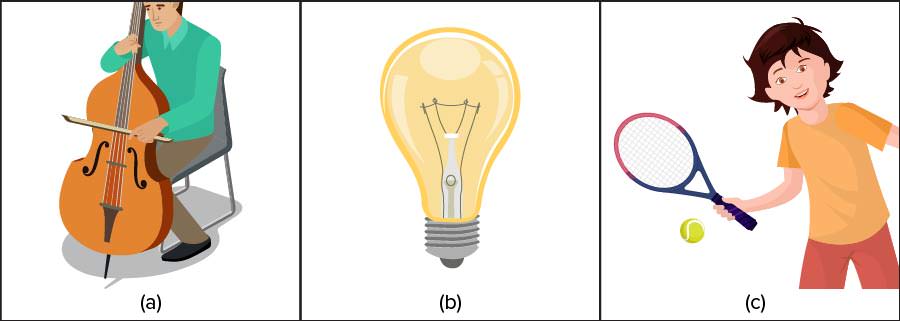
(a) The strings of a cello convert energy from vibrations into sound. (b) An incandescent light bulb converts electrical energy into heat and light. (c) A swinging tennis racket possesses energy that will be transferred to the ball when it hits.
Q: Based on the examples in Figure above, what might be other examples of energy and matter interacting?
A: Like the strings of cello, anything that vibrates produces waves of energy that travel through matter. For example, when you throw a pebble into a pond, waves of energy travel from the pebble through the water in all directions. Like an incandescent light bulb, anything that glows consists of matter that produces light energy. For example, fireflies use chemicals to produce light energy. Like a moving tennis racket, anything that moves has energy because it is moving, including your eyes as they read this sentence.
CK-12 Interactive
Summary
- Physics is the study of energy, matter, and their interactions. It is concerned with matter and energy at all levels—from the most fundamental particles of matter to the entire universe.
- Physics can help you understand just about everything in the world around you. That’s because everything around you is matter and has energy.
Review
- Outline the scope of physics.
- Describe three examples of interacting matter and energy in the world around you.


