 AI Teacher Tools




You are hiking one day with friends. When you stop to examine your map, you mark your position on a polar plot with your campsite at the origin, like this
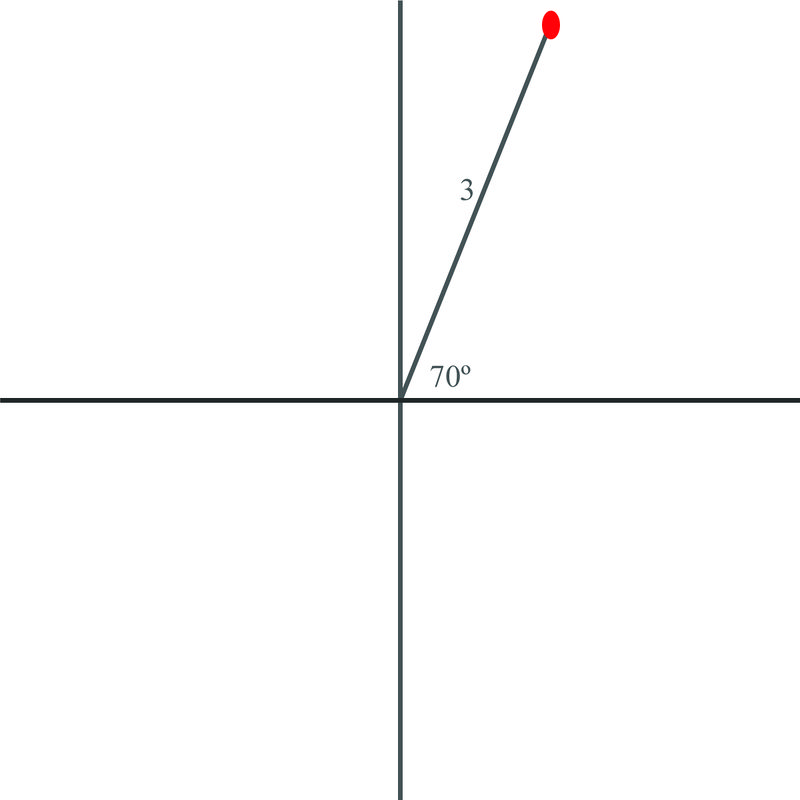
You decide to plot your position on a different map, which has a rectangular grid on it instead of a polar plot. Can you convert your coordinates from the polar representation to the rectangular one?
Converting Polar Coordinates to Rectangular Coordinates
Just as x and y are usually used to designate the rectangular coordinates of a point, r and θ are usually used to designate the polar coordinates of the point. r is the distance of the point to the origin. θ is the angle that the line from the origin to the point makes with the positive x−axis.
The diagram below shows both polar and Cartesian coordinates applied to a point P. By applying trigonometry, we can obtain equations that will show the relationship between polar coordinates (r,θ) and the rectangular coordinates (x,y)

The point P has the polar coordinates (r,θ) and the rectangular coordinates (x,y).
Therefore
x=rcosθr2=x2+y2y=rsinθtanθ=yx
These equations, also known as coordinate conversion equations, will enable you to convert from polar to rectangular form.
Converting Coordinates
Given the following polar coordinates, find the corresponding rectangular coordinates of the points: W(4,−200∘),H(4,π3)
For W(4,−200∘),r=4 and θ=−200∘
x=rcosθy=rsinθx=4cos(−200∘)y=4sin(−200∘)x=4(−.9396)y=4(.3420)x≈−3.76y≈1.37
The rectangular coordinates of W are approximately (−3.76,1.37).
For H(4,π3),r=4 and θ=π3
x=rcosθy=rsinθx=4cosπ3y=4sinπ3x=4(12)y=4(√32)x=2y=2√3
The rectangular coordinates of H are (2,2√3) or approximately (2,3.46).
Converting Equations
1. In addition to writing polar coordinates in rectangular form, the coordinate conversion equations can also be used to write polar equations in rectangular form.
Write the polar equation r=4cosθ in rectangular form.
r=4cosθr2=4rcosθMultiply both sides by r.x2+y2=4xr2=x2+y2 and x=rcosθ
The equation is now in rectangular form. The r2 and θ have been replaced. However, the equation, as it appears, does not model any shape with which we are familiar. Therefore, we must continue with the conversion.
x2−4x+y2=0x2−4x+4+y2=4Complete the square for x2−4x.(x−2)2+y2=4Factor x2−4x+4.
The rectangular form of the polar equation represents a circle with its centre at (2, 0) and a radius of 2 units.
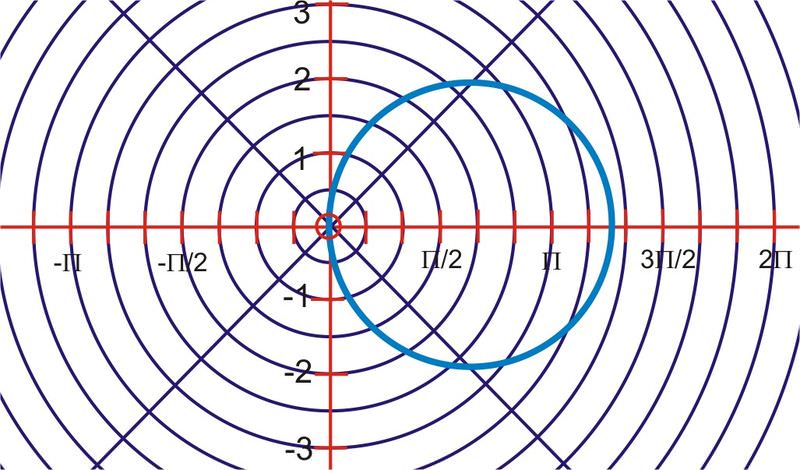
This is the graph represented by the polar equation r=4cosθ for 0≤θ≤2π or the rectangular form (x−2)2+y2=4.
2. Write the polar equation r=3cscθ in rectangular form.
r=3cscθrcscθ=3divide bycscθr⋅1cscθ=3rsinθ=3sinθ=1cscθy=3y=rsinθ
Examples
Example 1
Earlier, you were asked to convert your coordinates from polar representation to the rectangular one.
You can see from the map that your position is represented in polar coordinates as (3,70∘). Therefore, the radius is equal to 3 and the angle is equal to 70∘. The rectangular coordinates of this point can be found as follows:
x=rcosθy=rsinθx=3cos(70∘)y=3sin(70∘)x=3(.342)y=3(.94)x≈1.026y≈2.82
Example 2
Write the polar equation r=6cosθ in rectangular form.
r=6cosθr2=6rcosθx2+y2=6xx2−6x+y2=0x2−6x+9+y2=9(x−3)2+y2=9
Example 3
Write the polar equation rsinθ=−3 in rectangular form.
rsinθ=−3y=−3
Example 4
Write the polar equation r=2sinθ in rectangular form.
r=2sinθr2=2rsinθx2+y2=2yy2−2y=−x2y2−2y+1=−x2+1(y−1)2=−x2+1x2+(y−1)2=1
Review
Given the following polar coordinates, find the corresponding rectangular coordinates of the points.
- (2,π6)
- (4,2π3)
- (5,π3)
- (3,π4)
- (6,3π4)
Write each polar equation in rectangular form.
- r=3sinθ
- r=2cosθ
- r=5cscθ
- r=3secθ
- r=6cosθ
- r=8sinθ
- r=2cscθ
- r=4secθ
- r=3cosθ
- r=5sinθ
Review (Answers)
Click HERE to see the answer key or go to the Table of Contents and click on the Answer Key under the 'Other Versions' option.


