




You are looking at a map of your state with a rectangular coordinate grid. It looks like this
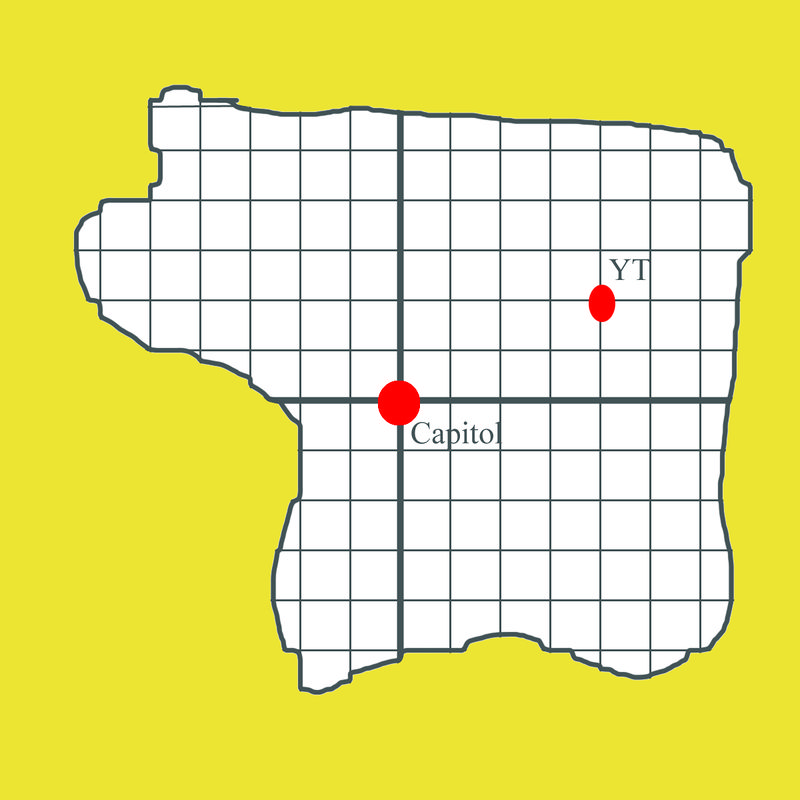
You realize that if you convert the coordinates of Your town (labelled with a "YT") to polar coordinates, you can more easily see the distance between the Capitol at the origin and Your town. Can you make this conversion from rectangular to polar coordinates?
Converting Rectangular Coordinates to Polar Coordinates
When converting rectangular coordinates to polar coordinates, we must remember that there are many possible polar coordinates. We will agree that when converting from rectangular coordinates to polar coordinates, one set of polar coordinates will be sufficient for each set of rectangular coordinates.
Most graphing calculators are programmed to complete the conversions and they too provide one set of coordinates for each conversion. The conversion of rectangular coordinates to polar coordinates is done using the Pythagorean Theorem and the Arctangent function. The Arctangent function only calculates angles in the first and fourth quadrants so π radians must be added to the value of θ for all points with rectangular coordinates in the second and third quadrants.


In addition to these formulas, r=√x2+y2 is also used in converting rectangular coordinates to polar form.
Converting Coordinates
Convert the following rectangular coordinates to polar form.
1. P(3,−5)
For P(3,−5) x=3 and y=−5. The point is located in the fourth quadrant and x>0.
r=√x2+y2θ= arctanyxr=√(3)2+(−5)2θ=tan−1(−53)r=√34θ≈−1.03r≈5.83
The polar coordinates of P(3,−5) are P(5.83,−1.03).
2. Q(−9,−12)
For Q(−9,−12) x=−9 and y=−5. The point is located in the third quadrant and x<0.
r=√x2+y2θ=arctanyx+πr=√(−9)2+(−12)2θ=tan−1(−12−9)+πr=√225θ≈4.07r=15
The polar coordinates of Q(−9,−12) are Q(15,4.07)
3. Q(2,7)
For Q(2,7) x=2 and y=7. The point is located in the first quadrant and x>0.
r=√x2+y2θ=arctanyx+πr=√(2)2+(7)2θ=tan−1(72)+πr=√54θ≈74.05r≈7.35
The polar coordinates of Q(2,7) are Q(7.35,74.05)
Examples
Example 1
Earlier, you were asked to convert rectangular coordinates to polar coordinates.
To convert these rectangular coordinates into polar coordinates, first use the Pythagorean Theorem:
r=√(4)2+(2)2=√20≈4.47
and then use the tangent function to find the angle:
θ=arctan42=63.43∘
The polar coordinates for Yourtown are YT(4.47,63.43∘)
Example 2
Write the following rectangular point in polar form: A(−2,5) using radians
For A(−2,5)x=−2 and y=5. The point is located in the second quadrant and x<0. r=√(−2)2+(5)2=√29≈5.39, θ= arctan5−2+π=1.95. The polar coordinates for the rectangular coordinates A(−2,5) are A(5.39,1.95)
Example 3
Write the following rectangular point in polar form: B(5,−4) using radians
For B(5,−4)x=5 and y=−4. The point is located in the fourth quadrant and x>0. r=√(5)2+(−4)2=√41≈6.4, θ=tan−1(−45)≈−0.67
Example 4
Write the following rectangular point in polar form: C(1,9) using degrees
The polar coordinates for the rectangular coordinates B(5,−4) are A(6.40,−0.67)
C(1,9) is located in the first quadrant. r=√12+92=√82≈9.06, θ=tan−191≈83.66.
Review
Write the following points, given in rectangular form, in polar form using radians where 0≤θ≤2π.
- (1,3)
- (2,5)
- (-2,3)
- (2,-1)
- (3,2)
- (4,5)
- (-1,2)
- (-3,3)
- (-2,5)
- (1,-4)
- (5,2)
- (1,6)
For each equation, convert the rectangular equation to polar form.
- x=5
- 2x−3y=5
- 2x+4y=2
- (x−1)2+y2=1
- (x+3)2+(y+3)2=18
- y=7
Review (Answers)
Click HERE to see the answer key or go to the Table of Contents and click on the Answer Key under the 'Other Versions' option.


