



Visualising Number and Shape Patterns
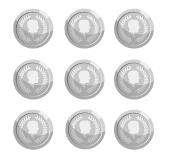
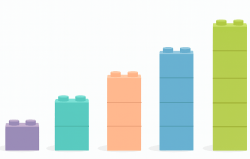
Have you ever played with building blocks or arranged coins on a table just for fun? You might have noticed that certain arrangements form neat shapes: a perfect square, a triangle, or a row that keeps growing in a pattern. What if I told you that those shapes are actually telling you a story about numbers? When we turn numbers into pictures using dots, blocks, or shapes, we are visualising the pattern. This way, our eyes can spot the hidden rules more quickly than our minds can calculate. It’s like solving a puzzle; once you see the picture, the answer suddenly makes sense!
-
Edit here for caption -
Edit here for caption
Patterns are also found in shapes. Sometimes, shapes follow a sequence, changing in a regular way, and these shape patterns are often connected to number patterns. In this lesson, we’ll learn how to turn numbers into pictures, explore how sequences are related, and see how shapes themselves can follow patterns
Visualising Number Patterns
Some number sequences can be understood better if we represent them as pictures. This helps us see how the numbers grow and how they are connected.
Even Numbers
Numbers that are exactly divisible by two are called even numbers.
When we divide an even number by two, the remainder is always zero.
The sequence of even numbers is:
2, 4, 6, 8, 10, 12, 14, …
For example:
2 ÷ 2 = 1 (no remainder)
4 ÷ 2 = 2 (no remainder)
6 ÷ 2 = 3 (no remainder)
We can also think of even numbers as numbers that can be arranged in equal columns of 2 dots without any dot left over.
For example:
4 can be shown as two columns of two dots:

8 can be shown as four columns of two dots:

Odd Numbers
Numbers that are not divisible by 2 are called odd numbers.
When we divide an odd number by 2, the remainder is always 1.
The sequence of odd numbers is:
1, 3, 5, 7, 9, 11, 13, …
For example:
1 ÷ 2 = 0 remainder 1
3 ÷ 2 = 1 remainder 1
5 ÷ 2 = 2 remainder 1
Odd numbers can be shown as dot arrangements where one dot is always left unpaired.
For example:
3 dots in two rows (one row has an extra dot):

5 dots in two rows (one row has an extra dot):

Square Numbers
A square number is obtained by multiplying a number by itself. 1,4,9,16,25... all are square numbers. The numbers themselves indicate their property.
For example,1=1×1=124=2×2=220(Product of a number with itself)It is read as 4 is equal to two squared or 4 is equal to two to the power two.
Similarly,9=3×3=32We call it 9 is equal to three squared.
Similarly,16=4×4=4225=5×5=520and so on.Such numbers can be represented by dots arranged in rows and columns. For example, 4 can be represented by four dots in two rows and two columns, as shown below:

9 can be represented by nine dots in three rows and three columns.

Thus, the square numbers 1,4,9,... can be represented as follows:
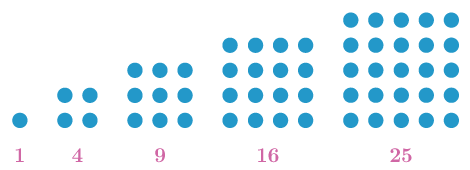
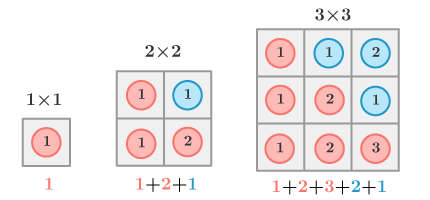
The square numbers also follow a certain pattern of numbers.
For example,1=14=1+2+19=1+2+3+2+116=1+2+3+4+3+2+125=1+2+3+4+5+4+3+2+1
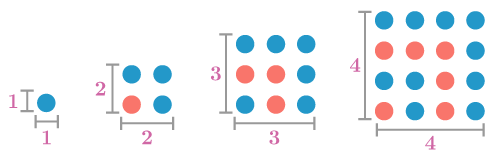
The same numbers can be represented as the sum of odd numbers.
For example,10=1=121+30=4=221+3+50=9=321+3+5+70=16=42
Triangular Numbers
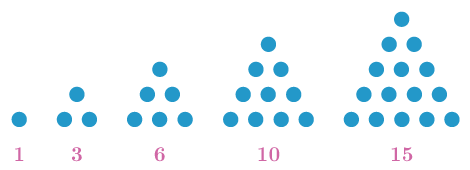
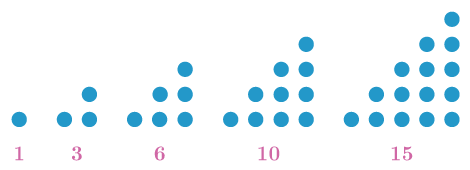
The numbers that can be represented as triangles are called triangular numbers.
The triangular numbers follow a certain pattern of numbers.
For example,1=13=1+26=1+2+310=1+2+3+415=1+2+3+4+5Triangular numbers are made by arranging dots to form either equilateral or right-angled isosceles triangles.
Cube Numbers
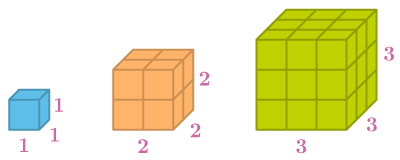
The numbers obtained by multiplying the number thrice by themselves are called cube numbers.
Look at the following cube.
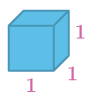
In geometry, the volume of a cube = length × width × height.
For the cube having a length of each side as a, we haveV cube=a3This means the volume of a cube is a cube number.
The cube shown above has a side of 1 unit.1×1×10=1=13Hence, a cube number is a product of multiplying a whole number by itself and then by itself again. Now, consider the following examples,2×2×20=8=233×3×30=27=33
Patterns in Shapes
A shape pattern is a series of shapes that changes in a regular way.
1. Regular polygons are shapes with all sides and angles equal. If we start with a triangle (3 sides), the next shapes in the sequence are a square (4 sides), a pentagon (5 sides), a hexagon (6 sides), and so on.
|
||
2. Stacked squares are made by arranging small equal-sized squares to make bigger squares. The total number of small squares follows the square number sequence.
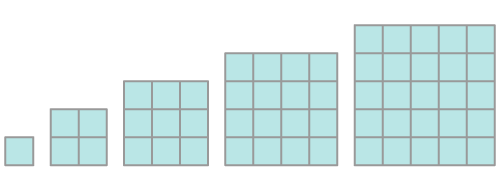
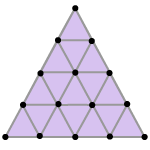
3. Stacked triangles are made by arranging dots in rows to form a triangle. The total number of dots follows the triangular number sequence.
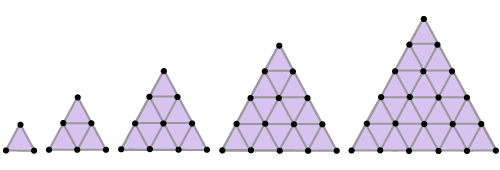
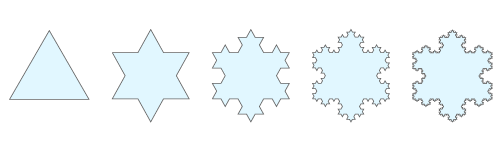
4. Koch Snowflake starts with a simple triangle. Then, at every step, smaller triangles are added to each side. As this continues, the shape gets more and more detailed—just like a snowflake!
Even though the perimeter keeps increasing, the area stays limited. That means it gets longer and longer, but never fills up an infinite space!
This is an example of a fractal which is a shape that has a repeating pattern at every scale. You’ll find fractals in nature too, like in snowflakes, trees, and coastlines!
Examples of Visualising Number Patterns and Patterns in Shapes
Example 1
Draw the square dot pattern for the number 9.
To draw the square dot pattern for the number 9, we begin by arranging the dots so that there are 3 dots in each row and 3 rows in total. This forms a perfect square because the number of rows and columns are equal.

If we count the dots row by row, the first row has 3 dots, the second row has 3 dots, and the third row also has 3 dots. Altogether, this gives us 3+3+3=9 dots. Thus, the number 9 can be represented as a 3×3 square of dots, which is why it is called a square number.
Example 2
Draw the triangular dot pattern for the 4th triangular number.
To draw the triangular dot pattern for the 4th triangular number, we start by arranging the dots row by row. The first row has 1 dot, the second row has 2 dots placed just below it, the third row has 3 dots, and the fourth row has 4 dots.
When we count the dots in all the rows, the total comes to 1 + 2 + 3 + 4 = 10. This means the 4th triangular number is 10.

Example 3
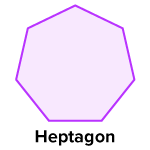
What is the next shape after a hexagon in the polygon sequence?
A hexagon has 6 sides, so the next shape has 7 sides which is a heptagon.
Example 4
A stacked triangle has 5 rows. How many dots are there?
A stacked triangle with 5 rows means that the first row will have 1 dot, the second row will have 2 dots, the third row will have 3 dots, the fourth row will have 4 dots, and the fifth row will have 5 dots. If we add them all together, we get 1+2+3+4+5=15.
So, the total number of dots is 15. This total is called the 5th triangular number, because it comes from arranging dots in a triangle with 5 rows.
| Summary of Visualising Number Patterns and Patterns in Shapes |
|
Review Questions of Visualising Number Patterns and Patterns in Shapes
- Draw dot patterns for the first three square numbers.
- Draw dot patterns for the first three triangular numbers.
- What shape comes after a pentagon in a polygon pattern?
- How many dots are in the 6th triangular number?
- Give two examples of shape patterns you see around you.
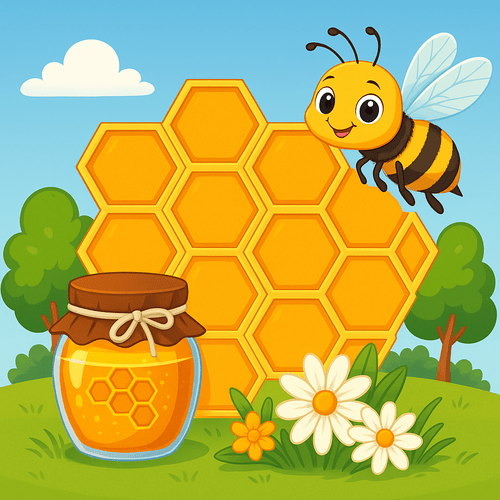
- Explain how a beehive shows a shape pattern.
|
||
| Image | Reference | Attributions |
|---|---|---|
 | Credit: CK-12 Source: CK-12 License: CK-12 Curriculum Materials License | |
 | Credit: CK-12 Source: CK-12 License: CK-12 Curriculum Materials License | |
 | Credit: CK-12 Source: CK-12 License: CK-12 Curriculum Materials License | |
 | Credit: CK-12 Source: CK-12 License: CK-12 Curriculum Materials License | |
 | Credit: CK-12 Source: CK-12 License: CK-12 Curriculum Materials License | |
 | Credit: CK-12 Source: CK-12 License: CK-12 Curriculum Materials License | |
 | Credit: CK-12 Source: CK-12 License: CK-12 Curriculum Materials License | |
 | Credit: CK-12 Source: CK-12 License: CK-12 Curriculum Materials License | |
 | Credit: CK-12 Source: CK-12 License: CK-12 Curriculum Materials License | |
 | Credit: CK-12 Source: CK-12 License: CK-12 Curriculum Materials License | |
 | Credit: CK-12 Source: CK-12 License: CK-12 Curriculum Materials License | |
 | Credit: CK-12 Source: CK-12 License: CK-12 Curriculum Materials License | |
 | Credit: CK-12 Source: CK-12 License: CK-12 Curriculum Materials License | |
 | Credit: CK-12 Source: CK-12 License: CK-12 Curriculum Materials License | |
 | Credit: CK-12 Source: CK-12 License: CK-12 Curriculum Materials License | |
 | Credit: CK-12 Source: CK-12 License: CK-12 Curriculum Materials License | |
 | Credit: CK-12 Source: CK-12 License: CK-12 Curriculum Materials License | |
 | Credit: CK-12 Source: CK-12 License: CK-12 Curriculum Materials License | |
 | Credit: CK-12 Source: CK-12 License: CK-12 Curriculum Materials License | |
 | Credit: CK-12 Source: CK-12 License: CK-12 Curriculum Materials License | |
 | Credit: CK-12 Source: CK-12 License: CK-12 Curriculum Materials License | |
 | Credit: CK-12 Source: CK-12 License: CK-12 Curriculum Materials License | |
 | Credit: CK-12 Source: CK-12 License: CK-12 Curriculum Materials License | |
 | License: CC BY-NC | |
 | License: CC BY-NC | |
 | License: CC BY-NC | |
 | License: CC BY-NC | |
 | License: CC BY-NC | |
 | License: CC BY-NC | |
 | Credit: Steve Snodgrass Source: https://www.flickr.com/photos/stevensnodgrass/4288992542/ | |
 | License: CC BY-NC | |
 | License: CC BY-NC |