



Introduction to Weather
Lesson
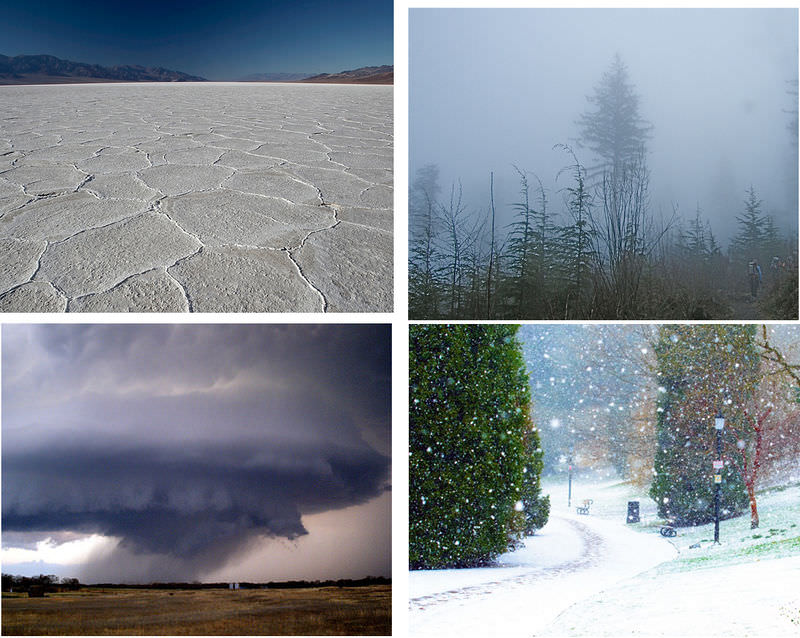
What's the weather like?
Depending on where you live, you probably experience many different types of weather. Weather can be hot or cold; wet or dry; stormy or clear; and everything in between.
What Is Weather?
All weather takes place in the atmosphere. Nearly all of it in the lower atmosphere. Weather refers to the conditions of the atmosphere at a given time and place. Climate is the average of weather over a long time.
Imagine your grandmother who lives in a distant place calls you up. She asks what your weather is like today. What would you say? Is it warm or cold? Sunny or cloudy? Calm or windy? Clear or rainy? What features of weather are important to mention?
A location’s weather depends on:
- air temperature.
- air pressure.
- fog.
- humidity.
- cloud cover.
- precipitation.
- wind speed and direction.
All of these characteristics are directly related to the amount of energy that is in the system, and where that energy is. The ultimate source of this energy is the Sun.
Weather is what we experience from day to day, or minute to minute. Weather can change rapidly.
What Causes Weather?
Weather occurs because of unequal heating of the atmosphere. The source of heat is the Sun. The general principles behind weather can be stated simply:
- The Sun heats Earth’s surface more in some places than in others.
- Where it is warm, heat from the Sun warms the air close to the surface. If there is water at the surface, it may cause some of the water to evaporate.
- Warm air is less dense, so it rises. When this happens, more dense air flows in to take its place. The flowing surface air is wind.
- The rising air cools as it goes higher in the atmosphere. If it is moist, the water vapor may condense. Clouds may form, and precipitation may fall.
Science Friday: Snowflake Safari
Next snowstorm, grab a magnifying glass and look carefully at snowflakes. Bullet rosettes, stellar plates and capped columns are just a few of the many varieties of snow crystals. In this video by Science Friday, physicist Kenneth Libbrecht shares secrets about snowflakes.
Summary
- A region's weather depends on its air temperature, air pressure, humidity, precipitation, wind speed and direction, and other factors.
- Climate is the long-term average of weather.
- Weather can change in minutes, but climate changes very slowly.
Review
- Compare and contrast weather and climate.
- What factors account for a location's weather?
- Describe how unequal heating causes weather.
Asked by Students
Overview
- A region's weather depends on its air temperature, air pressure, humidity, precipitation, wind speed and direction, and other factors.
- Climate is the long-term average of weather.
- Weather can change in minutes, but climate changes very slowly.
Notable Images
Vocabulary
Test Your Knowledge
Which of the following affects the weather in a specific location?
Air temperature
Precipitation
Wind speed and direction
Weather refers to the conditions of the atmosphere at a given time and place.
What are some things that happen as a result of unequal heating of the atmosphere?
The long-term average of temperature and precipitation
Weather is what we experience from day to day, or minute to minute. Weather can change rapidly.
Asked by Students
Related Content

| Image | Reference | Attributions |
|---|---|---|
| Credit: Fikret Onal, nordique, chascar, George Hodan Source: http://www.flickr.com/photos/fikretonal/2075443512/; http://www.flickr.com/photos/nordique/8615427400/; http://www.flickr.com/photos/chascar/476475563/; http://www.publicdomainpictures.net/view-image.php?image=34650&picture=snowing-in-the-park License: Public Domain(last), CC-BY 2.0(rest) |
