



Humidity
Lesson

Would you rather spend a summer day in Phoenix or in Houston?
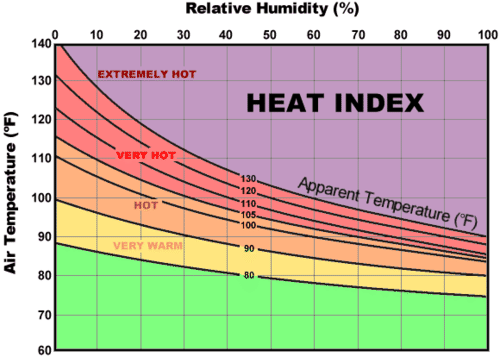
In Phoenix, Arizona in July, the average high temperature is 106°F (41°C). That's hot! But people who live in Phoenix are told that summer isn't so bad because "it's a dry heat." What does that mean? Imagine that one day, both Phoenix, Arizona and Houston, Texans have a temperature of 90°F (32°C). In Phoenix, the relative humidity is 20%. In Houston, the relative humidity is 90%. So in Phoenix it feels like it's 90°, but in Houston it feels like it's 122 (50°C)! Humidity can make a big difference!
Humidity
Humidity is the amount of water vapor in the air. High humidity increases the chances of clouds and precipitation.
Relative Humidity
Humidity usually refers to relative humidity. This is the percent of water vapor in the air relative to the total amount the air can hold. How much water vapor can the air hold? That depends on temperature. Warm air can hold more water vapor than cool air (Figurebelow).

Humidity and Heat
People often say, “it’s not the heat but the humidity.” Humidity can make a hot day feel even hotter. When sweat evaporates, it cools your body. But when the air contains as much water vapor as it can hold, water condenses on your skin just as fast as it evaporates, providing no cooling benefit. The heat index (Figurebelow) is a measure of what the temperature feels like because of the humidity.
Dew Point
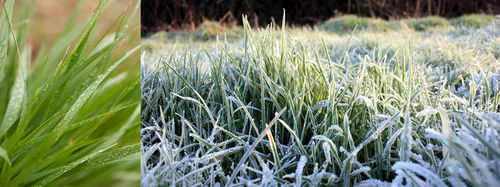
You’ve probably noticed dew on the grass on a summer morning. Why does dew form? Remember that the land heats up and cools down fairly readily. So when night comes, the land cools. Air that was warm and humid in the daytime also cools over night. As the air cools, it can hold less water vapor. Some of the water vapor condenses on the cool surfaces, such as blades of grass. The temperature at which water vapor condenses is called the dew point. If this temperature is below freezing, ice crystals of frost form instead of dew (Figurebelow). The dew point occurs at 100 percent relative humidity. Can you explain why?
Science Friday: Snowflake Safari
Next snowstorm, grab a magnifying glass and look carefully at snowflakes. Bullet rosettes, stellar plates and capped columns are just a few of the many varieties of snow crystals. In this video by Science Friday, physicist Kenneth Libbrecht shares secrets about snowflakes.
Summary
- Air reaches its dew point when humidity increases or temperature decreases.
- Water droplets form when the air reaches 100% humidity. If the temperature is cold enough, frost will form.
- Relative humidity is how the air feels at its temperature and humidity.
Review
- What is humidity? What is relative humidity?
- Explain what heat index is.
- Why does water come out of the air at its dew point?
Explore More
Use the resource below to answer the questions that follow.
- What is humidity?
- What is water vapor?
- What is absolute humidity?
- What two factors does relative humidity consider?
- What are you likely to see when the humidity is 100%?
Asked by Students
Overview
- Air reaches its dew point when humidity increases or temperature decreases.
- Water droplets form when the air reaches 100% humidity. If the temperature is cold enough, frost will form.
- Relative humidity is how the air feels at its temperature and humidity.
Notable Images
Vocabulary
Asked by Students


| Image | Reference | Attributions |
|---|