



Branches of Earth Science
Lesson

What is Earth science?
Earth scientists seek to understand the beautiful sphere on which we live. Earth is a very large, complex set of systems. So most Earth scientists study one aspect of the planet. Researchers work together to answer complicated questions. The major branches of Earth science are described below.
Geology
Geology is the study of the solid Earth. Geologists study how rocks and minerals form. The way mountains rise up is part of geology. The way mountains erode away is another part. Geologists also study fossils and Earth’s history. There are many other branches of geology. There is so much to know about our home planet that most geologists become specialists in one area. For example, a mineralogist studies minerals (Figurebelow).
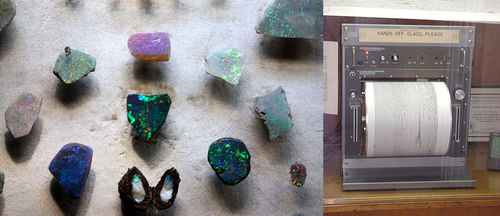
Some volcanologists brave molten lava to study volcanoes. Seismologists monitor earthquakes worldwide to help protect people and property from harm (Figureabove). Paleontologists are interested in fossils and how ancient organisms lived. Scientists who compare the geology of other planets to Earth are planetary geologists. Some geologists study the Moon. Others look for petroleum. Still others specialize in studying soil. Some geologists can tell how old rocks are and determine how different rock layers formed. There is probably an expert in almost anything you can think of related to Earth!
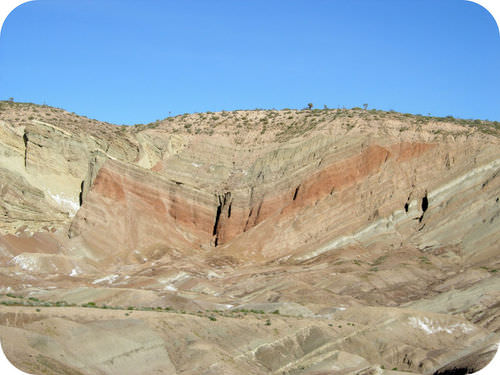
Geologists might study rivers and lakes, the underground water found between soil and rock particles, or even water that is frozen in glaciers. Earth scientists need geographers who explore the features of Earth’s surface. They work with cartographers, who make maps. Studying the layers of rock beneath the surface helps us to understand the history of planet Earth (Figurebelow).
Geologists ask a lot of questions. They wonder what they need to know about earthquakes to be able to predict them in time to evacuate a region. They ask what will happen to shorelines as sea level rises. Some even wonder what would happen if the magnetic field reverses!
Oceanography
Oceanography is the study of the oceans. The word oceanology might be more accurate, since “ology” is “the study of.” “Graph” is “to write” and refers to mapmaking. But mapping the oceans is how oceanography started.
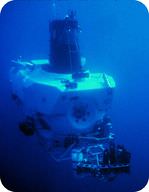
More than 70% of Earth’s surface is covered with water. Almost all of that water is in the oceans. Scientists have visited the deepest parts of the ocean in submarines. Remote vehicles go where humans can't (Figurebelow). Yet much of the ocean remains unexplored. Some people call the ocean “the last frontier.”
There are many branches of oceanography. Physical oceanography is the study of water movement, like waves and ocean currents. Physical oceanographers ask when or if a tsunami will hit a shoreline. Marine geologists look at rocks and structures in the ocean basins. These scientists ask how new ocean crust forms. Chemical oceanographers study the natural elements in ocean water. Chemical oceanographers might be concerned with where carbon dioxide goes in the oceans. Marine biologists look at marine life. There are lots of questions to ask about marine life!
Meteorology and Climatology
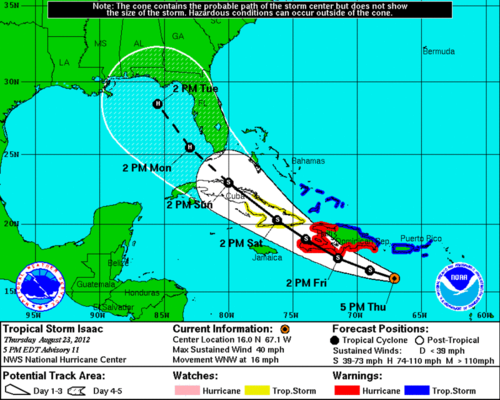
Meteorologists don’t study meteors—they study the atmosphere! The atmosphere is a thin layer of gas that surrounds Earth. The word “meteor” refers to things in the air. Meteorology includes the study of weather patterns, clouds, hurricanes, and tornadoes. Meteorology is very important. Using radars and satellites, meteorologists work to predict, or forecast, the weather (Figurebelow). Meteorologists are getting better at predicting the weather all the time. Meteorologists wonder how to better predict weather. They wonder what the effects of rising water vapor in the atmosphere will be on weather.
Climatologists also study the atmosphere. These scientists work to understand the climate as it is now. They also study how climate will change in response to global warming. There are lots of questions to ask about our changing climate.
Environmental Science
Environmental scientists study the effects people have on their environment. This includes the landscape, atmosphere, water, and living things. These scientists ask all sorts of questions about how Earth systems are changing as a result of human actions. They try to predict what changes will come in the future.
Ecologists study lifeforms and the environments they live in (Figurebelow). They try to predict the chain reactions that could occur when one part of the ecosystem is disrupted.

We hope to find better ways of living that can help the environment.
Astronomy
Astronomy is the study of outer space and the physical bodies beyond planet Earth. Astronomers use telescopes to see things far beyond what the human eye can see. Astronomers help to design spacecrafts or satellites that travel into space and send back information about faraway places (Figurebelow).
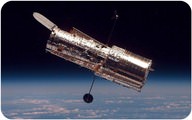
Astronomers ask a wide variety of questions. How do strong bursts of energy from the Sun, called solar flares, affect communications? How might an impact from an asteroid affect life on Earth? What are the properties of black holes? Astronomers ask bigger questions too. How was the Universe created? Is there life on other planets? Are there resources on other planets that people could use for space travel? Astronomers use what Earth scientists know about our planet to make comparisons with other planets.
Summary
- The study of Earth science includes many different fields, including geology, meteorology, oceanography, and astronomy.
- Each type of Earth scientist investigates the processes and materials of the Earth.
- Like other scientists, Earth scientists ask questions.
Review
- What do geologists study? Oceanographers? Meteorologists? Climatologists? Environmental scientists? Astronomers?
- Ask a question that is relevant to each of the fields of Earth science.
- Why is Earth science made up of all of these fields?
NOTES / HIGHLIGHTS
Asked by Students
Overview
- The study of Earth science includes many different fields, including geology, meteorology, oceanography, and astronomy. Geology is the study of the solid Earth.
- Oceanography explores oceans' mysteries, including physical aspects, marine life, and uncharted regions.
- Meteorology and climatology involve the study of the atmosphere.
- Environmental science studies the effects people have on their environment.
- Astronomy is the study of outer space and the physical bodies beyond planet Earth.
Notable Images
Vocabulary
Test Your Knowledge
What is the study of Earth’s solid material and structures, and the processes that create them?
oceanography
meteorology
geology
astronomy
Geology is the study of the solid Earth. Geologists study how rocks and minerals form. The way mountains rise up is part of geology. The way mountains erode away is another part. Geologists also study fossils and Earth’s history. There are many other branches of geology. There is so much to know about our home planet that most geologists become specialists in one area. For example, a mineralogist studies minerals (Figure below).
Which scientists study the solid Earth?
climatologists
geologists
oceanographers
meteorologists
Geology is the study of the solid Earth. Geologists study how rocks and minerals form. The way mountains rise up is part of geology. The way mountains erode away is another part. Geologists also study fossils and Earth’s history. There are many other branches of geology. There is so much to know about our home planet that most geologists become specialists in one area. For example, a mineralogist studies minerals (Figure below).
Study Guide
Asked by Students



| Image | Reference | Attributions |
|---|---|---|
| Credit: DonkeyHotey Source: http://www.flickr.com/photos/donkeyhotey/5679642883/ License: CC BY 2.0 | |
 | Credit: (left) Henrique Vicente; (right) Oleg Alexandrov Source: (left) http://www.flickr.com/photos/henriquev/3363662308/; (right) http://commons.wikimedia.org/wiki/File:Seismometer_at_Lick_Observatory.JPG License: (left) CC BY 2.0; (right) Public Domain | |
 | Credit: Mark A. Wilson (Department of Geology, The College of Wooster) (Wikipedia: Wilson44691) Source: http://commons.wikimedia.org/wiki/File:Rainbow_Basin.JPG License: Public Domain | |
 | Credit: Courtesy of the US National Oceanic and Atmospheric Administration (NOAA) Source: http://commons.wikimedia.org/wiki/File:ALVIN_submersible.jpg License: Public Domain | |
 | Credit: Courtesy of the US National Oceanic and Atmospheric Administration (NOAA) Source: http://commons.wikimedia.org/wiki/File:09L_2012_5day.gif License: Public Domain | |
 | Credit: Petr Kratochvil Source: http://www.publicdomainpictures.net/view-image.php?image=16978&picture=tropical-fish-underwater License: Public Domain | |
 | Credit: Courtesy of NASA Source: http://commons.wikimedia.org/wiki/File:Hubble_01.jpg License: Public Domain |
