



Earth's Shape
Lesson

What is a flat-earther?
Flat-earther is a term used to describe someone who believes something despite the evidence. Or who does not believe something despite the evidence. There are actually people who believe that Earth is flat. They say that satellite photos are faked. They believe that the Apollo Moon landings were faked. But there are very few people alive today who actually believe that Earth is flat. There are, however, plenty of people who can be called flat-earthers. These people believe (or disbelieve) something despite the evidence.
Earth’s Shape
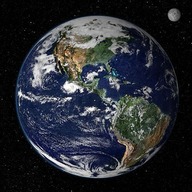
As you walk around, the ground looks flat. So why do you think that Earth is round? The best reason is that we have pictures of Earth taken from space. These photos show that Earth is round. Astronauts aboard the Apollo 17 shuttle took this one, called “The Blue Marble” (Figure below). Earth looks like a giant blue and white ball.

Did people only come to think that Earth is round when spacecrafts took photos? No! Even the ancient Greeks knew that Earth was round. They figured this out by observing the arc shape of the shadow on the Moon during a lunar eclipse. Since Galileo, people can look through a telescope and see that the planets orbit around the Sun. These bodies—the Sun and each of the planets—are round. If Earth is a planet, it is certainly round.
Another way to tell that Earth is round is to look at ships sailing off into the distance. What do you see when you watch a tall ship sail over the horizon of the Earth? The bottom part of the ship disappears faster than the top part (Figure below). What would that ship look like if Earth were flat? No part of it would disappear before the other. It would all just get smaller as it moved farther away.

Hemispheres
Earth is a sphere (technically, an oblate spheroid, a bit squashed at the poles). As a sphere, it can be divided. Half of a sphere is a hemisphere. Earth is divided into hemispheres: north, south, east, west (Figure below).
Remember that the equator is the line that falls at 0°. North of the equator is the Northern Hemisphere. South of the equator is the Southern Hemisphere. The North Pole is at 90°N. So there are 90 degree lines in the Northern Hemisphere. The South Pole is 90°S. So there are 90 degree lines in the Southern Hemisphere.
Earth also has an Eastern Hemisphere and a Western Hemisphere. They are just made by humans so that locations can more easily be specified. The Prime Meridian is 0° longitude and passes through Greenwich, England. The International Date Line is the 180° meridian. The Eastern Hemisphere is east of the Prime Meridian to the International Date Line. It includes eastern Europe and Asia. The Western Hemisphere west of the Prime Meridian to the International Date Line. It includes western Europe and the Americas.

Summary
- Ancient Greeks knew that Earth was round. They saw the shadow the planet cast on the Moon during a lunar eclipse.
- Through a simple telescope, the other planets appear to be round. So Earth must be round.
- A boat does not get smaller with distance but sinks below the horizon. This is more evidence that Earth is round.
Review
- Before telescopes and spaceships, how did people know that Earth is round?
- What would a ship sailing away from you look like if Earth were flat? If Earth were round?
- Define where the hemispheres are located: northern, southern, western, and eastern.
Explore More
Use the resource below to answer the questions that follow.
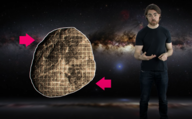
- Is the formation of clouds of matter into flattened disks unique to our solar system?
- Why do the planets in our solar system orbit in approximately the same plane around the sun?
- What causes massive spinning clouds of debris in space to flatten out into a disc shape?
Asked by Students
Overview
- The Earth is round, a fact that is evident from images taken from space.
- The ancient Greeks deduced that the Earth was round by observing the arc shape of the shadow on the Moon during a lunar eclipse.
- The curvature of the Earth can be observed when watching a tall ship sail over the horizon.
- The Earth is technically an oblate spheroid, slightly squashed at the poles.
Notable Images
Vocabulary
Test Your Knowledge
The ________ Hemisphere is west of the Prime Meridian to the International Date Line.
Eastern
Western
Northern
Southern
Earth also has an Eastern Hemisphere and a Western Hemisphere. They are just made by humans so that locations can more easily be specified. The Prime Meridian is 0° longitude and passes through Greenwich, England. The International Date Line is the 180° meridian. The Eastern Hemisphere is east of the Prime Meridian to the International Date Line. It includes eastern Europe and Asia. The Western Hemisphere west of the Prime Meridian to the International Date Line. It includes western Europe and the Americas.
The Southern Hemisphere is south of the Equator to the ______ Pole.
West
East
South
North
Remember that the Equator is the line that falls at 0°. North of the Equator is the Northern Hemisphere. South of the Equator is the Southern Hemisphere. The North Pole is at 90°N. So there are 90 degree lines in the Northern Hemisphere. The South Pole is 90°S. So there are 90 degree lines in the Southern Hemisphere.
Study Guide
Asked by Students
| Image | Reference | Attributions |
|---|---|---|
| Credit: Zappy's Source: CK-12 Foundation License: CC BY-NC 3.0 | |
 | Credit: Courtesy of NASA Source: http://commons.wikimedia.org/wiki/File:Earth_Western_Hemisphere.jpg License: Public Domain | |
 | Credit: Conan (Flickr:conanil) Source: http://www.flickr.com/photos/conanil/502138210/ License: CC BY-NC 2.0 | |
 | Credit: Zappy's;Conan (Flickr:conanil) Source: CK-12 Foundation;http://www.flickr.com/photos/conanil/502138210/ License: CC BY-NC 3.0; CC BY 2.0 |
