



What's the control center of your body?
Your brain is like the control center of your body. It controls your breathing and heartbeat. It helps you to think and learn. The brain is so "central" to all your body systems, it's not surprising that the brain and spinal cord are called the central nervous system.
The Central Nervous System
The central nervous system (CNS) (Figure below) is the largest part of the nervous system. It includes the brain and the spinal cord. The bony skull protects the brain. The spinal cord is protected within the bones of the spine, which are called vertebrae.
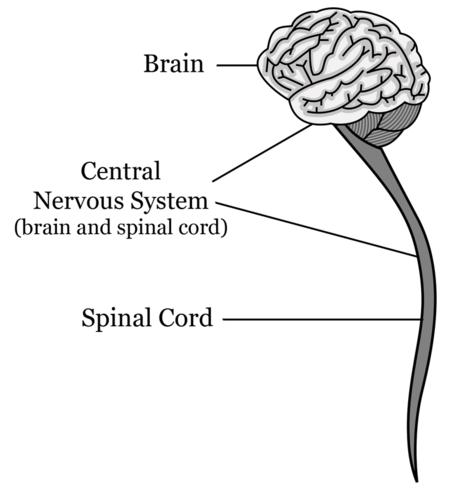
The brain and spinal cord make up the central nervous system.
The Brain
What weighs about three pounds and contains up to 100 billion cells? The answer is the human brain. The brain is the control center of the nervous system. It’s like the pilot of a plane. It tells other parts of the nervous system what to do.
The brain is also the most complex organ in the body. Each of its 100 billion neurons has synapses connecting it with thousands of other neurons. All those neurons use a lot of energy. In fact, the adult brain uses almost a quarter of the total energy used by the body. The developing brain of a baby uses an even greater amount of the body’s total energy.
The brain is the organ that lets us understand what we see, hear, or sense in other ways. It also allows us to use language, learn, think, and remember. The brain controls the organs in our body and our movements as well. The brain consists of three main parts, the cerebrum, the cerebellum, and the brain stem (Figure below).
- The cerebrum is the largest part of the brain. It sits on top of the brain stem. The cerebrum controls functions that we are aware of, such as problem-solving and speech. It also controls voluntary movements, like waving to a friend. Whether you are doing your homework or jumping hurdles, you are using your cerebrum.
- The cerebellum is the next largest part of the brain. It lies under the cerebrum and behind the brain stem. The cerebellum controls body position, coordination, and balance. Whether you are riding a bicycle or writing with a pen, you are using your cerebellum.
- The brain stem is the smallest of the three main parts of the brain. It lies directly under the cerebrum. The brain stem controls basic body functions, such as breathing, heartbeat, and digestion. The brain stem also carries information back and forth between the cerebrum and spinal cord.

Side view of the brain (right). Can you find the locations of the three major parts of the brain? Top view of the brain (left).
The cerebrum is divided into a right and left half (Figure above). Each half of the cerebrum is called a hemisphere. The two hemispheres are connected by a thick bundle of axons called the corpus callosum. It lies deep inside the brain and carries messages back and forth between the two hemispheres.
Did you know that the right hemisphere controls the left side of the body, and the left hemisphere controls the right side of the body? By connecting the two hemispheres, the corpus callosum allows this to happen.
Each hemisphere of the cerebrum is divided into four parts, called lobes. The four lobes are the:
- Frontal.
- Parietal.
- Temporal.
- Occipital.
Each lobe has different jobs. Some of the functions are listed below (Table below).
| Lobe | Main Function(s) |
|---|---|
| Frontal | Speech, thinking, touch |
| Parietal | Speech, taste, reading |
| Temporal | Hearing, smell |
| Occipital | Sight |
The Spinal Cord
The spinal cord is a long, tube-shaped bundle of neurons, protected by the vertebrae. It runs from the brain stem to the lower back. The main job of the spinal cord is to carry nerve impulses back and forth between the body and brain. The spinal cord is like a two-way highway. Messages about the body, both inside and out, pass through the spinal cord to the brain. Messages from the brain pass in the other direction through the spinal cord to tell the body what to do.
Science Friday: Face Time: How quickly do you judge a face?
How fast do you judge somebody by their face? In this video by Science Friday, Dr. Jon Freeman discusses how the brain quickly creates character assessments of people and the effects these assessments may have.
Summary
- The central nervous system is made up of the brain and the spinal cord.
- The brain consists of three main parts: the cerebrum, the cerebellum, and the brain stem.
Explore More
Use the resource below to answer the questions that follow.
- The Human Brain at http://www.youtube.com/watch?v=gVjpfPNpoGA (1:36)
- What are two components of the central nervous system?
- Describe the spinal cord.
- What are the main divisions of the brain?
- What are the four lobes of the cerebrum?
Review
- What two structures make up the central nervous system?
- Compare and contrast the three main parts of the brain.
- Describe the main function of the spinal cord.


