 AI Teacher Tools



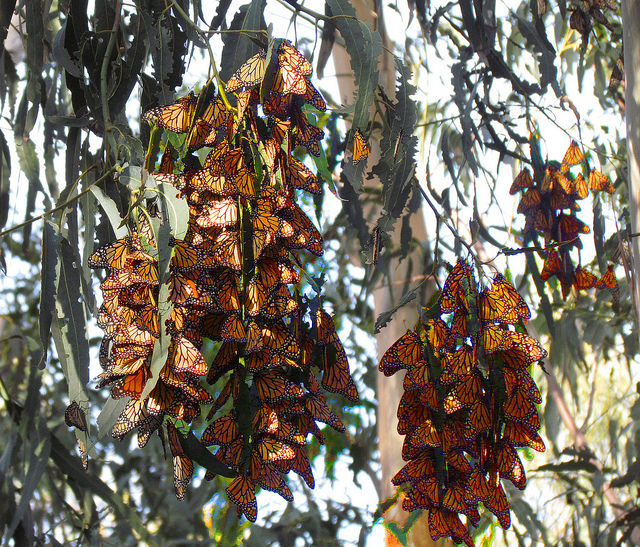
What are these butterflies doing?
Monarch butterflies gather in large groups as they migrate 2,500 miles south each fall. They return to the north in the spring. This migration is a cycle that repeats every year.
Cycles of Behavior
Many animal behaviors change in a regular way. They go through cycles. Some cycles of behavior repeat each year. Other cycles of behavior repeat every day.
Yearly Cycles
An example of a behavior with a yearly cycle is hibernation. Hibernation is a state in which an animal’s body processes are slower than usual, and its body temperature falls. An animal uses less energy than usual during hibernation. This helps the animal survive during a time of year when food is scarce. Hibernation may last for weeks or months. Animals that hibernate include species of bats, squirrels, and snakes.
Most people think that bears hibernate. In fact, bears do not go into true hibernation. In the winter, they go into a deep sleep. However, their body processes do not slow down very much. Their body temperature also remains about the same as usual. Bears can be awakened easily from their winter sleep.
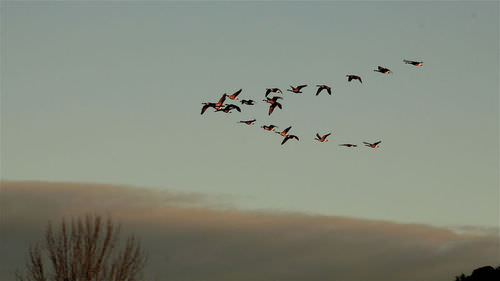
Another example of a behavior with a yearly cycle is migration. Migration is the movement of animals from one place to another. Migration is an innate behavior that is triggered by changes in the environment. For example, animals may migrate when the days get shorter in the fall. Migration is most common in birds, fish, and insects. In the Northern Hemisphere, many species of birds, including robins and geese, travel south for the winter. They migrate to areas where it is warmer and where there is more food. They return north in the spring. A flock of migrating geese is pictured below (Figure below).
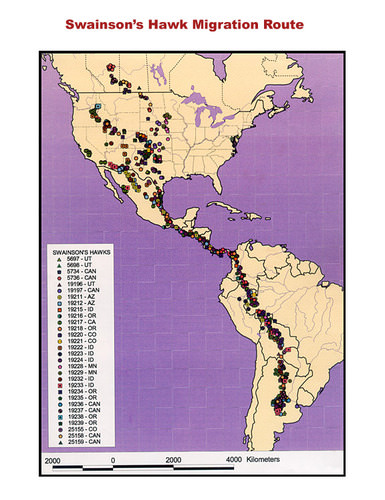
Some animals migrate very long distances. The map shown below shows the migration route of a species of hawk called Swainson’s hawk (Figure below). About how many miles do the hawks travel from start to finish? Are you surprised that birds migrate that far? Some species of birds migrate even farther. Whales also are known to migrate thousands of miles each year to take advantage of warmer waters in the winter months. The great migration of millions of zebra, wildebeest and other antelope in East Africa also occurs yearly. Each year around 1.5 million wildebeest and 300,000 zebra (along with other antelope) go in search of food and water, traveling a distance of around 1800 miles.
Birds and other migrating animals follow the same routes each year. How do they know where to go? It depends on the species. Some animals follow landmarks, such as rivers or coastlines. Other animals are guided by the position of the sun, the usual direction of the wind, or other clues in the environment.
Daily Cycles
Many animal behaviors change at certain times of day, day after day. For example, most animals go to sleep when the sun sets and wake up when the sun rises. Animals that are active during the daytime are called diurnal. Some animals do the opposite. They sleep all day and are active during the night. These animals are called nocturnal. Examples of nocturnal animals include bats, foxes, possums, skunks and coyotes. Many mammals (including humans), insects, reptiles and birds are diurnal.
Animals may eat and drink at certain times of day as well. Humans have daily cycles of behavior, too. Most people start to get sleepy after dark and have a hard time sleeping when it is light outside. Daily cycles of behavior are called circadian rhythms.
In many species, including humans, circadian rhythms are controlled by a tiny structure called the biological clock. This structure is located in a gland at the base of the brain. The biological clock sends signals to the body. The signals cause regular changes in behavior and body processes. The amount of light entering the eyes helps control the biological clock. The clock causes changes that repeat every 24 hours.
Summary
- Yearly cycles of behavior include hibernation and migration.
- Daily cycles of behavior, including sleeping and waking, are called circadian rhythms.
Explore More
Use the resources below to answer the questions that follow.
Explore More I
- Red Knot Migration - Port Royal Sound at http://www.youtube.com/watch?v=P21xTCFrJbU (2:07)
- Thousands of Red Knots migrate through New Jersey at http://www.youtube.com/watch?v=TE5EHoBWdAA (2:55)
- How far do Red Knots (Calidris canutus) migrate each year?
- Are Red Knots the only species of bird to use horseshoe crab (Limulus polyphemus) eggs as a resource?
- What information do scientists collect from the red Knots? How do they use this information?
- Why do scientists think Red Knot populations are declining? How is this connected to their extremely long migration?
Explore More II
- Ocean Life - Vertical Migration & Aggregation at http://www.youtube.com/watch?v=zVQd9pn8j6E (7:16)
- What is the largest migration of animals on the planet? When does this occur?
- Why do animals undergo this migration? What types of organisms undergo this migration?
- How does the timing of this migration vary throughout the year?
Review
- What are two examples of yearly cycles of behavior?
- What is the difference between a nocturnal and a diurnal animal?
- What is a circadian rhythm?
- What controls circadian rhythms in humans? Explain how this process works.


