



How many organs of the digestive system can you name?
Stomach? Mouth? It takes many different organs working together in order to digest your food. Some are part of the pipeline that food passes through. Others make special chemicals that are needed for digestion.
Organs of the Digestive System
The mouth and stomach are just two of the organs of the digestive system. Other digestive system organs are the esophagus, small intestine, and large intestine. Below, you can see that the digestive organs form a long tube (Figure below). In adults, this tube is about 30 feet long! At one end of the tube is the mouth. At the other end is the anus. Food enters the mouth and then passes through the rest of the digestive system. Food waste leaves the body through the anus.

This drawing shows the liver, gallbladder, and pancreas. These organs are part of the digestive system. Food does not pass through them, but they secrete substances needed for chemical digestion.
The organs of the digestive system are lined with muscles. The muscles contract, or tighten, to push food through the system (Figure below). The muscles contract in waves. The waves pass through the digestive system like waves through a slinky. This movement of muscle contractions is called peristalsis. Without peristalsis, food would not be able to move through the digestive system. Peristalsis is an involuntary process, which means that it occurs without your conscious control.
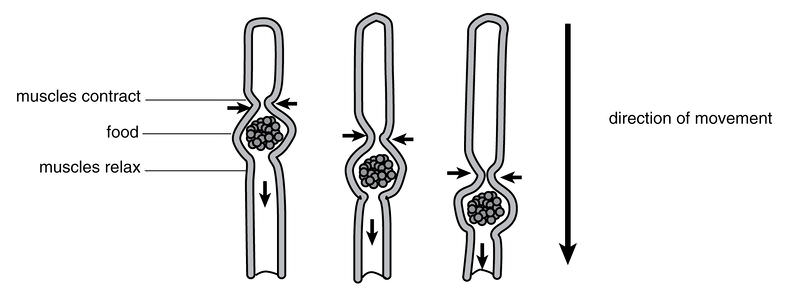
This diagram shows how muscles push food through the digestive system. Muscle contractions travel through the system in waves, pushing the food ahead of them. This is called peristalsis.
The liver, gallbladder, and pancreas are also organs of the digestive system (Figure above). Food does not pass through these three organs. However, these organs are important for digestion. They secrete or store enzymes or other chemicals that are needed to help digest food chemically.
Mouth, Esophagus, and Stomach
The mouth is the first organ that food enters. But digestion may start even before you put the first bite of food into your mouth. Just seeing or smelling food can cause the release of saliva and digestive enzymes in your mouth.
Once you start eating, saliva wets the food, which makes it easier to break up and swallow. Digestive enzymes, including the enzyme amylase, start breaking down starches into sugars. Your tongue helps mix the food with the saliva and enzymes.
Your teeth also help digest food. Your front teeth are sharp. They cut and tear food when you bite into it. Your back teeth are broad and flat. They grind food into smaller pieces when you chew. Chewing is part of mechanical digestion. Your tongue pushes the food to the back of your mouth so you can swallow it. When you swallow, the lump of chewed food passes down your throat to your esophagus.
The esophagus is a narrow tube that carries food from the throat to the stomach. Food moves through the esophagus because of peristalsis. At the lower end of the esophagus, a circular muscle controls the opening to the stomach. The muscle relaxes to let food pass into the stomach. Then the muscle contracts again to prevent food from passing back into the esophagus.
Some people think that gravity moves food through the esophagus. If that were true, food would move through the esophagus only when you are sitting or standing upright. In fact, because of peristalsis, food can move through the esophagus no matter what position you are in—even upside down! Just don’t try to swallow food when you are upside down—you could choke!
The stomach is a sac-like organ at the end of the esophagus. It has thick muscular walls. The muscles contract and relax. This moves the food around and helps break it into smaller pieces. Mixing the food around with the enzyme pepsin and other chemicals helps digest proteins.
Water, salt, and simple sugars can be absorbed into the blood from the stomach. Most other substances are broken down further in the small intestine before they are absorbed. The stomach stores food until the small intestine is ready to receive it. A circular muscle controls the opening between the stomach and small intestine. When the small intestine is empty, the muscle relaxes. This lets food pass from the stomach into the small intestine.
Small Intestine
The small intestine a is narrow tube that starts at the stomach and ends at the large intestine (Figure above). In adults, the small intestine is about 23 feet long. Chemical digestion takes place in the first part of the small intestine. Many enzymes and other chemicals are secreted here. The small intestine is also where most nutrients are absorbed into the blood. The later sections of the small intestines are covered with tiny projections called villi (Figure below). Villi contain very tiny blood vessels. Nutrients are absorbed into the blood through these tiny vessels. There are millions of villi, so, altogether, there is a very large area for absorption to take place. In fact, villi make the inner surface area of the small intestine 1,000 times larger than it would be without them. The entire inner surface area of the small intestine is about as big as a basketball court!

This is what the villi lining the intestine looks like when magnified. Each one is actually only about 1 millimeter long. Villi are just barely visible with the unaided eye.
The small intestine is much longer than the large intestine. So why is it called “small”? If you compare small and large intestines (Figure above), you will see the small intestine is smaller in width than the large intestine.
Large Intestine
The large intestine is a wide tube that connects the small intestine with the anus. In adults, it is about five feet long. Waste enters the large intestine from the small intestine in a liquid state. As the waste moves through the large intestine, excess water is absorbed from it. After the excess water is absorbed, the remaining solid waste is called feces.
Circular muscles control the anus. They relax to let the feces pass out of the body through the anus. After feces pass out of the body, they are called stool. Releasing the stool from the body is referred to as a bowel movement.
Summary
- The main organs of the digestive system are the mouth, esophagus, stomach, small intestine, and large intestine.
- The liver, gallbladder, and pancreas contribute chemicals that aid in digestion.
Explore More
Use the resource below to answer the questions that follow.
- Functions of the Organs of the Digestive System at http://www.youtube.com/watch?v=NtDTy6KLvYo (2:48)
- What organ starts the digestion process? What does it do?
- What function does the liver serve in digestion? How does the liver work together with the gallbladder?
- What are the functions of the pancreas?
Review
- List five organs of the digestive system.
- Describe peristalsis, and explain why it is necessary for digestion.
- Describe the stomach and its function.
- In which organ of the digestive system does absorption of nutrients take place?


