





What is aerobic exercise?
When you hear the word "aerobic," an aerobics class may come to mind. But that's just one type of aerobic exercise. Aerobic exercise is any exercise that strengthens your cardiovascular system—playing basketball or swimming, for example.
Muscles and Exercise
Regular physical exercise is important in preventing lifestyle diseases such as cardiovascular disease, some types of cancer, type 2 diabetes, and obesity. Regular exercise also improves the health of the muscular system. Muscles that are exercised are bigger and stronger than muscles that are not exercised.
Exercise improves both muscular strength and muscular endurance. Muscular strength is the ability of a muscle to use force during a contraction. Muscular endurance is the ability of a muscle to continue to contract over a long time without getting tired.
Exercises are grouped into three types depending on the effect they have on the body:
- Aerobic exercises, such as cycling, walking, and running, increase muscular endurance and cardiovascular health.
- Anaerobic exercises, such as weight training or sprinting, increase muscle strength.
- Flexibility exercises, such as stretching, improve the range of motion of muscles and joints. Regular stretching helps people avoid activity-related injuries.
Anaerobic Exercise and Muscular Strength
Anaerobic exercises comprise brief periods of physical exertion and high-intensity, strength-training activities. Anaerobic exercises cause muscles to get bigger and stronger. Anaerobic exercises use a resistance against which the muscle has to work to lift or push away. The resistance can be a weight or a person’s own body weight (Figure below). Sports such as basketball, tennis, football and even baseball can be anaerobic.

Aerobic Exercise and Muscular Endurance
Aerobic exercises are exercises in which a low to moderate level of exertion can be sustained over long periods. These are exercises that cause your heart to beat faster and allow your muscles to use oxygen to contract. If you exercise aerobically, overtime, your muscles will not get easily tired, and you will use oxygen more efficiently. Aerobic exercise (Figure below) also helps improve cardiac muscle.

Muscle Injuries
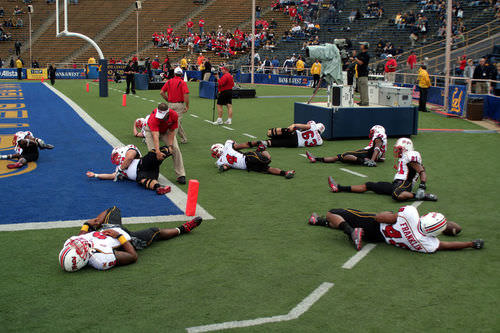
Sometimes muscles and tendons get injured when a person starts doing an activity before they have warmed up properly. A warm up is a slow increase in the intensity of a physical activity that prepares muscles for an activity. Warming up increases the blood flow to the muscles and increases the heart rate. Warmed-up muscles and tendons are less likely to get injured. For example, before running or playing soccer, a person might jog slowly to warm muscles and increase their heart rate. Even elite athletes need to warm up (Figure below).
When you don't do a proper warm-up, several types of injuries can occur. A strain happens when muscle or tendons tear. Strains are also known as "pulled muscles." Another common injury is tendinitis, the irritation of the tendons. Strains and tendinitis are usually treated with rest, cold compresses, and stretching exercises that a physical therapist designs for each patient.
Injuries can also be prevented by proper rest and recovery. If you do not get enough rest, your body will become injured and will not react well to exercise, or improve. You can also rest by doing a different activity. For example, if you run, you can rest your running muscles and joints by swimming.
Summary
- Aerobic exercise helps improve the cardiovascular system, while anaerobic exercise causes muscles to get bigger and stronger.
- Muscle strain and tendinitis can be prevented by warming up before rigorous exercise and allowing your muscles to rest and recover.
Review
- What are lifestyle diseases? Given an example.
- Describe muscular strength and endurance.
- What are the health benefits of aerobic exercise?
- Describe two types of muscle injuries.


