





What do nerve cells look like?
Note that like most other cells, these nerve cells have a nucleus. They also have other organelles. However, the long, threadlike extensions of the nerve cells are unique. This is where the nerve impulses are transmitted.
Neurons and Nerve Impulses
The nervous system is made up of nerves. A nerve is a bundle of nerve cells. A nerve cell that carries messages is called a neuron (Figure below). The messages carried by neurons are called nerve impulses. Nerve impulses can travel very quickly because they are electrical impulses.
Think about flipping on a light switch when you enter a room. When you flip the switch, the electricity flows to the light through wires inside the walls. The electricity may have to travel many meters to reach the light, but the light still comes on as soon as you flip the switch. Nerve impulses travel just as fast through the network of nerves inside the body.

The axons of many neurons, like the one shown here, are covered with a fatty layer called myelin sheath. The sheath covers the axon, like the plastic covering on an electrical wire, and allows nerve impulses to travel faster along the axon. The node of Ranvier, shown in this diagram, is any gap in the myelin sheath; it allows faster transmission of a signal.
What Does a Neuron Look Like?
A neuron has a special shape that lets it pass signals from one cell to another. A neuron has three main parts (Figure above):
- The cell body.
- Many dendrites.
- One axon.
The cell body contains the nucleus and other organelles. Dendrites and axons connect to the cell body, similar to rays coming off of the sun. Dendrites receive nerve impulses from other cells. Axons pass the nerve impulses on to other cells. A single neuron may have thousands of dendrites, so it can communicate with thousands of other cells but only one axon. The axon is covered with a myelin sheath, a fatty layer that insulates the axon and allows the electrical signal to travel much more quickly. The node of Ranvier is any gap within the myelin sheath exposing the axon, and it allows even faster transmission of a signal.
Types of Neurons
Neurons are usually classified based on the role they play in the body. Two main types of neurons are sensory neurons and motor neurons.
- Sensory neurons carry nerve impulses from sense organs and internal organs to the central nervous system.
- Motor neurons carry nerve impulses from the central nervous system to organs, glands, and muscles—the opposite direction.
Both types of neurons work together. Sensory neurons carry information about the environment found inside or outside of the body to the central nervous system. The central nervous system uses the information to send messages through motor neurons to tell the body how to respond to the information.
The Synapse
The place where the axon of one neuron meets the dendrite of another is called a synapse. Synapses are also found between neurons and other types of cells, such as muscle cells. The axon of the sending neuron does not actually touch the dendrite of the receiving neuron. There is a tiny gap between them, the synaptic cleft (Figure below).
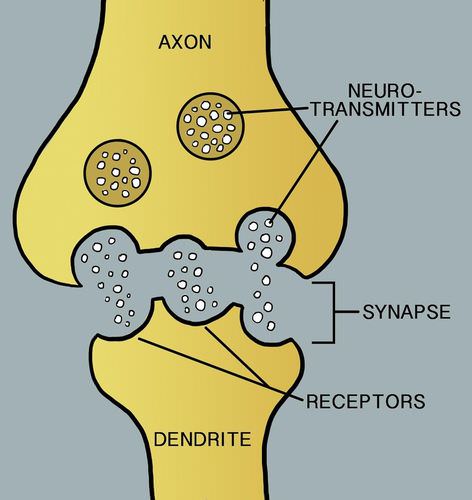
This diagram shows a synapse between neurons. When a nerve impulse arrives at the end of the axon, neurotransmitters are released and travel to the dendrite of another neuron, carrying the nerve impulse from one neuron to the next.
The following steps describe what happens when a nerve impulse reaches the end of an axon.
- When a nerve impulse reaches the end of an axon, the axon releases chemicals called neurotransmitters.
- Neurotransmitters travel across the synapse between the axon and the dendrite of the next neuron.
- Neurotransmitters bind to the membrane of the dendrite.
- The binding allows the nerve impulse to travel through the receiving neuron.
Did you ever watch a relay race? After the first runner races, he or she passes the baton to the next runner, who takes over. Neurons are a little like relay runners. Instead of a baton, they pass neurotransmitters to the next neuron. Examples of neurotransmitters are chemicals such as serotonin, dopamine, and adrenaline.
You can watch an animation of nerve impulses and neurotransmitters at http://www.mind.ilstu.edu/curriculum/neurons_intro/neurons_intro.php.
Some people have low levels of the neurotransmitter called serotonin in their brain. Scientists think that this is one cause of depression. Medications called antidepressants help bring serotonin levels back to normal. For many people with depression, antidepressants control the symptoms of their depression and help them lead happy, productive lives.
Summary
- Neurons, or nerve cells that carry nerve impulses, are made up of the cell body, the axon, and several dendrites.
- Signals move across the synapse, the place where the axon of one neuron meets the dendrite of another, using chemicals called neurotransmitters.
Explore More
Use the resource below to answer the questions that follow.
- Neuroscience For Kids at http://faculty.washington.edu/chudler/cells.html
- What are the three types of neurons?
- What neurons are most abundant in the central nervous system?
- What is the function of sensory neurons?
- What is the function of motor neurons?
- What is the role of interneurons?
Review
- Describe a neuron and identify its three main parts.
- Distinguish between dendrites and the axon.
- Distinguish between sensory and motor neurons.
- Explain how one neuron transmits a nerve impulse to another neuron.


