




Why do you breathe?
We breathe because we need oxygen. Breathing also releases carbon dioxide from our bodies into the air. The respiratory system is the body system that brings air containing oxygen into the body and releases carbon dioxide into the atmosphere. Recall that oxygen is needed to make ATP.
How We Breathe
Most of the time, you breathe without thinking about it. Breathing is mostly an involuntary action that is controlled by a part of your brain that also controls your heart beat. If you swim, do yoga, or sing, you know you can control your breathing, however. Taking air into the body through the nose and mouth is called inhalation. Pushing air out of the body through the nose or mouth is called exhalation. The woman pictured below is exhaling before she surfaces from the pool water (Figure below).
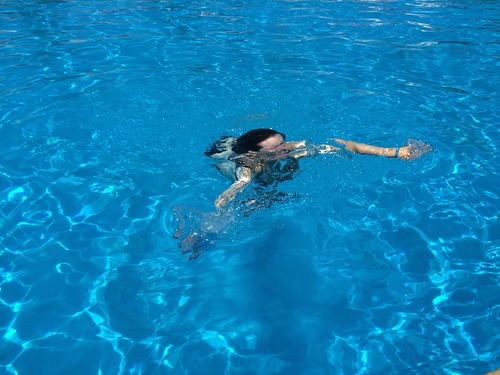
Being able to control breathing is important for many activities, such as swimming. The woman in the photograph is exhaling as she exits the water.
How do lungs allow air in? Air moves into and out of the lungs by the movement of muscles. The most important muscle in the process of breathing is the diaphragm, a sheet of muscle that spreads across the bottom of the rib cage. The diaphragm and rib muscles contract and relax to move air into and out of the lungs. During inhalation, the diaphragm contracts and moves downward. The rib muscles contract and cause the ribs to move outward. This causes the chest volume to increase. Because the chest volume is larger, the air pressure inside the lungs is lower than the air pressure outside. This difference in air pressures causes air to be sucked into the lungs. When the diaphragm and rib muscles relax, air is pushed out of the lungs. Exhalation is similar to letting the air out of a balloon.
How does the inhaled oxygen get into the bloodstream? The exchange of gasses between the lungs and the blood happens in tiny sacs called alveoli. The walls of the alveoli are very thin and allow gases to pass though them. The alveoli are lined with capillaries (Figure below). Oxygen moves from the alveoli to the blood in the capillaries that surround the alveoli. At the same time, carbon dioxide moves in the opposite direction, from capillary blood to the alveoli. The gases move by simple diffusion, passing from an area of high concentration to an area of low concentration. For example, initially there is more oxygen in the alveoli than in the blood, so oxygen moves by diffusion from the alveoli into the blood.
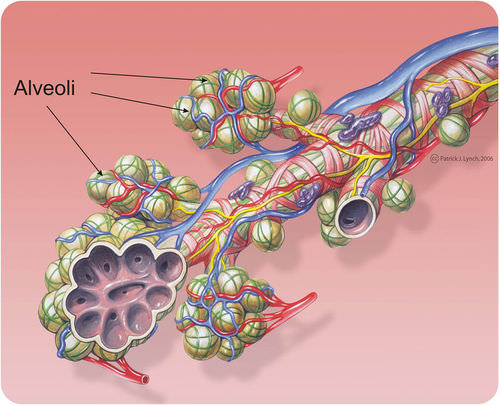
During respiration, oxygen gets pulled into the lungs and enters the blood by passing across the thin alveoli membranes and into the capillaries. The alveoli are at the end of the long air passages.
Breathing and Respiration
The process of getting oxygen into the body and releasing carbon dioxide is called respiration. Sometimes breathing is called respiration, but there is much more to respiration than just breathing. Breathing is only the movement of oxygen into the body and carbon dioxide out of the body. The process of respiration also includes the exchange of oxygen and carbon dioxide between the blood and the cells of the body.
Further Reading
Summary
- The diaphragm and rib muscles contract when you inhale and relax when you exhale.
- The process of getting oxygen into the body and releasing carbon dioxide is called respiration.
Review
- In what part of the lung does gas exchange occur?
- What causes the gases to move in the lungs during gas exchange?
- What is the difference between breathing and respiration?


