





What are the organs that help you breathe?
When you think of the processes of breathing, the lungs probably come to mind. The lungs are the main organ of the respiratory system. However, many other organs are also needed for the process of respiration to take place.
Organs of The Respiratory System
Your respiratory system is made up of the tissues and organs that allow oxygen to enter your body and carbon dioxide to leave your body. Organs in your respiratory system include your:
- Nose.
- Mouth.
- Larynx.
- Pharynx.
- Lungs.
- Diaphragm.
These structures are shown below (Figure below).
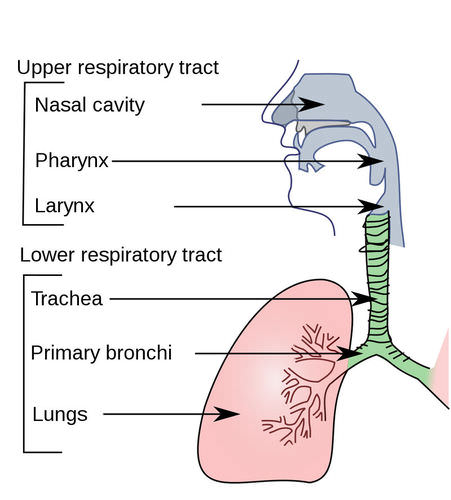
The organs of the respiratory system move air into and out of the body.
What do you think is the purpose of each of these organs?
- The nose and the nasal cavity filter, warm, and moisten the air you breathe. The nose hairs and the mucus produced by the cells in the nose catch particles in the air and keep them from entering the lungs.
- Behind the nasal cavity, air passes through the pharynx, a long tube. Both food and air pass through the pharynx.
- The larynx, also called the "voice box," is found just below the pharynx. Your voice comes from your larynx. Air from the lungs passes across thin tissues in the larynx and produces sound.
- The trachea, or windpipe, is a long tube that leads down to the lungs, where it divides into the right and left bronchi. The bronchi branch out into smaller bronchioles in each lung. There is small flap called the epiglottis that covers your trachea when you eat or drink. The muscle controlling the epiglottis is involuntary and prevents food from entering your lungs or windpipe.
- The bronchioles lead to the alveoli. Alveoli are the little sacs at the end of the bronchioles (Figure below). They look like little bunches of grapes. Oxygen is exchanged for carbon dioxide in the alveoli. That means oxygen enters the blood, and carbon dioxide moves out of the blood. The gases are exchanged between the blood and alveoli by simple diffusion.
- The diaphragm is a sheet of muscle that spreads across the bottom of the rib cage. When the diaphragm contracts, the chest volume gets larger, and the lungs take in air. When the diaphragm relaxes, the chest volume gets smaller, and air is pushed out of the lungs.
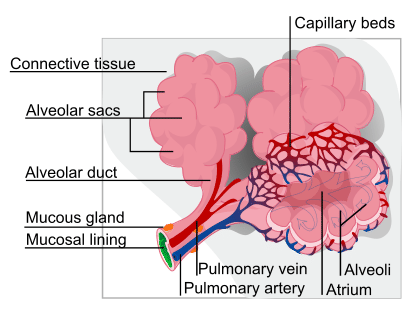
"Grape-like" alveoli in the lungs.
Summary
- The organs of the respiratory system include the lungs, pharynx, larynx, trachea, and bronchi.
Explore More
Use the resource below to answer the questions that follow.
- The Respiratory System Parts and Functions - https://www.youtube.com/watch?v=tYhqUpWuReQ
- What muscle controls the process of breathing?
- Where is the trachea located and what is its function?
- What is the relationship between the bronchi, bronchial tubes, and bronchioles? What function does this relationship serve?
- Why does air funnel into smaller and smaller spaces within the lungs?
Review
- Name four organs in the respiratory system.
- What is the trachea? What does the trachea lead into?
- What organ is known as the voice box?
- What is the diaphragm? Why is the diaphragm important?


