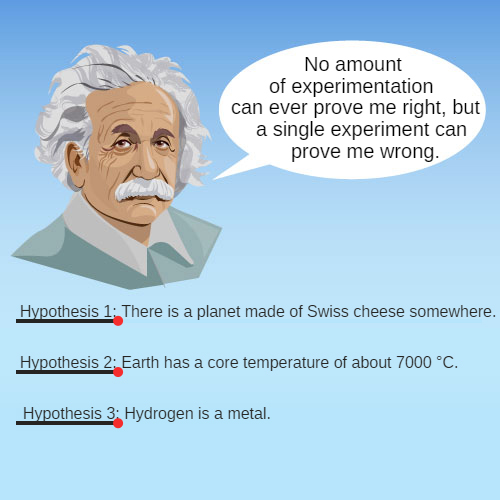
Many young scientists learn that a good scientist tries to disprove her hypothesis. This is the best way to be sure that your hypothesis is getting a rigorous test. Why do you think established scientists tell students this? Why is it a good idea?
Testing Hypothesis 1
How do you test a hypothesis? In this example, we will look into the scientific literature to find data in studies that were done using scientific method.
To test Hypothesis 1 from the concept "Development of Hypotheses," we need to see if the amount of CO2 gas released by volcanoes over the past several decades has increased.
There are two ways volcanoes could account for the increase in CO2:
There has been an increase in volcanic eruptions in that time.
The CO2 content of volcanic gases has increased over time globally.
To test the first hypothesis, we look at the scientific literature. We see that the number of volcanic eruptions is about constant. We also learn from the scientific literature that volcanic gas compositions have not changed over time. Different types of volcanoes have different gas compositions, but overall the gases are the same. Another journal article states that major volcanic eruptions for the past 30 years have caused short-term cooling, not warming!
Hypothesis 1 is wrong! Volcanic activity is not able to account for the rise in atmospheric CO2. Remember that science is falsifiable. We can discard Hypothesis 1.
Testing Hypothesis 2
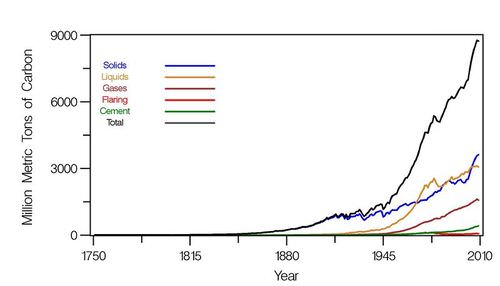
Hypothesis 2 states that the increase in atmospheric CO2 is due to the increase in the amount of fossil fuels that are being burned. We look into the scientific literature and find this graph in the Figurebelow.
Global carbon dioxide emissions from fossil fuel consumption and cement production. The black line represents all emission types combined, and colored lines show emissions from individual fossil fuels.
Fossil fuels have added an increasing amount of carbon dioxide to the atmosphere since the beginning of the Industrial Revolution in the mid 19th century. Hypothesis 2 is true!
Summary
Science is falsifiable. An incorrect hypothesis is discarded.
Carbon dioxide levels in the atmosphere are increasing due to fossil fuel burning.
Review
Think of at least one other hypothesis for why atmospheric carbon dioxide has been rising for the past several decades. How would you test that hypothesis?
If your hypothesis is shown to be true, does that mean that hypothesis 2, which states that the increase in atmospheric CO2 is due to fossil fuel burning, is wrong?
How did having multiple working hypotheses help this investigation along?
Explore More
Use this resource to answer the questions that follow.
What is the purpose of the scientific method?
What is your task?
Create a hypothesis that explains how the machine works.
What would you like to know to be able to better create a hypothesis?
What would you need to do to see if your hypothesis right?
NOTES / HIGHLIGHTS
Please Sign In to create your own Highlights / Notes
Notes/Highlights
Color
Highlighted Text
Notes
Please Sign In to create your own Highlights / Notes
Credit:T.A. Boden, G. Marland, and R.J. Andres; courtesy of the Carbon Dioxide Information Analysis Center, Oak Ridge National Laboratory, U.S. Department of Energy Source:http://cdiac.ornl.gov/trends/emis/glo.html License:Public Domain
Credit:T.A. Boden, G. Marland, and R.J. Andres; courtesy of the Carbon Dioxide Information Analysis Center, Oak Ridge National Laboratory, U.S. Department of Energy Source:http://cdiac.ornl.gov/trends/emis/glo.html License:Public Domain
 AI Teacher Tools

 FlexiA FREE Digital Tutor for Every Student
 FlexBooks 2.0Customizable, digital textbooks in a new, interactive platform
 FlexBooksCustomizable, digital textbooks
 SchoolsFlexBooks from schools and districts near you
 Study GuidesQuick review with key information for each concept
 Adaptive PracticeBuilding knowledge at each student’s skill level
 SimulationsInteractive Physics & Chemistry Simulations
 PLIXPlay. Learn. Interact. eXplore.
 CCSS MathConcepts and FlexBooks aligned to Common Core
 NGSSConcepts aligned to Next Generation Science Standards
 Certified EducatorStand out as an educator. Become CK-12 Certified.
 WebinarsLive and archived sessions to learn about CK-12