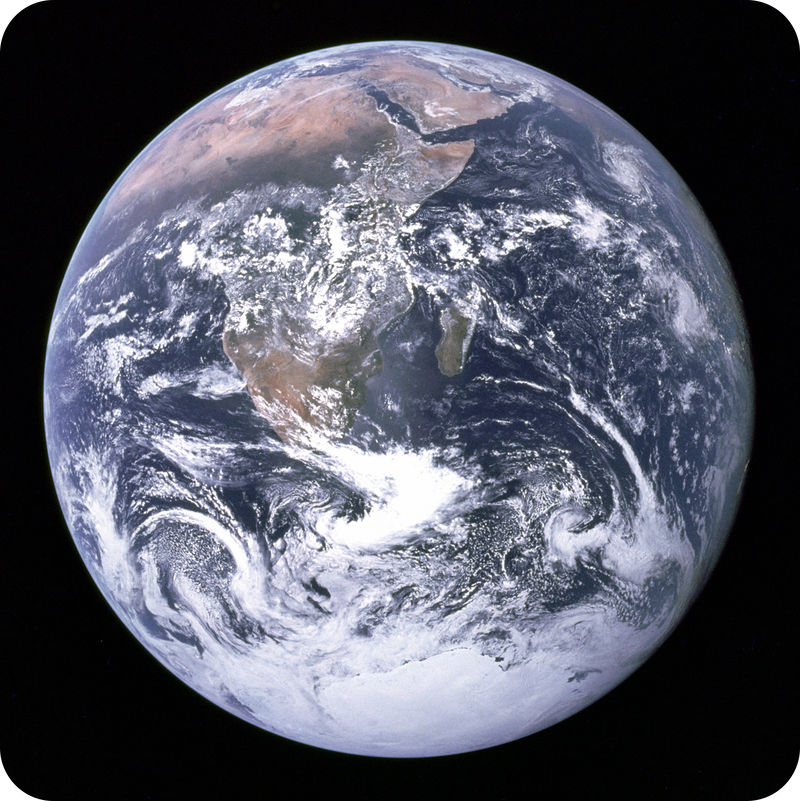
4.6 billion years old. Arriving at this number wasn't easy but there are many lines of evidence that have allowed scientists to reach that conclusion.
Indirect Estimates
During the 18th and 19th centuries, geologists tried to estimate the age of Earth with indirect techniques. What methods can you think of for doing this? One example is that by measuring how much sediment a stream deposited in a year, a geologist might try to determine how long it took for a stream to deposit an ancient sediment layer. Not surprisingly, these methods resulted in wildly different estimates. A relatively good estimate was produced by the British geologist Charles Lyell, who thought that 240 million years had passed since the appearance of the first animals with shells. Today scientists know that this event occurred about 530 million years ago.
In 1892, William Thomson (later known as Lord Kelvin) calculated that the Earth was 100 million years old, which he later lowered to 20 million years. He did this systematically assuming that the planet started off as a molten ball and calculating the time it would take for it to cool to its current temperature. This estimate was a blow to geologists and supporters of Charles Darwin’s theory of evolution, which required an older Earth to provide time for geological and evolutionary processes to take place.
Kelvin’s calculations were soon shown to be flawed when radioactivity was discovered in 1896. What Kelvin didn't know is that radioactive decay of elements inside Earth’s interior provides a steady source of heat. He also didn't know that the mantle is able to flow and so convection moves heat from the interior to the surface of the planet. Thomson had grossly underestimated Earth’s age.
More Quantitatively
Radioactivity turned out to be useful for dating Earth materials and for coming up with a quantitative age for Earth. Scientists not only date ancient rocks from Earth's crust, they also date meteorites that formed at the same time Earth and the rest of the solar system were forming. Moon rocks also have been radiometrically dated.
Using a combination of radiometric dating, index fossils, and superposition, geologists have constructed a well-defined timeline of Earth history. With information gathered from all over the world, estimates of rock and fossil ages have become increasingly accurate. This is the modern geologic time scale with all of the ages.
Summary
Early geologists estimated Earth's age in a variety of inaccurate ways like the amount of time it might take for a sediment layer to be deposited.
Estimates of how long it would take for a molten Earth to cool were also too young since scientists didn't know about radioactivity.
Radiometric dating of meteorites and Moon rocks indicate that Earth is 4.6 billion years old.
Review
How do scientists know that Earth is 4.6 billion years old?
Why was Lord Kelvin's estimate of Earth's age too young?
How does the modern geologic time scale differ from the original?
Explore More
Use this resource to answer the questions that follow.
How does comparative dating indicate that Earth is old?
How does dendrochronology show that Earth is older than 6,000 years?
How does carbon dating show Earth is older than 6,000 years?
How do we know that carbon dating works?
Why aren't coal and diamonds dated using the C-14 method?
Where does DNA dating lead human ancestors to?
What is paleomagnetic dating?
What is potassium-argon dating useful for?
What has been found with radiometric dating?
What do creation scientists need to do to show that Earth is actually young?
Resources
Notes/Highlights
Color
Highlighted Text
Notes
Please Sign In to create your own Highlights / Notes

 FlexiA FREE Digital Tutor for Every Student
 FlexBooks 2.0Customizable, digital textbooks in a new, interactive platform
 FlexBooksCustomizable, digital textbooks
 SchoolsFlexBooks from schools and districts near you
 Study GuidesQuick review with key information for each concept
 Adaptive PracticeBuilding knowledge at each student’s skill level
 SimulationsInteractive Physics & Chemistry Simulations
 PLIXPlay. Learn. Interact. eXplore.
 CCSS MathConcepts and FlexBooks aligned to Common Core
 NGSSConcepts aligned to Next Generation Science Standards
 Certified EducatorStand out as an educator. Become CK-12 Certified.
 WebinarsLive and archived sessions to learn about CK-12