How you date a rock depends on what type of rock it is and how old it might be. Different radioactive isotopes have different half lives and so they are useful for dating different types and ages of rocks. Who would want to? Why, geologists, of course!
Radiometric Dating of Rocks
Radiometric dating is the process of using the concentrations of radioactive substances and daughter products to estimate the age of a material. Different isotopes are used to date materials of different ages. Using more than one isotope helps scientists to check the accuracy of the ages that they calculate.
Radiocarbon Dating
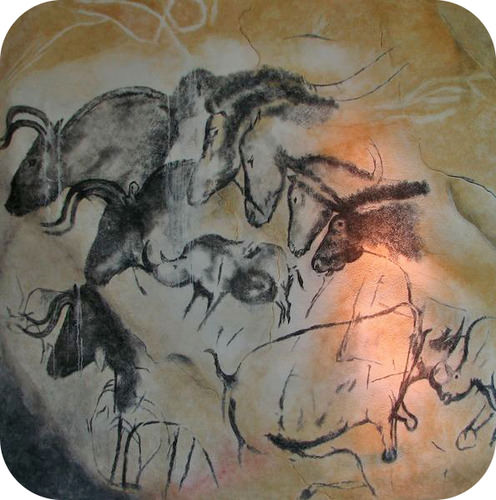
Radiocarbon dating is used to find the age of once-living materials between 100 and 50,000 years old. This range is especially useful for determining ages of human fossils and habitation sites (Figurebelow).
Carbon isotopes from the black material in these cave paintings places their creating at about 26,000 to 27,000 years BP (before present).
The atmosphere contains three isotopes of carbon: carbon-12, carbon-13 and carbon-14. Only carbon-14 is radioactive; it has a half-life of 5,730 years. The amount of carbon-14 in the atmosphere is tiny and has been relatively stable through time.
Plants remove all three isotopes of carbon from the atmosphere during photosynthesis. Animals consume this carbon when they eat plants or other animals that have eaten plants. After the organism’s death, the carbon-14 decays to stable nitrogen-14 by releasing a beta particle. The nitrogen atoms are lost to the atmosphere, but the amount of carbon-14 that has decayed can be estimated by measuring the proportion of radioactive carbon-14 to stable carbon-12. As time passes, the amount of carbon-14 decreases relative to the amount of carbon-12.
Potassium-Argon Dating
Potassium-40 decays to argon-40 with a half-life of 1.26 billion years. Argon is a gas so it can escape from molten magma, meaning that any argon that is found in an igneous crystal probably formed as a result of the decay of potassium-40. Measuring the ratio of potassium-40 to argon-40 yields a good estimate of the age of that crystal.
Potassium is common in many minerals, such as feldspar, mica, and amphibole. With its half-life, the technique is used to date rocks from 100,000 years to over a billion years old. The technique has been useful for dating fairly young geological materials and deposits containing the bones of human ancestors.
Uranium-Lead Dating
Two uranium isotopes are used for radiometric dating.
Uranium-238 decays to lead-206 with a half-life of 4.47 billion years.
Uranium-235 decays to form lead-207 with a half-life of 704 million years.
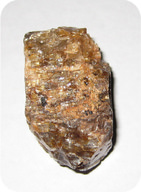
Uranium-lead dating is usually performed on zircon crystals (Figurebelow). When zircon forms in an igneous rock, the crystals readily accept atoms of uranium but reject atoms of lead. If any lead is found in a zircon crystal, it can be assumed that it was produced from the decay of uranium.
Zircon crystal.
Uranium-lead dating is useful for dating igneous rocks from 1 million years to around 4.6 billion years old. Zircon crystals from Australia are 4.4 billion years old, among the oldest rocks on the planet.
Limitations of Radiometric Dating
Radiometric dating is a very useful tool for dating geological materials but it does have limits:
The material being dated must have measurable amounts of the parent and/or the daughter isotopes. Ideally, different radiometric techniques are used to date the same sample; if the calculated ages agree, they are thought to be accurate.
Radiometric dating is not very useful for determining the age of sedimentary rocks. To estimate the age of a sedimentary rock, geologists find nearby igneous rocks that can be dated and use relative dating to constrain the age of the sedimentary rock.
Using Radiometric Ages to Date Other Materials
As you've learned, radiometric dating can only be done on certain materials. But these important numbers can still be used to get the ages of other materials! How would you do this? One way is to constrain a material that cannot be dated by one or more that can. For example, if sedimentary rock A is below volcanic rock B and the age of volcanic rock B is 2.0 million years, then you know that sedimentary rock A is older than 2.0 million years. If sedimentary rock A is above volcanic rock C and it's age is 2.5 million years then you know that sedimentary rock A is between 2.0 and 2.5 million years. In this way, geologists can figure out the approximate ages of many different rock formations.
Summary
Radiocarbon is useful for relatively young, carbon-based materials; other longer-lived isotopes are good for older rocks and minerals.
Different isotope pairs are useful for certain materials of certain ages.
Radiometric dating cannot be used if parent or daughter are not measurable or if one or the other has been lost from the system.
Review
How would you determine which isotope pair to use for a particular material?
How does potassium-argon dating work and on what materials does it work best on?
What types of rocks are best for radiometric dating and why?
Explore More
Use this resource to answer the questions that follow.
What is radiocarbon dating?
What are the three isotopes of carbon and how many protons and neutrons do they each have? Which isotope of carbon is not stable?
How does carbon-14 form?
Why is carbon-14 used for radiocarbon dating?
How does carbon get into a living thing? How does carbon-14 get into a living thing?
How much carbon-14 is in your body when you are alive? What happens to the carbon-14 in your body after you die?
What is the half life of carbon-14?
What's the greatest age that a thing can be to be able to be dated by carbon-14?
How do we know that carbon-14 dating is accurate?
Why can't you use radiocarbon dating on an object from 1965?
Resources
Vocabulary
termdefinition
radiometric datingprocess of using the concentrations of radioactive substances and daughter products to estimate the age of a material.
Notes/Highlights
Color
Highlighted Text
Notes
Please Sign In to create your own Highlights / Notes


 FlexiA FREE Digital Tutor for Every Student
 FlexBooks 2.0Customizable, digital textbooks in a new, interactive platform
 FlexBooksCustomizable, digital textbooks
 SchoolsFlexBooks from schools and districts near you
 Study GuidesQuick review with key information for each concept
 Adaptive PracticeBuilding knowledge at each student’s skill level
 SimulationsInteractive Physics & Chemistry Simulations
 PLIXPlay. Learn. Interact. eXplore.
 CCSS MathConcepts and FlexBooks aligned to Common Core
 NGSSConcepts aligned to Next Generation Science Standards
 Certified EducatorStand out as an educator. Become CK-12 Certified.
 WebinarsLive and archived sessions to learn about CK-12