Pierre and Marie Curie, a husband and wife team of physicists, discovered the spontaneous emission of particles from certain elements. They called this phenomenon "radioactivity." Together they won three Nobel prizes, and the element curium was named in their honor.
Radioactive Decay
Radioactivity is the tendency of certain atoms to decay into lighter atoms, a process that emits energy. Radioactivity also provides a way to find the absolute age of a rock. First, we need to know about radioactive decay.
Radioactive Isotopes
Some isotopes are radioactive; radioactive isotopes are unstable and spontaneously change by gaining or losing particles. Two types of radioactive decay are relevant to dating Earth materials (Tablebelow):
Types of Radioactive Decay
Particle
Composition
Effect on Nucleus
Alpha
2 protons, 2 neutrons
The nucleus contains two fewer protons and two fewer neutrons.
Beta
1 electron
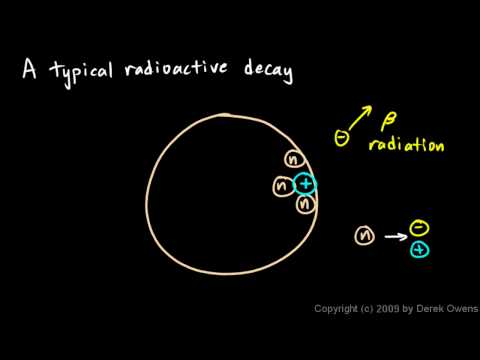
One neutron decays to form a proton and an electron. The electron is emitted.
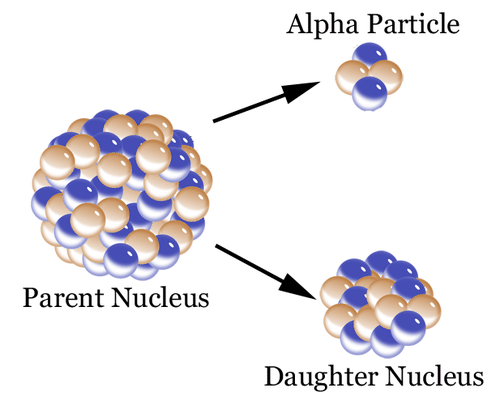
The radioactive decay of a parent isotope (the original element) leads to the formation of stable daughter product, also known as daughter isotope. As time passes, the number of parent isotopes decreases and the number of daughter isotopes increases (Figurebelow).
A parent emits an alpha particle to create a daughter.
Half-Lives
Radioactive materials decay at known rates, measured as a unit called half-life. The half-life of a radioactive substance is the amount of time it takes for half of the parent atoms to decay. This is how the material decays over time (see Tablebelow).
Radioactive Decay
No. of half lives passed
Percent parent remaining
Percent daughter produced
0
100
0
1
50
50
2
25
75
3
12.5
87.5
4
6.25
93.75
5
3.125
96.875
6
1.563
98.437
7
0.781
99.219
8
0.391
99.609
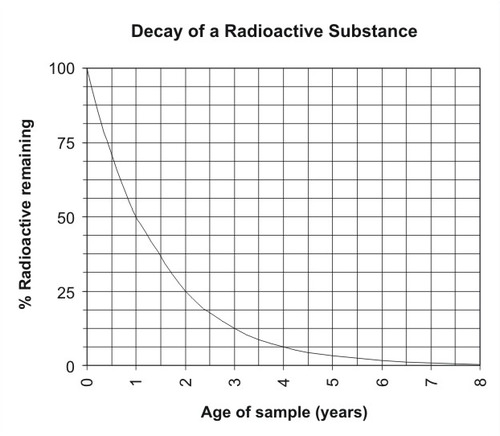
Pretend you find a rock with 3.125% parent atoms and 96.875% daughter atoms. How many half lives have passed? If the half-life of the parent isotope is 1 year, then how old is the rock? The decay of radioactive materials can be shown with a graph (Figurebelow).
Decay of an imaginary radioactive substance with a half-life of one year.
Notice how it doesn’t take too many half lives before there is very little parent remaining and most of the isotopes are daughter isotopes. This limits how many half lives can pass before a radioactive element is no longer useful for dating materials. Fortunately, different isotopes have very different half lives.
Summary
A half life is the time it takes for half of the parent isotopes of an element to change to daughter isotopes.
With alpha decay, the nucleus loses two protons and two neutrons; with beta decay only one electron is lost.
Radiometric decay is exponential.
Review
Describe the two types of radioactive decay that are relevant to dating earth materials.
For how many half lives is a set of parent and daughter isotopes useful as a system of dating?
What does it mean that radioactive decay is exponential?
Explore More
Use this resource to answer the questions that follow.
What is radiation?
How is radiation detected?
What happens to the ratio between protons and neutrons between smaller atoms and larger atoms?
Why does a large nucleus lose neutrons?
What is alpha decay and what charge and mass does it have?
What is beta decay and what charge and mass does it have?
What is gamma radiation and what charge and mass does it have?
What type of radiation does U-238 undergo? What does it lose?
Why does U-238 become Th-234?
Why does Cs-137 become Ba-137?
Why does Na-11 become Ne-12?
NOTES / HIGHLIGHTS
Please Sign In to create your own Highlights / Notes
Vocabulary
termdefinition
daughter productthe product of the radioactive decay of a parent isotope.
half-lifethe amount of time required for half of the atoms of a radioactive substance to decay to the daughter product.
parent isotopean unstable isotope that will undergo radioactive decay.
radioactive isotopesubstance that is unstable and likely to decay into another isotope.
radioactivitythe spontaneous emission of high energy particles from an unstable atomic nucleus.
Notes/Highlights
Color
Highlighted Text
Notes
Please Sign In to create your own Highlights / Notes


 FlexiA FREE Digital Tutor for Every Student
 FlexBooks 2.0Customizable, digital textbooks in a new, interactive platform
 FlexBooksCustomizable, digital textbooks
 SchoolsFlexBooks from schools and districts near you
 Study GuidesQuick review with key information for each concept
 Adaptive PracticeBuilding knowledge at each student’s skill level
 SimulationsInteractive Physics & Chemistry Simulations
 PLIXPlay. Learn. Interact. eXplore.
 CCSS MathConcepts and FlexBooks aligned to Common Core
 NGSSConcepts aligned to Next Generation Science Standards
 Certified EducatorStand out as an educator. Become CK-12 Certified.
 WebinarsLive and archived sessions to learn about CK-12