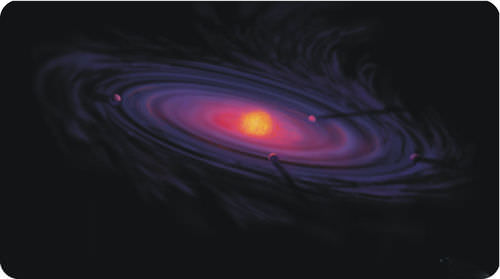
No! Although our Solar System formed nearly 5 billion years ago, we can see stars forming elsewhere in the galaxy, such as in the Large Magellanic cloud 160,000 light years away. Although we can't know for sure, astronomers think that our early solar system looked very much like this.
Formation of the Solar System
The most widely accepted explanation of how the solar system formed is called the nebular hypothesis. According to this hypothesis, the Sun and the planets of our solar system formed about 4.6 billion years ago from the collapse of a giant cloud of gas and dust, called a nebula.
The nebula was drawn together by gravity, which released gravitational potential energy. As small particles of dust and gas smashed together to create larger ones, they released kinetic energy. As the nebula collapsed, the gravity at the center increased and the cloud started to spin because of its angular momentum. As it collapsed further, the spinning got faster, much as an ice skater spins faster when he pulls his arms to his sides during a spin.
Much of the cloud’s mass migrated to its center but the rest of the material flattened out in an enormous disk. The disk contained hydrogen and helium, along with heavier elements and even simple organic molecules.
Formation of the Sun and Planets
As gravity pulled matter into the center of the disk, the density and pressure at the center became intense. When the pressure in the center of the disk was high enough, nuclear fusion began. A star was born—the Sun. The burning star stopped the disk from collapsing further.
An artist’s painting of a protoplanetary disk.
Meanwhile, the outer parts of the disk were cooling off. Matter condensed from the cloud and small pieces of dust started clumping together. These clumps collided and combined with other clumps. Larger clumps, called planetesimals, attracted smaller clumps with their gravity. Gravity at the center of the disk attracted heavier particles, such as rock and metal and lighter particles remained further out in the disk. Eventually, the planetesimals formed protoplanets, which grew to become the planets and moons that we find in our solar system today.
Because of the gravitational sorting of material, the inner planets — Mercury, Venus, Earth, and Mars — formed from dense rock and metal. The outer planets — Jupiter, Saturn, Uranus and Neptune — condensed farther from the Sun from lighter materials such as hydrogen, helium, water, ammonia, and methane. Out by Jupiter and beyond, where it’s very cold, these materials form solid particles.
The nebular hypothesis was designed to explain some of the basic features of the solar system:
The orbits of the planets lie in nearly the same plane with the Sun at the center
The planets revolve in the same direction
The planets mostly rotate in the same direction
The axes of rotation of the planets are mostly nearly perpendicular to the orbital plane
A giant cloud of dust and gas, called a nebula, collapsed to form the solar system; this is the nebular hypothesis.
The nebular hypothesis explains many of the features of the solar system like the orbital plane, the revolution and rotation of the planets, the relationship of the axes of rotation and the orbital plane and the age of moon rocks.
Planets nearer the Sun are similar because they formed of denser metal and rocks, but planets further out are lighter and gaseous.
Review
What is the nebular hypothesis?
Why did the solar system form two very different groups of planets, the inner and outer planets?
How does the nebular hypothesis account for the observable features of the solar system?
Explore More
Use this resource to answer the questions that follow.
How old is the story of our solar system?
Why does the story of our solar system start with an exploding star?
What was the early Earth made of and how did it come together?
What was happening at the heart of the nebula?
What happened when the sun ignited?
Where and what names are the huge gas planets?
What are the inner planets and what are they made of?
How long will the sun burn in all?
Resources
Vocabulary
termdefinition
nebulacloud of dust and gas where stars form in space.
nebular hypothesishypothesis that our solar system formed from a spinning cloud of gas and dust called a nebula.
Notes/Highlights
Color
Highlighted Text
Notes
Please Sign In to create your own Highlights / Notes


 FlexiA FREE Digital Tutor for Every Student
 FlexBooks 2.0Customizable, digital textbooks in a new, interactive platform
 FlexBooksCustomizable, digital textbooks
 SchoolsFlexBooks from schools and districts near you
 Study GuidesQuick review with key information for each concept
 Adaptive PracticeBuilding knowledge at each student’s skill level
 SimulationsInteractive Physics & Chemistry Simulations
 PLIXPlay. Learn. Interact. eXplore.
 CCSS MathConcepts and FlexBooks aligned to Common Core
 NGSSConcepts aligned to Next Generation Science Standards
 Certified EducatorStand out as an educator. Become CK-12 Certified.
 WebinarsLive and archived sessions to learn about CK-12