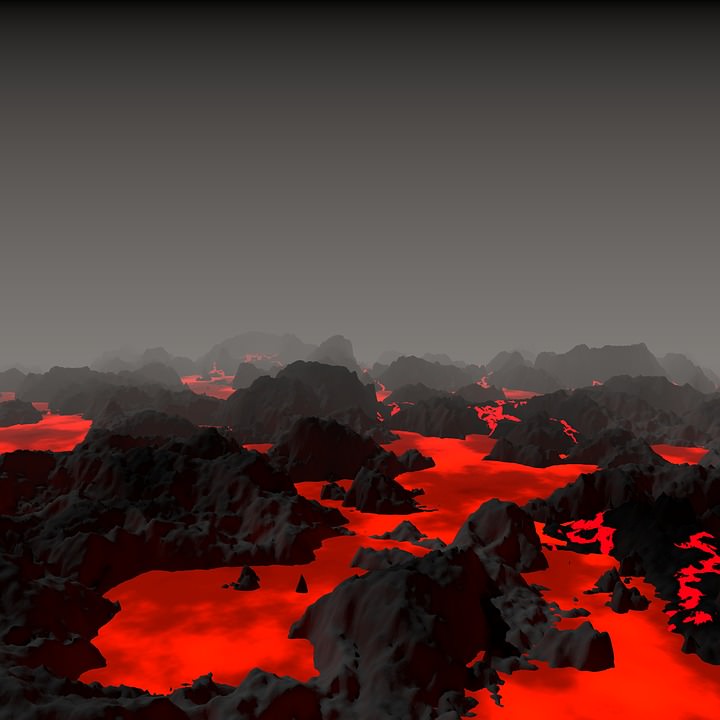
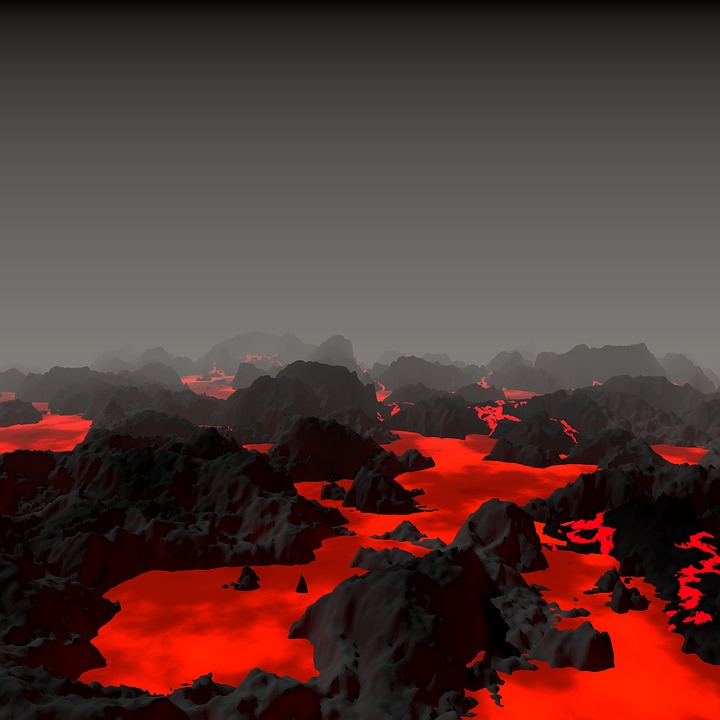
Earth was not always the moderate and habitable planet it is today. In its earliest days, Earth was scorching hot and without an atmosphere or water. If life originated early on, it was wiped out by the terrible conditions.
Formation of Earth
Earth formed at the same time as the other planets. The history of Earth is part of the history of the Solar System.
Planets Form
Earth came together (accreted) from the cloud of dust and gas known as the solar nebula nearly 4.6 billion years ago, the same time the Sun and the rest of the solar system formed. Gravity caused small bodies of rock and metal orbiting the proto-Sun to smash together to create larger bodies. Over time, the planetoids got larger and larger until they became planets.
Molten Earth
When Earth first came together it was really hot, hot enough to melt the metal elements that it contained. Earth was so hot for three reasons:
Gravitational contraction: As small bodies of rock and metal accreted, the planet grew larger and more massive. Gravity within such an enormous body squeezes the material in its interior so hard that the pressure swells. As Earth’s internal pressure grew, its temperature also rose.
Radioactive decay: Radioactive decay releases heat, and early in the planet’s history there were many radioactive elements with short half lives. These elements long ago decayed into stable materials, but they were responsible for the release of enormous amounts of heat in the beginning.
Bombardment: Ancient impact craters found on the Moon and inner planets indicate that asteroid impacts were common in the early solar system. Earth was struck so much in its first 500 million years that the heat was intense. Very few large objects have struck the planet in the past many hundreds of millions of year.
Differentiation
When Earth was entirely molten, gravity drew denser elements to the center and lighter elements rose to the surface. The separation of Earth into layers based on density is known as differentiation. The densest material moved to the center to create the planet’s dense metallic core. Materials that are intermediate in density became part of the mantle (Figurebelow).
Earth’s interior: Inner core, outer core, mantle, and crust.
First Crust
Lighter materials accumulated at the surface of the mantle to become the earliest crust. The first crust was probably basaltic, like the oceanic crust is today. Intense heat from the early core drove rapid and vigorous mantle convection so that crust quickly recycled into the mantle. The recycling of basaltic crust was so effective that no remnants of it are found today.
Early Solar System Materials
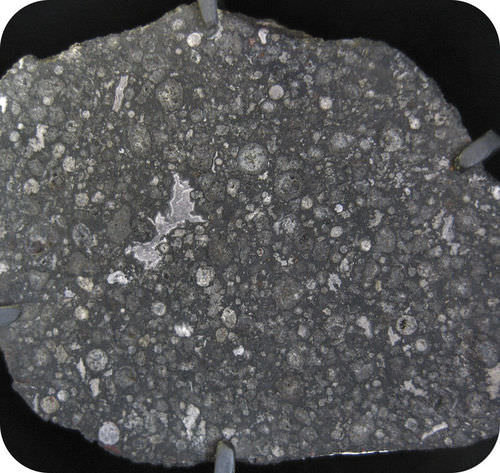
There is not much material to let us know about the earliest days of our planet Earth. What there is comes from three sources: (1) zircon crystals, the oldest materials found on Earth, which show that the age of the earliest crust formed at least 4.4 billion years ago; (2) meteorites that date from the beginning of the solar system, to nearly 4.6 billion years ago (Figurebelow); and (3) lunar rocks, which represent the early days of the Earth-Moon system as far back as 4.5 billion years ago.
The Allende Meteorite is a carbonaceous chondrite that struck Earth in 1969. The calcium-aluminum-rich inclusions are fragments of the earliest solar system.
Summary
In the beginning, Earth was exceedingly hot due to gravitational contraction, the radioactive decay of short-lived isotopes, and bombardment from meteorites.
The molten Earth separated into layers by density in a process known as differentiation.
We know about the early Earth from zircon crystals, meteorites that originated elsewhere in the solar system, and moon rocks.
Review
Radioactive elements inside the planet release heat now, but why was so much more heat released earlier in Earth's history that is released now?
Describe how and why Earth material separated into layers.
How do zircon crystals indicate when the first crust formed?
Resources
NOTES / HIGHLIGHTS
Please Sign In to create your own Highlights / Notes
Vocabulary
termdefinition
differentiationprocess by which unspecialized cells become specialized into one of many different types of cells, such as neurons or epithelial cells.
Notes/Highlights
Color
Highlighted Text
Notes
Please Sign In to create your own Highlights / Notes


 FlexiA FREE Digital Tutor for Every Student
 FlexBooks 2.0Customizable, digital textbooks in a new, interactive platform
 FlexBooksCustomizable, digital textbooks
 SchoolsFlexBooks from schools and districts near you
 Study GuidesQuick review with key information for each concept
 Adaptive PracticeBuilding knowledge at each student’s skill level
 SimulationsInteractive Physics & Chemistry Simulations
 PLIXPlay. Learn. Interact. eXplore.
 CCSS MathConcepts and FlexBooks aligned to Common Core
 NGSSConcepts aligned to Next Generation Science Standards
 Certified EducatorStand out as an educator. Become CK-12 Certified.
 WebinarsLive and archived sessions to learn about CK-12