These ancient greenstones are metamophosed pillow lavas from much earlier in Earth history. These rocks are found in eastern Canada and similar rocks are found in cratons around the world.
Early Continents
The first crust was made of basaltic rock, like the current ocean crust. Partial melting of the lower portion of the basaltic crust began more than 4 billion years ago. This created the silica-rich crust that became the felsic continents.
Craton
The earliest felsic continental crust is now found in the ancient cores of continents, called the cratons. Rapid plate motions meant that cratons experienced many continental collisions. Little is known about the paleogeography, or the ancient geography, of the early planet, although smaller continents could have come together and broken up.
Geologists can learn many things about the Pre-Archean by studying the rocks of the cratons.
Cratons also contain felsic igneous rocks, which are remnants of the first continents.
Cratonic rocks contain rounded sedimentary grains. Of what importance is this fact? Rounded grains indicate that the minerals eroded from an earlier rock type and that rivers or seas also existed.
One common rock type in the cratons is greenstone, a metamorphosed volcanic rock (Figurebelow). Since greenstones are found today in oceanic trenches, what does the presence of greenstones mean? These ancient greenstones indicate the presence of subduction zones.
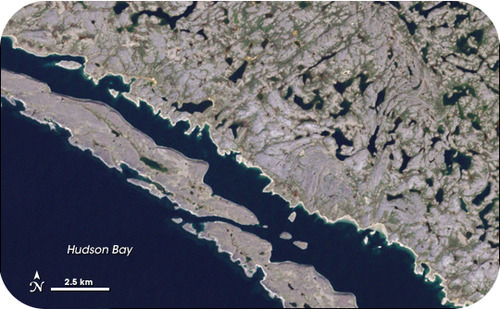
Ice age glaciers scraped the Canadian Shield down to the 4.28 billion year old greenstone in Northwestern Quebec.
Shield
Places the craton crops out at the surface is known as a shield. Cratons date from the Precambrian and are called Precambrian shields. Many Precambrian shields are about 570 million years old (Figurebelow).
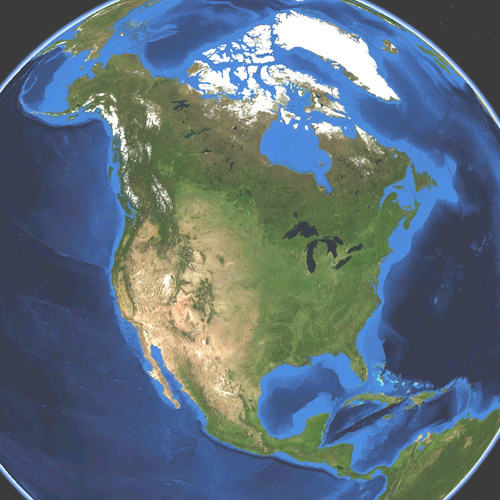
The Canadian Shield is the ancient flat part of Canada that lies around Hudson Bay, the northern parts of Minnesota, Wisconsin and Michigan and much of Greenland.
Platform
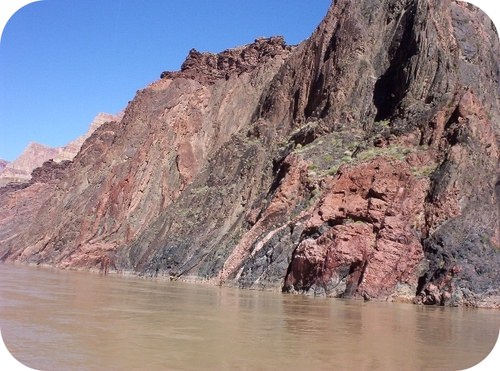
In most places the cratons were covered by younger rocks, which together are called a platform. Sometimes the younger rocks eroded away to expose the Precambrian craton (Figurebelow).
The Precambrian craton is exposed in the Grand Canyon where the Colorado River has cut through the younger sedimentary rocks.
Early Convection
During the Pre-Archean and Archean, Earth’s interior was warmer than today. Mantle convection was faster and plate tectonics processes were more vigorous. Since subduction zones were more common, the early crustal plates were relatively small.
Since the time that it was completely molten, Earth has been cooling. Still, about half the internal heat that was generated when Earth formed remains in the planet and is the source of the heat in the core and mantle today.
Summary
The ancient core of a continent, at and beneath the surface, is its craton.
The cratonic rock that is seen at the surface is called the shield. Where the shield is covered by younger sediments is the platform.
Convection on early Earth was faster and so plate tectonics was faster. Since then, Earth has been cooling.
Review
Why is it that the felsic continental crust could not be Earth's first crust?
What are greenstones and why are they important in understanding early Earth history?
Why was plate tectonics more vigorous in the early Earth? What would plate tectonics have been like?
Resources
Vocabulary
termdefinition
cratonearliest continental crust found in the ancient cores of continents; ancient Precambrian felsic continental crust.
greenstonea metamorphosed volcanic rock that forms at a subduction zone
paleogeographythe arrangement of the continents; ancient geography.
platforma craton and its overlying younger sedimentary rocks.
shieldthe part of a craton that crops out at the surface.
Notes/Highlights
Color
Highlighted Text
Notes
Please Sign In to create your own Highlights / Notes


 FlexiA FREE Digital Tutor for Every Student
 FlexBooks 2.0Customizable, digital textbooks in a new, interactive platform
 FlexBooksCustomizable, digital textbooks
 SchoolsFlexBooks from schools and districts near you
 Study GuidesQuick review with key information for each concept
 Adaptive PracticeBuilding knowledge at each student’s skill level
 SimulationsInteractive Physics & Chemistry Simulations
 PLIXPlay. Learn. Interact. eXplore.
 CCSS MathConcepts and FlexBooks aligned to Common Core
 NGSSConcepts aligned to Next Generation Science Standards
 Certified EducatorStand out as an educator. Become CK-12 Certified.
 WebinarsLive and archived sessions to learn about CK-12