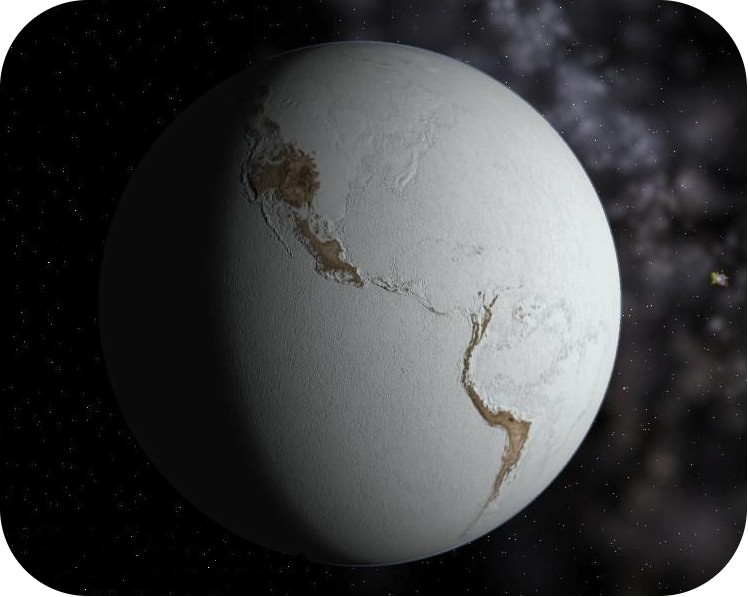
Was Earth ever so cold that it was completely encased in ice?
There is a hypothesis that much of the planet was covered by ice at the end of the Precambrian. This hypothesis is called Snowball Earth. One line of evidence is the rapid evolution of life in the Ediacara and Cambrian periods. It is thought that when the ice melted and conditions were favorable, life evolved rapidly.
Precambrian Plate Tectonics
By the end of the Archean, about 2.5 billion years ago, plate tectonics processes were completely recognizable. Small Proterozoic continents known as microcontinents collided to create supercontinents, which resulted in the uplift of massive mountain ranges.
The history of the North American craton is an example of what generally happened to the cratons during the Precambrian. As the craton drifted, it collided with microcontinents and oceanic island arcs, which were added to the continents. Convergence was especially active between 1.5 and 1.0 billion years ago. These lands came together to create the continent of Laurentia.
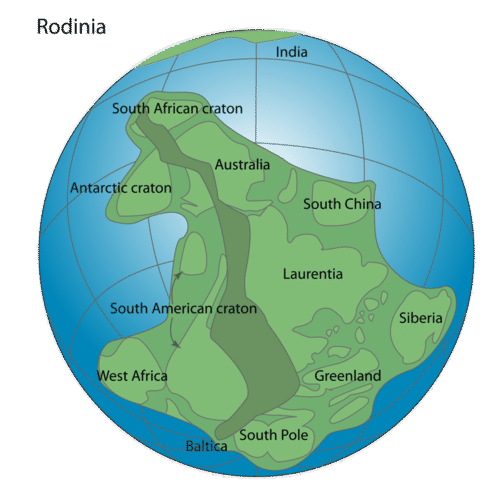
About 1.1 billion years ago, Laurentia became part of the supercontinent Rodinia (Figurebelow). Rodinia probably contained all of the landmass at the time, which was about 75% of the continental landmass present today.
Rodinia as it came together about 1.1 billion years ago.
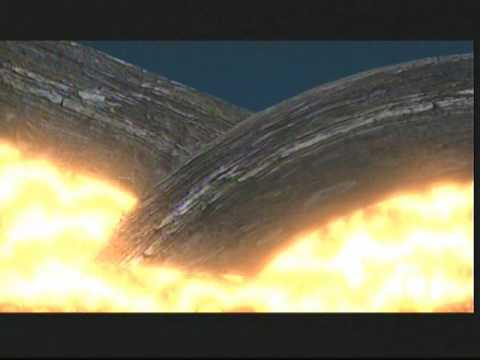
Rodinia broke up about 750 million years ago. The geological evidence for this breakup includes large lava flows that are found where continental rifting took place. Seafloor spreading eventually started and created the oceans between the continents.
The breakup of Rodinia may have triggered Snowball Earth around 700 million years ago.
Summary
About 2 billion years after Earth formed, plate tectonics processes were similar to those around today.
Microcontinents collided together to create larger continents and supercontinents.
The supercontinent of Rodinia came together about 1.1 billion years ago and broke apart about 750 million years ago.
Review
Why did it take 2 billion years for plate tectonics to be similar to the way it is today?
What evidence is there for Snowball Earth? What evidence would you look for to test the hypothesis?
How did Rodinia break apart and what is the evidence for that?
Explore More
Use this resource to answer the questions that follow.
What were the landmasses like at 2.5 billion years ago?
What formed at 2.0 billion years?
What was the next continent to form?
What happened 1.8 billion years ago?
What continents came together 1 billion years ago to form a supercontinent of what name?
What happened after the supercontinent of Rodinia split up?
Vocabulary
termdefinition
microcontinentfragment of continental crust that may attach to a continent and cause it to grow.
supercontinentvery large continent created by several continents and microcontinents coming together because of plate tectonics.
Notes/Highlights
Color
Highlighted Text
Notes
Please Sign In to create your own Highlights / Notes


 FlexiA FREE Digital Tutor for Every Student
 FlexBooks 2.0Customizable, digital textbooks in a new, interactive platform
 FlexBooksCustomizable, digital textbooks
 SchoolsFlexBooks from schools and districts near you
 Study GuidesQuick review with key information for each concept
 Adaptive PracticeBuilding knowledge at each student’s skill level
 SimulationsInteractive Physics & Chemistry Simulations
 PLIXPlay. Learn. Interact. eXplore.
 CCSS MathConcepts and FlexBooks aligned to Common Core
 NGSSConcepts aligned to Next Generation Science Standards
 Certified EducatorStand out as an educator. Become CK-12 Certified.
 WebinarsLive and archived sessions to learn about CK-12