During the Paleozoic the continents were joined and they were not in their current latitudes. In the late Cambrian, for example, they were clustered around the south polar region. It's probably just chance that they found their way there. This was hundreds of millions of years before the first human expedition reached the South Pole in 1911.
The Paleozoic
The Paleozoic is the furthest back era of the Phanerozoic and it lasted the longest. But the Paleozoic was relatively recent, beginning only 570 million years ago. Compared with the long expanse of the Precambrian, the Phanerozoic is recent history. Much more geological evidence is available for scientists to study so the Phanerozoic is much better known.
The Paleozoic begins and ends with a supercontinent. At the beginning of the Paleozoic, the supercontinent Rodinia began to split up. At the end, Pangaea came together.
Formation of Pangaea
A mountain-building event is called an orogeny. Orogenies take place over tens or hundreds of millions of years. As continents smash into microcontinents and island arcs collided, mountains rise.
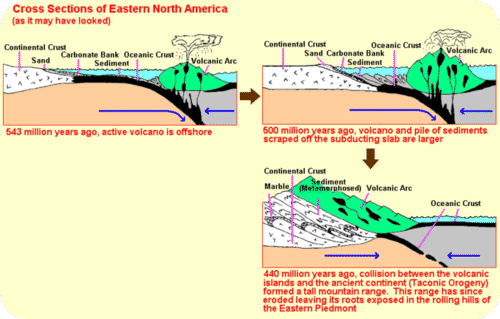
Geologists find evidence for the orogenies that took place while Pangaea was forming in many locations. For example, Laurentia collided with the Taconic Island Arc during the Taconic Orogeny (Figurebelow). The remnants of this mountain range make up the Taconic Mountains in New York.
The Taconic Orogeny is an example of a collision between a continent and a volcanic island arc.
Laurentia experienced other orogenies as it merged with the northern continents. The southern continents came together to form Gondwana. When Laurentia and Gondwana collided to create Pangaea, the Appalachians rose. Geologists think they may once have been higher than the Himalayas are now.
Pangaea
Pangaea was the last supercontinent on Earth. Evidence for the existence of Pangaea was what Alfred Wegener used to create his continental drift hypothesis, which was described in the chapter Plate Tectonics.
As the continents move and the land masses change shape, the shape of the oceans changes too. During the time of Pangaea, about 250 million years ago, most of Earth’s water was collected in a huge ocean called Panthalassa (Figurebelow).
Pangaea was the sole landform 250 million years ago, leaving a huge ocean called Panthalassa, along with a few smaller seas.
Summary
The Paleozoic began with the supercontinent Rodinia and ended with the supercontinent Pangaea.
As continents come together, orogenies build up mountain ranges.
Pangaea was a giant landmass made of all of the continents around 250 million years ago.
Review
What happens to create an orogeny? How are plate tectonics processes related to orogenies?
How did Pangaea come together?
How is the creation of Pangaea related to events like the Taconic orogeny?
Explore More
Use this resource (watch up to 8:44) to answer the questions that follow.
What were the continents like at the beginning of the Mesozoic?
How did the area between North/South America and Eurasia/Africa evolve from 200 million years ago to 150 million years ago to 90 million years ago?
Why did a desert exist in the region of the Sahara and the United Kingdom 250 million years ago?
Why is the Grand Canyon important? What is displayed there from 265 million years ago?
What does this video present as the reason for the mass extinction at the end of the Permian?
Resources
Vocabulary
termdefinition
orogenya mountain building event, usually taking place over tens or hundreds of millions of years.
Notes/Highlights
Color
Highlighted Text
Notes
Please Sign In to create your own Highlights / Notes
Credit:Image copyright plena, 2013, modified by Zachary Wilson (CK-12 Foundation) Source:http://www.shutterstock.com License:Used under license from Shutterstock.com

 FlexiA FREE Digital Tutor for Every Student
 FlexBooks 2.0Customizable, digital textbooks in a new, interactive platform
 FlexBooksCustomizable, digital textbooks
 SchoolsFlexBooks from schools and districts near you
 Study GuidesQuick review with key information for each concept
 Adaptive PracticeBuilding knowledge at each student’s skill level
 SimulationsInteractive Physics & Chemistry Simulations
 PLIXPlay. Learn. Interact. eXplore.
 CCSS MathConcepts and FlexBooks aligned to Common Core
 NGSSConcepts aligned to Next Generation Science Standards
 Certified EducatorStand out as an educator. Become CK-12 Certified.
 WebinarsLive and archived sessions to learn about CK-12