Mostly the oceans are cold, dark and have extremely high pressure. Except at the very top, they are completely inhospitable to humans. Even this humpback whale can only dive to about 700 feet, so there's a lot about the ocean it doesn't know. Earth would not be the same planet without its oceans.
Oceans Moderate Climate
The oceans, along with the atmosphere, keep temperatures fairly constant worldwide. While some places on Earth get as cold as -70oC and others as hot as 55oC, the range is only 125oC. On Mercury temperatures go from -180oC to 430oC, a range of 610oC.
The oceans, along with the atmosphere, distribute heat around the planet. The oceans absorb heat near the Equator and then move that solar energy to more polar regions. The oceans also moderate climate within a region. At the same latitude, the temperature range is smaller in lands nearer the oceans than away from the oceans. Summer temperatures are not as hot, and winter temperatures are not as cold, because water takes a long time to heat up or cool down.
Water Cycle
The oceans are an essential part of Earth’s water cycle. Since they cover so much of the planet, most evaporation comes from oceans and most precipitation falls on oceans.
Biologically Rich
The oceans are home to an enormous amount of life. That is, they have tremendous biodiversity (Figurebelow). Tiny ocean plants, called phytoplankton, create the base of a food web that supports all sorts of life forms. Many of these organisms supply us with food and photosynthetic organisms in oceansare responsible formore than half of the Earth's oxygen production.
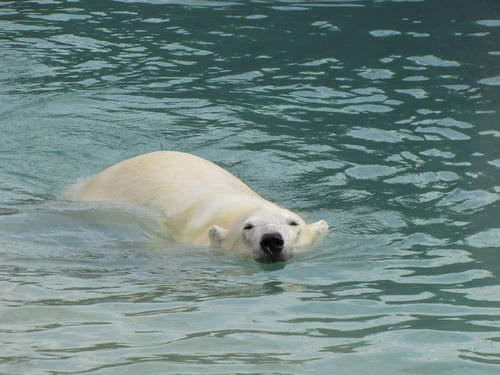
Polar bears are well adapted to frigid Arctic waters.
Summary
Oceans moderate Earth's temperature by not changing temperature rapidly and by distributing heat around the planet.
Oceans are an enormous reservoir for water in the water cycle.
Oceans have tremendous biodiversity and the majority of all biomass on Earth.
Review
What organisms form the base of the ocean food web?
How do the oceans moderate Earth's temperature?
What role do oceans play in the water cycle?
Vocabulary
termdefinition
biomassthe total mass of living organisms in a given region.
Notes/Highlights
Color
Highlighted Text
Notes
Please Sign In to create your own Highlights / Notes


 FlexiA FREE Digital Tutor for Every Student
 FlexBooks 2.0Customizable, digital textbooks in a new, interactive platform
 FlexBooksCustomizable, digital textbooks
 SchoolsFlexBooks from schools and districts near you
 Study GuidesQuick review with key information for each concept
 Adaptive PracticeBuilding knowledge at each student’s skill level
 SimulationsInteractive Physics & Chemistry Simulations
 PLIXPlay. Learn. Interact. eXplore.
 CCSS MathConcepts and FlexBooks aligned to Common Core
 NGSSConcepts aligned to Next Generation Science Standards
 Certified EducatorStand out as an educator. Become CK-12 Certified.
 WebinarsLive and archived sessions to learn about CK-12