Besides making food taste better, salt is important for the human diet. Before refrigeration, salt was essential for curing and preserving food. Even in antiquity people built access roads they called "salt roads" so that they could obtain this essential mineral. What is salt? It's what you get when you evaporate seawater!
Composition of Ocean Water
Remember that H2O is a polar molecule, so it can dissolve many substances (Figurebelow). Salts, sugars, acids, bases, and organic molecules can all dissolve in water.
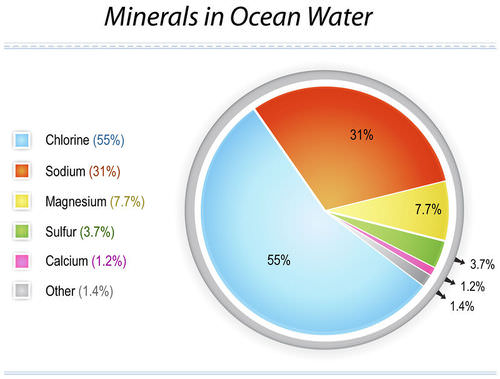
Ocean water is composed of many substances, many of them salts such as sodium, magnesium, and calcium chloride.
Salinity
Where does the salt in seawater come from? As water moves through rock and soil on land it picks up ions. This is the flip side of weathering. Salts comprise about 3.5% of the mass of ocean water, but the salt content, or salinity, is different in different locations.
What would the salinity be like in an estuary? Where seawater mixes with fresh water, salinity is lower than average.
What would the salinity be like where there is lots of evaporation? Where there is lots of evaporation but little circulation of water, salinity can be much higher. The Dead Sea has 30% salinity — nearly nine times the average salinity of ocean water (Figurebelow). Why do you think this water body is called the Dead Sea?
Because of the increased salinity, the water in the Dead Sea is very dense, it has such high salinity that people can easily float in it!
In some areas, dense saltwater and less dense freshwater mix, and they form an immiscible layer, just like oil and water. One such place is a "cenote", or underground cave, very common in certain parts of Central America.
Density
With so many dissolved substances mixed in seawater, what is the density (mass per volume) of seawater relative to fresh water?

 FlexiA FREE Digital Tutor for Every Student
 FlexBooks 2.0Customizable, digital textbooks in a new, interactive platform
 FlexBooksCustomizable, digital textbooks
 SchoolsFlexBooks from schools and districts near you
 Study GuidesQuick review with key information for each concept
 Adaptive PracticeBuilding knowledge at each student’s skill level
 SimulationsInteractive Physics & Chemistry Simulations
 PLIXPlay. Learn. Interact. eXplore.
 CCSS MathConcepts and FlexBooks aligned to Common Core
 NGSSConcepts aligned to Next Generation Science Standards
 Certified EducatorStand out as an educator. Become CK-12 Certified.
 WebinarsLive and archived sessions to learn about CK-12