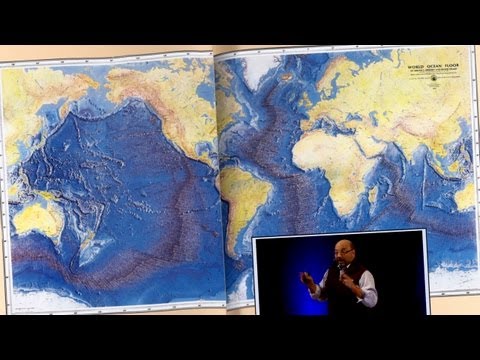
When scientists first dove in Alvin and witnessed hydrothermal vents, they were not surprised by the eruptions of hot water. But they never anticipated finding life there. Without sunlight, they knew that photosynthesis could not be the basis of this community. Eventually they discovered a different way of producing food, chemosynthesis. Many more hydrothermal vents were discovered and many more types of vent organisms.
The Intertidal
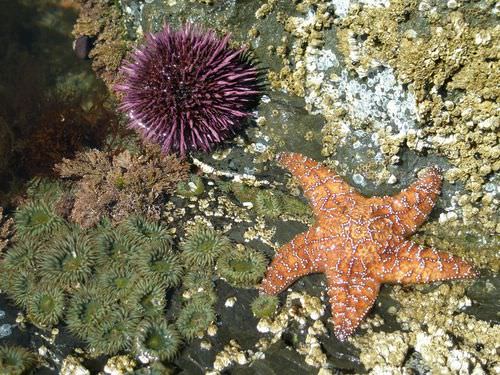
Conditions in the intertidal zone change rapidly as water covers and uncovers the region and waves pound on the rocks. A great abundance of life is found in the intertidal zone (Figurebelow). High energy waves hit the organisms that live in this zone, so they must be adapted to pounding waves and exposure to air during low tides. Hard shells protect from waves and also protect against drying out when the animal is above water. Strong attachments keep the animals anchored to the rock.
Organisms in a tide pool include sea stars and sea urchins.
In a tide pool, as in the photo, what organisms are found where and what specific adaptations do they have to that zone? The mussels on the top left have hard shells for protection and to prevent drying because they are often not covered by water. The sea anemones in the lower right are more often submerged and have strong attachments but can close during low tides.
Many young organisms get their start in estuaries and so they must be adapted to rapid shifts in salinity.
Reefs
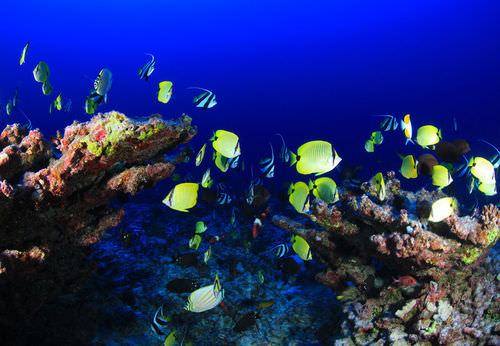
Corals and other animals deposit calcium carbonate to create rock reefs near the shore. Coral reefs are the “rainforests of the oceans,” with a tremendous amount of species diversity (Figurebelow).
Coral reefs are among the most densely inhabited and diverse areas on the globe.
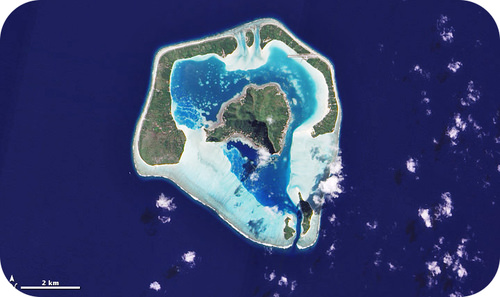
Reefs can form interesting shapes in the oceans. Remember that hot spots create volcanoes on the seafloor. If these volcanoes rise above sea level to become islands, and if they occur in tropical waters, coral reefs will form on them. Since the volcanoes are cones, the reef forms in a circle around the volcano. As the volcano comes off the hot spot, the crust cools. The volcano subsides and then begins to erode away (Figurebelow).
In this image of Maupiti Island in the South Pacific, the remnants of the volcano are surrounded by the circular reef.
Eventually, all that is left is a reef island called an atoll. A lagoon is found inside the reef.
Oceanic Zone
The open ocean is a vast area. Food either washes down from the land or is created by photosynthesizing plankton. Zooplankton and larger animals feed on the phytoplankton and on each other. Larger animals such as whales and giant groupers may live their entire lives in the open water.
How do fish survive in the deepest ocean? The few species that live in the greatest depths are very specialized (Figurebelow). Since it’s rare to find a meal, the fish use very little energy; they move very little, breathe slowly, have minimal bone structure and a slow metabolism. These fish are very small. To maximize the chance of getting a meal, some species may have jaws that unhinge to accept a larger fish or backward-folding teeth to keep prey from escaping.
An 1896 drawing of a deep sea angler fish with a bioluminescent “lure” to attract prey.
Hydrothermal Vents
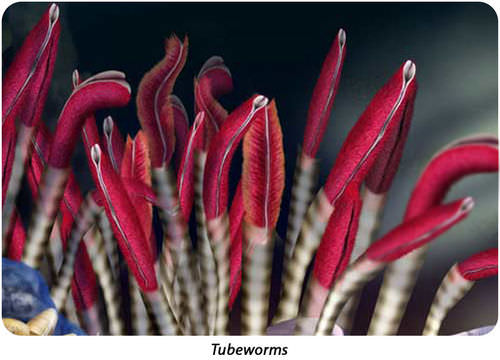
Hydrothermal vents are among the most unusual ecosystems on Earth since they are dependent on chemosynthetic organisms at the base of the food web. At mid-ocean ridges at hydrothermal vents, bacteria that use chemosynthesis for food energy are the base of a unique ecosystem (Figurebelow). This ecosystem is entirely separate from the photosynthesis at the surface. Shrimp, clams, fish, and giant tube worms have been found in these extreme places.
Giant tube worms found at hydrothermal vents get food from the chemosynthetic bacteria that live within them. The bacteria provide food; the worms provide shelter.
A video explaining hydrothermal vents with good footage is seen here:
Summary
In the ocean, phytoplankton photosynthesize as the main food source. They are eaten by zooplankton and other larger animals.
Organisms that live in the deepest ocean have amazing adaptations to the exceptionally harsh conditions, such as unhinging jaws, backward-folding teeth, or a bioluminescent lure.
A hydrothermal vent ecosystem has chemosynthesis as its food source. The ecosystem is independent of photosynthesis at the surface.
Review
Why is there so much biodiversity in the intertidal zone?
Why is survival in the deep ocean difficult? What adaptations to organisms have to do this?
What is the source of energy at a hydrothermal vent system? How much do these communities depend on the surface?
Explore More
Use this resource to answer the questions that follow.
What are a few of the ecological services provided by marine ecosystems?
What is the economic value of the oceans?
What are the three major life zones in the oceans?
What is the coastal zone?
What is the value or the coastal zone to the marine ecosystems? Why is this true?
What are two estuaries and why are they rich in life?
Why is life harsh in the coastal zone?
What ecological services do estuaries and coastal marshes provide?
What is the intertidal zone? What do organisms in this zone need to deal with?
What ecological services are provided by coral reefs?
What are the three zones of the open ocean? How are they divided?
What are the characteristics of the upper zone?
What are the characteristics of the middle zone?
What are the characteristics of the bottom zone?
Why does the ocean have high productivity?
Where is productivity relatively high? Why?
Which human activities are causing losses in ocean productivity?
Resources
Vocabulary
termdefinition
hydrothermal venta stream of heated water that enters into the ocean at a mid-ocean ridge.
reefa large underwater structure created from the calcium carbonate skeletons of coral.
Notes/Highlights
Color
Highlighted Text
Notes
Please Sign In to create your own Highlights / Notes


 FlexiA FREE Digital Tutor for Every Student
 FlexBooks 2.0Customizable, digital textbooks in a new, interactive platform
 FlexBooksCustomizable, digital textbooks
 SchoolsFlexBooks from schools and districts near you
 Study GuidesQuick review with key information for each concept
 Adaptive PracticeBuilding knowledge at each student’s skill level
 SimulationsInteractive Physics & Chemistry Simulations
 PLIXPlay. Learn. Interact. eXplore.
 CCSS MathConcepts and FlexBooks aligned to Common Core
 NGSSConcepts aligned to Next Generation Science Standards
 Certified EducatorStand out as an educator. Become CK-12 Certified.
 WebinarsLive and archived sessions to learn about CK-12