How does the ocean seem all the same, yet have so much biodiversity?
Although it may seem like the ocean is all the same, there are many different habitats based on temperature, salinity, pressure, light, currents, and other factors. Organisms have adapted to these conditions in many interesting and effective ways. Covering 70% of Earth's surface, the oceans are home to a large portion of all life on Earth.
Types of Ocean Organisms
The smallest and largest animals on Earth live in the oceans. Why do you think the oceans can support large animals?
Marine animals breathe air or extract oxygen from the water. Some float on the surface and others dive into the ocean’s depths. There are animals that eat other animals, and plants generate food from sunlight. A few bizarre creatures break down chemicals to make food! The following section divides ocean life into seven basic groups.
Plankton
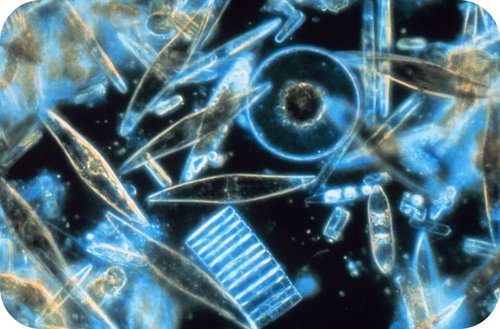
Plankton are organisms that cannot swim but that float along with the current. The word "plankton" comes from the Greek for wanderer. Most plankton are microscopic, but some are visible to the naked eye (Figurebelow).
Phytoplankton are tiny plants that make food by photosynthesis. Because they need sunlight, phytoplankton live in the photic zone. Phytoplankton are responsible for about half of the total primary productivity (food energy) on Earth. Like other plants, phytoplankton release oxygen as a waste product.
Microscopic diatoms are a type of phytoplankton.
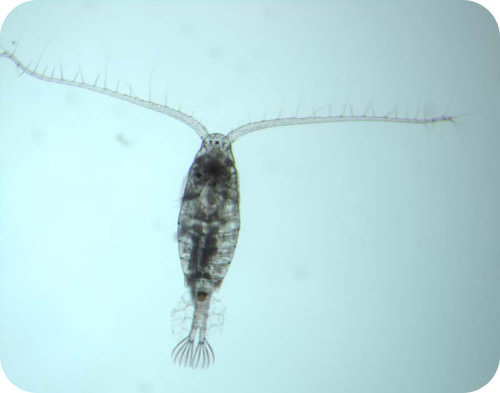
Zooplankton, or animal plankton, eat phytoplankton as their source of food (Figurebelow). Some zooplankton live as plankton all their lives and others are juvenile forms of animals that will attach to the bottom as adults. Some small invertebrates live as zooplankton.
Copepods are abundant and so are an important food source for larger animals.
Plants and Algae
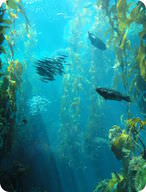
The few true plants found in the oceans include salt marsh grasses and mangrove trees. Although they are not true plants, large algae, which are called seaweed, also use photosynthesis to make food. Plants and seaweeds are found in the neritic zone, where the light they need penetrates so that they can photosynthesize (Figurebelow).
Kelp grows in forests in the neritic zone. Otters and other organisms depend on the kelp-forest ecosystem.
Marine Invertebrates
The variety and number of invertebrates, animals without a backbone, is truly remarkable (Figurebelow). Marine invertebrates include sea slugs, sea anemones, starfish, octopuses, clams, sponges, sea worms, crabs, and lobsters. Most of these animals are found close to the shore, but they can be found throughout the ocean.
(a) Mussels; (b) Crown of thorns sea star; (c) Moon jelly; (d) A squid.
Jellies are otherworldly creatures that glow in the dark, without brains or bones, some more than 100 feet long. Along with many other ocean areas, they live just off California's coast.
Fish
Fish are vertebrates; they have a backbone. What are some of the features fish have that allows them to live in the oceans? All fish have most or all of these traits:
Fins with which to move and steer.
Scales for protection.
Gills for extracting oxygen from the water.
A swim bladder that lets them rise and sink to different depths.
Ectothermy (cold-bloodedness), so that their bodies are the same temperature as the surrounding water.
Bioluminescence, or light created from a chemical reaction that can attract prey or mates in the dark ocean.
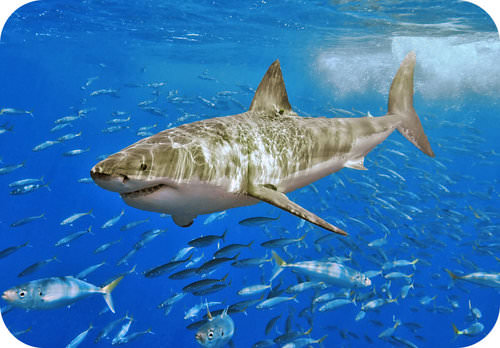
Included among the fish are sardines, salmon, and eels, as well as the sharks and rays (which lack swim bladders) (Figurebelow).
The Great White Shark is a fish that preys on other fish and marine mammals.
Reptiles
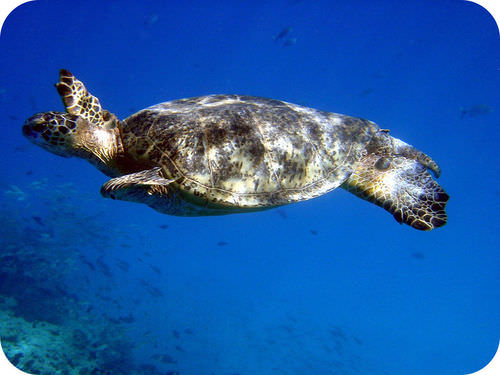
Only a few types of reptiles live in the oceans and they live in warm water. Why are reptiles so restricted in their ability to live in the sea? Sea turtles, sea snakes, saltwater crocodiles, and marine iguana that are found only at the Galapagos Islands sum up the marine reptile groups (Figurebelow). Sea snakes bear live young in the ocean, but turtles, crocodiles, and marine iguanas all lay their eggs on land.
Sea turtles are found all over the oceans, but their numbers are diminishing.
Seabirds
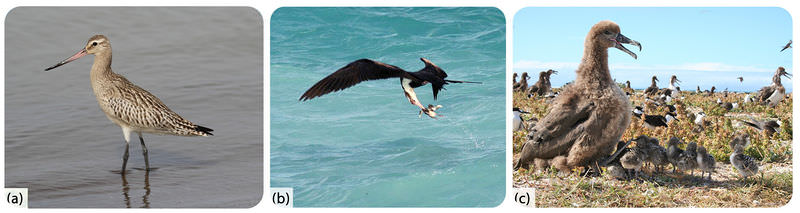
Many types of birds are adapted to living in the sea or on the shore. With their long legs for wading and long bills for digging in sand for food, shorebirds are well adapted for the intertidal zone. Many seabirds live on land but go to sea to fish, such as gulls, pelicans, and frigate birds. Some birds, like albatross, spend months at sea and only come on shore to raise chicks (Figurebelow).
(a) Shorebirds; (b) Seabirds; (c) Albatross.
Marine Mammals
What are the common traits of mammals? Mammals are endothermic (warm-blooded) vertebrates that give birth to live young, feed them with milk, and have hair, ears, and a jaw bone with teeth.
What traits might mammals have to be adapted to life in the ocean?
For swimming: streamlined bodies, slippery skin or hair, fins.
For warmth: fur, fat, high metabolic rate, small surface area to volume, specialized blood system.
For salinity: kidneys that excrete salt, impervious skin.
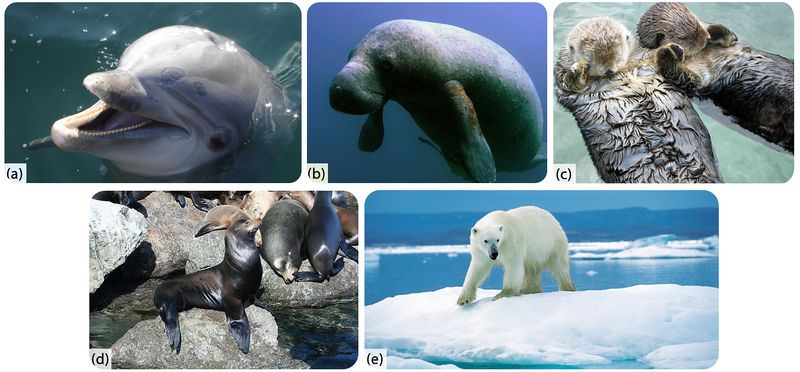
The five types of marine mammals are pictured here: (Figurebelow).
(a) Cetaceans: whales, dolphins, and porpoises. (b) Sirenians: manatee and the dugong. (c) Mustelids: Sea otters (terrestrial members are skunks, badgers and weasels). (d) Pinnipeds: Seals, sea lions, and walruses. (e) Polar bear.
Summary
Plankton are tiny organisms that are swept along on currents. Phytoplankton are tiny photosynthesizers and zooplankton are tiny animals.
Fish have gills for breathing, swim bladders for rising and sinking, and other adaptations for life in the oceans.
Shorebirds live at the interface of land and sea; some birds live on land but fish at sea, and some birds spend most of their time at sea and only come to shore to nest.
Review
How are phytoplankton different from plant-like algae?
Describe how fish are adapted to life in the oceans.
Describe how marine mammals are adapted to life in the oceans. How are these adaptations different from those of fish?
Explore More
Use this resource to answer the questions that follow.
What are kelp? Where are kelp forests found?
Why are kelp forests important to their ecosystem?
How do kelp withstand the forces of waves and currents?
How are the kelp blades kept in the zone for photosynthesis?
What does the canopy of the kelp forest provide to organisms and how?
what does the ocean provide?
NOTES / HIGHLIGHTS
Please Sign In to create your own Highlights / Notes
Vocabulary
termdefinition
phytoplanktonbacteria and algae that perform photosynthesis to make food.
planktonmainly microscopic organisms that float in the water of the photic zone.
primary productivitythe creation of food energy.
Notes/Highlights
Color
Highlighted Text
Notes
Please Sign In to create your own Highlights / Notes


 FlexiA FREE Digital Tutor for Every Student
 FlexBooks 2.0Customizable, digital textbooks in a new, interactive platform
 FlexBooksCustomizable, digital textbooks
 SchoolsFlexBooks from schools and districts near you
 Study GuidesQuick review with key information for each concept
 Adaptive PracticeBuilding knowledge at each student’s skill level
 SimulationsInteractive Physics & Chemistry Simulations
 PLIXPlay. Learn. Interact. eXplore.
 CCSS MathConcepts and FlexBooks aligned to Common Core
 NGSSConcepts aligned to Next Generation Science Standards
 Certified EducatorStand out as an educator. Become CK-12 Certified.
 WebinarsLive and archived sessions to learn about CK-12