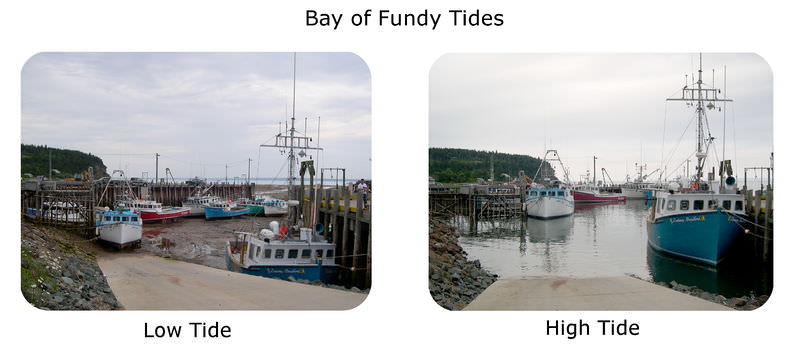
These two photos show low tide (left) and high tide (right) at Bay of Fundy on the Gulf of Maine. The Bay of Fundy has the greatest tidal ranges on Earth at 38.4 feet. Why is this tidal range so extreme? Why aren't all tidal ranges so great? Tidal range depends on many factors, including the slope of the continental margin.
The Tides
Tides are the daily rise and fall of sea level at any given place. The pull of the Moon’s gravity on Earth is the primary cause of tides and the pull of the Sun’s gravity on Earth is the secondary cause (Figurebelow). The Moon has a greater effect because, although it is much smaller than the Sun, it is much closer. The Moon’s pull is about twice that of the Sun’s.
To understand the tides it is easiest to start with the effect of the Moon on Earth. As the Moon revolves around our planet, its gravity pulls Earth toward it. The lithosphere is unable to move much, but the water is pulled by the gravity and a bulge is created. This bulge is the high tide beneath the Moon. On the other side of the Earth, a high tide is produced where the Moon’s pull is weakest. These two water bulges on opposite sides of the Earth aligned with the Moon are the high tides. The places directly in between the high tides are low tides. As the Earth rotates beneath the Moon, a single spot will experience two high tides and two low tides approximately every day.
The gravitational attraction of the Moon to ocean water creates the high and low tides.
The Moon is located above the same spot over the Earth every 24 hours and 50 minutes so high tides occur twice a day, with one arriving each 12 hours and 25 minutes. One is caused by the water bulge beneath the Moon and the other is caused by the water bulge at the opposite side of Earth. Low tides are also separated by 12 hours and 25 minutes. What is the time between a high tide and the next low tide?
The gravity of the Sun also pulls Earth’s water towards it and causes its own tides. Because the Sun is so far away, its pull is smaller than the Moon’s.
Some coastal areas do not follow this pattern at all. These coastal areas may have one high and one low tide per day or a different amount of time between two high tides. These differences are often because of local conditions, such as the shape of the coastline that the tide is entering.
Tidal Range
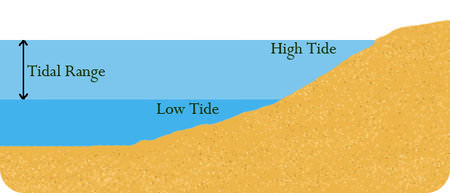
The tidal range is the difference between the ocean level at high tide and the ocean level at low tide (Figurebelow). The tidal range in a location depends on a number of factors, including the slope of the seafloor. Water appears to move a greater distance on a gentle slope than on a steep slope.
The tidal range is the difference between the ocean level at high tide and low tide.
Monthly Tidal Patterns
If you look at the diagram of high and low tides on a circular Earth above, you’ll see that tides are waves. So when the Sun and Moon are aligned, what do you expect the tides to look like?
Waves are additive, so when the gravitational pull of both bodies is in the same direction, the high tides are higher and the low tides lower than at other times through the month (Figurebelow). These more extreme tides, with a greater tidal range, are called spring tides. Spring tides don't just occur in the spring; they occur whenever the Moon is in a new-moon or full-moon phase, about every 14 days.
A spring tide occurs when the gravitational pull of both Moon and the Sun is in the same direction, making high tides higher and low tides lower and creating a large tidal range.
Neap tides are tides that have the smallest tidal range, and they occur when the Earth, the Moon, and the Sun form a 90o angle (Figurebelow). They occur exactly halfway between the spring tides, when the Moon is at first or last quarter. How do the tides add up to create neap tides? The Moon's high tide occurs in the same place as the Sun's low tide and the Moon's low tide in the same place as the Sun's high tide. At neap tides, the tidal range is relatively small.
A neap tide occurs when the high tide of the Sun adds to the low tide of the Moon and vice versa, so the tidal range is relatively small.
Studying ocean tides' rhythmic movements helps scientists understand the ocean and the Sun/Moon/Earth system. This QUEST video explains how tides work, and visits the oldest continually operating tidal gauge in the Western Hemisphere.
Summary
The primary cause of tides is the gravitational attraction of the Moon, which causes two high and two low tides a day.
When the Sun's and Moon's tides match, there are spring tides; when they are opposed, there are neap tides.
The difference between the daily high and the daily low is the tidal range.
Review
If the Moon is over the same spot on Earth only once per day, why are there two high tides per day?
Describe the causes of spring and neap tides.
What are the possible reasons that the Bay of Fundy has such a large tidal range?
Explore More
Use this resource to answer the questions that follow.
If you are standing on the shore and it is high tide, what are the two possible locations for the moon relative to where you are?
What is the secondary reason for the tides? Why are these tides weaker than the moon's tides?
Why is it good that the moon is not closer to the Earth?
Vocabulary
termdefinition
high tidethe highest water levels during a day caused by the gravitational pull of the Moon.
low tidethe lowest water levels during a day when high tide is one-quarter of the way around Earth’s sphere.
neap tidethe smallest tidal range in a lunar month occurring at the first- and third-quarter moons when the Sun and Moon are at 90 degrees relative to each other, relative to Earth.
spring tidea large tidal range that occurs when the Moon, Sun, and Earth are aligned; this happens at full and new moon phases.
tidal rangethe difference between the high and low tide in a day.
tidethe regular rising and falling of Earth’s surface waters twice a tidal day as a result of the Moon’s and Sun’s gravitational attraction.
Notes/Highlights
Color
Highlighted Text
Notes
Please Sign In to create your own Highlights / Notes


 FlexiA FREE Digital Tutor for Every Student
 FlexBooks 2.0Customizable, digital textbooks in a new, interactive platform
 FlexBooksCustomizable, digital textbooks
 SchoolsFlexBooks from schools and districts near you
 Study GuidesQuick review with key information for each concept
 Adaptive PracticeBuilding knowledge at each student’s skill level
 SimulationsInteractive Physics & Chemistry Simulations
 PLIXPlay. Learn. Interact. eXplore.
 CCSS MathConcepts and FlexBooks aligned to Common Core
 NGSSConcepts aligned to Next Generation Science Standards
 Certified EducatorStand out as an educator. Become CK-12 Certified.
 WebinarsLive and archived sessions to learn about CK-12