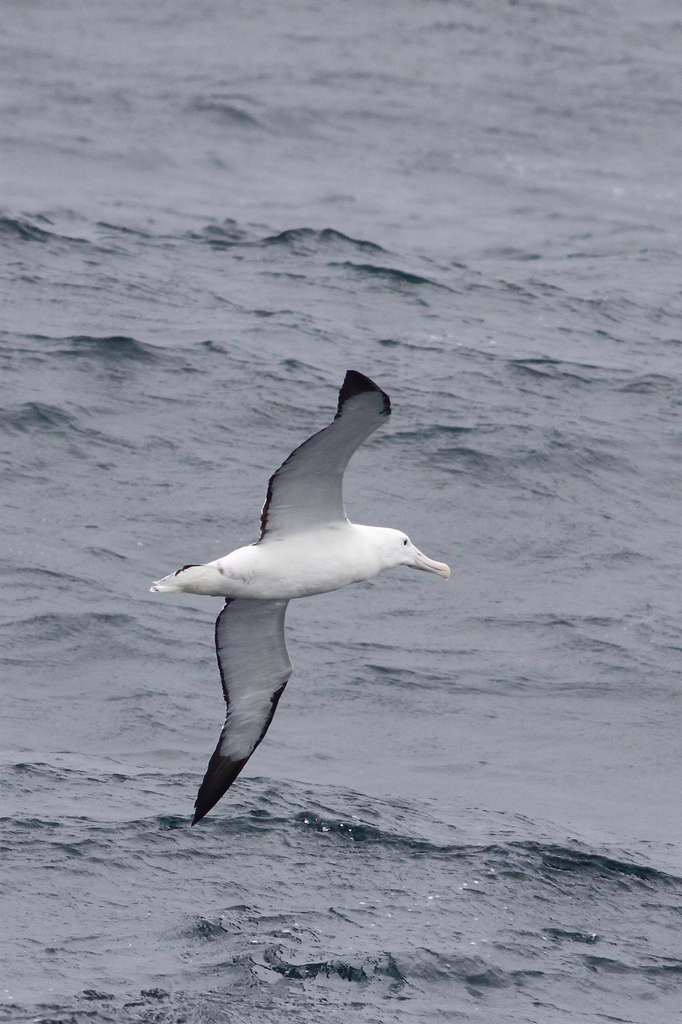
The Great Pacific Garbage Patch is a region in the center of the north Pacific Ocean where plastic bits and chemicals are concentrated. Trash from the countries bordering the region enters the oceans and is transported into the center of the North Pacific Gyre, where it remains. Seabirds may get sick from ingesting so much plastic instead of food. More about the patch can be found in the chapter Human Impacts on Earth's Systems.
Surface Currents
Ocean water moves in predictable ways along the ocean surface. Surface currents can flow for thousands of kilometers and can reach depths of hundreds of meters. These surface currents do not depend on weather; they remain unchanged even in large storms because they depend on factors that do not change.
Surface currents are created by three things:
global wind patterns
the rotation of the Earth
the shape of the ocean basins
Surface currents are extremely important because they distribute heat around the planet and are a major factor influencing climate around the globe.
Global Wind Patterns
Winds on Earth are either global or local. Global winds blow in the same directions all the time and are related to the unequal heating of Earth by the Sun — that is, more solar radiation strikes the Equator than the polar regions — and the rotation of the Earth — that is, the Coriolis effect. Coriolis was described in the chapter Earth as a Planet. The causes of the global wind patterns will be described in detail in the chapter Atmospheric Processes.
Water in the surface currents is pushed in the direction of the major wind belts:
trade winds: east to west between the Equator and 30oN and 30oS
westerlies: west to east in the middle latitudes
polar easterlies: east to west between 50o and 60o north and south of the Equator and the north and south pole
Shape of the Ocean Basins
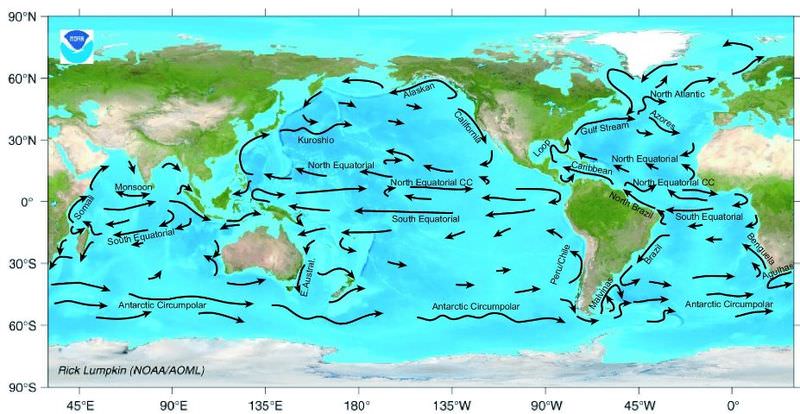
When a surface current collides with land, the current must change direction. In the Figurebelow, the Atlantic South Equatorial Current travels westward along the Equator until it reaches South America. At Brazil, some of it goes north and some goes south. Because of Coriolis effect, the water goes right in the Northern Hemisphere and left in the Southern Hemisphere.
The major surface ocean currents.
Gyres
You can see on the map of the major surface ocean currents that the surface ocean currents create loops called gyres (Figurebelow). The Antarctic Circumpolar Current is unique because it travels uninhibited around the globe. Why is it the only current to go all the way around?
The ocean gyres. Why do the Northern Hemisphere gyres rotate clockwise and the Southern Hemisphere gyres rotate counterclockwise?
Local Surface Currents
The surface currents described above are all large and unchanging. Local surface currents are also found along shorelines (Figurebelow). Two are longshore currents and rip currents.
Longshore currents move water and sediment parallel to the shore in the direction of the prevailing local winds.
Rip currents are potentially dangerous currents that carry large amounts of water offshore quickly. Each summer in the United States at least a few people die when they are caught in rip currents.
Summary
Major surface ocean currents are the result of global wind patterns, Earth's rotation, and the shape of the ocean basins.
Major surface currents circle the oceans in five gyres.
Local surface currents, like longshore and rip currents, move near shorelines.
Review
Describe the motion of a water particle that is stuck in a gyre in the North Pacific.
What should you do if you get stuck in a rip current?
What would happen if a major surface current did not run into a continent? Note that this is what happens with the Antarctic Circumpolar Current.
Explore More
Use this resource to answer the questions that follow.
Which direction do currents move across the equator both north and south? What direction does the counter current flow?
What is unique about the Antarctic Circumpolar Current and why?
What are gyres?
Where are currents that move heat from the equator to the higher latitudes flowing relative to the continents?
Why is the Caribbean so hot and humid?
Why does the Gulf Stream cool before it reaches Europe?
Why is it warmer and more pleasant to swim off of the Eastern Seaboard than off of California?
What are the western boundary currents due to?
Vocabulary
termdefinition
gyrefive loops located on Earth's oceans created by surface ocean currents.
longshore currentlocal surface currents that move along a shoreline in the direction of prevailing winds.
rip currenta strong surface current that returns to the ocean from the shore.
surface currentthe ocean current caused by wind that flows through the surface of the water.
Notes/Highlights
Color
Highlighted Text
Notes
Please Sign In to create your own Highlights / Notes


 FlexiA FREE Digital Tutor for Every Student
 FlexBooks 2.0Customizable, digital textbooks in a new, interactive platform
 FlexBooksCustomizable, digital textbooks
 SchoolsFlexBooks from schools and districts near you
 Study GuidesQuick review with key information for each concept
 Adaptive PracticeBuilding knowledge at each student’s skill level
 SimulationsInteractive Physics & Chemistry Simulations
 PLIXPlay. Learn. Interact. eXplore.
 CCSS MathConcepts and FlexBooks aligned to Common Core
 NGSSConcepts aligned to Next Generation Science Standards
 Certified EducatorStand out as an educator. Become CK-12 Certified.
 WebinarsLive and archived sessions to learn about CK-12