Seawater doesn't just circulate around the surface, it moves through the deep sea. Just like at the surface, normal circulation patterns transport much of the water. Seawater is moved as if on a conveyor through the surface and deep ocean, a trip that takes hundreds of years.
Deep Currents
Thermohaline circulation drives deep ocean circulation. Thermo means heat and haline refers to salinity. Differences in temperature and in salinity change the density of seawater. So thermohaline circulation is the result of density differences in water masses because of their different temperature and salinity.
What is the temperature and salinity of very dense water? Lower temperature and higher salinity yield the densest water. When a volume of water is cooled, the molecules move less vigorously, so same number of molecules takes up less space and the water is denser. If salt is added to a volume of water, there are more molecules in the same volume, so the water is denser.
Downwelling
Changes in temperature and salinity of seawater take place at the surface. Water becomes dense near the poles. Cold polar air cools the water and lowers its temperature, increasing its salinity. Fresh water freezes out of seawater to become sea ice, which also increases the salinity of the remaining water. This very cold, very saline water is very dense and sinks. This sinking is called downwelling.
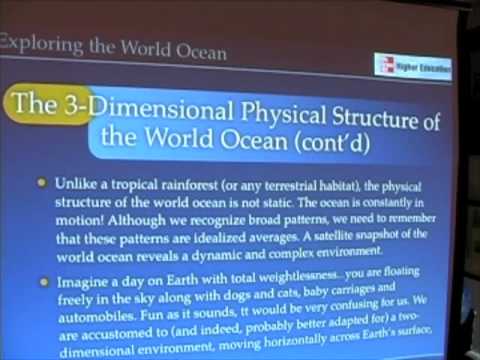
This video lecture discusses the vertical distribution of life in the oceans. Seawater density creates currents, which provide different habitats for different creatures:
Two things then happen. The dense water pushes deeper water out of its way and that water moves along the bottom of the ocean. This deep water mixes with less dense water as it flows. Surface currents move water into the space vacated at the surface where the dense water sank (Figurebelow). Water also sinks into the deep ocean off of Antarctica.
Cold water (blue lines) sinks in the North Atlantic, flows along the bottom of the ocean and upwells in the Pacific or Indian. The water then travels in surface currents (red lines) back to the North Atlantic. Deep water also forms off of Antarctica.
Upwelling
Since unlimited amounts of water cannot sink to the bottom of the ocean, water must rise from the deep ocean to the surface somewhere. This process is called upwelling (Figurebelow).
Upwelling forces denser water from below to take the place of less dense water at the surface that is pushed away by the wind.
Generally, upwelling occurs along the coast when wind blows water strongly away from the shore. This leaves a void that is filled by deep water that rises to the surface.
Upwelling is extremely important where it occurs. During its time on the bottom, the cold deep water has collected nutrients that have fallen down through the water column. Upwelling brings those nutrients to the surface. Those nutrients support the growth of plankton and form the base of a rich ecosystem. California, South America, South Africa, and the Arabian Sea all benefit from offshore upwelling.
Upwelling also takes place along the Equator between the North and South Equatorial Currents. Winds blow the surface water north and south of the Equator, so deep water undergoes upwelling. The nutrients rise to the surface and support a great deal of life in the equatorial oceans.
Summary
Cooling or evaporation of fresh water from the sea surface makes surface water dense and causes it to sink.
Downwelling of cold, dense water drives thermohaline circulation.
Upwelling takes place at some coastlines or along the Equator and brings cool, nutrient-rich water to the surface.
Review
Why is upwelling important?
How does downwelling drive thermohaline circulation?
What would happen if water in the north Pacific no longer became cold and dense enough to sink?
Explore More
Use this resource (watch up to 6:45) to answer the questions that follow.
When ice forms from seawater what is the composition of the ice? How does that change the composition of seawater nearby?
What are the characteristics of the seawater that is left behind? What happens to it as a result of these characteristics?
What do the Antarctic Bottom Water and the North Atlantic Deep Water contain and why? Why does cold water trap more gas?
Why are the cold polar regions so rich in life?
Vocabulary
termdefinition
downwellingocean water that sinks due to higher density.
thermohaline circulationtemperature and salinity (density) driven currents that drive deep ocean circulation.
upwellingcold, nutrient-rich water that rises from oceanic depths.
Notes/Highlights
Color
Highlighted Text
Notes
Please Sign In to create your own Highlights / Notes


 FlexiA FREE Digital Tutor for Every Student
 FlexBooks 2.0Customizable, digital textbooks in a new, interactive platform
 FlexBooksCustomizable, digital textbooks
 SchoolsFlexBooks from schools and districts near you
 Study GuidesQuick review with key information for each concept
 Adaptive PracticeBuilding knowledge at each student’s skill level
 SimulationsInteractive Physics & Chemistry Simulations
 PLIXPlay. Learn. Interact. eXplore.
 CCSS MathConcepts and FlexBooks aligned to Common Core
 NGSSConcepts aligned to Next Generation Science Standards
 Certified EducatorStand out as an educator. Become CK-12 Certified.
 WebinarsLive and archived sessions to learn about CK-12