If Earth didn't have an atmosphere, would it always be cold?
This is a question commonly asked by 12-year-old girls being driven to school by their mothers. "Of course," the moms answer, "it would be extremely hot when the Sun is out and bitter cold when it's dark." Does this conversation sound familiar?
What Is the Atmosphere?
Earth’s atmosphere is a thin blanket of gases and tiny particles — together called air. We are most aware of air when it moves and creates wind. Earth's atmosphere, along with the abundant liquid water at Earth's surface, are the keys to our planet's unique place in the solar system. Much of what makes Earth exceptional depends on the atmosphere. For example, all living things need some of the gases in air for life support. Without an atmosphere, Earth would likely be just another lifeless rock.
Let's consider some of the reasons we are lucky to have an atmosphere.
Gases Indispensable for Life on Earth
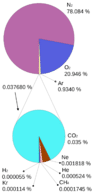
The composition of Earth's atmosphere.
Without the atmosphere, Earth would look a lot more like the Moon. Atmospheric gases, especially carbon dioxide (CO2) and oxygen (O2), are extremely important for living organisms. How does the atmosphere make life possible? How does life alter the atmosphere?
Photosynthesis
In photosynthesis, plants use CO2 and create O2. Photosynthesis is responsible for nearly all of the oxygen currently found in the atmosphere.
The chemical reaction for photosynthesis is:
6CO2 + 6H2O + solar energy → C6H12O6 (sugar) + 6O2
Respiration
By creating oxygen and food, plants have made an environment that is favorable for animals. In respiration, animals use oxygen to convert sugar into food energy they can use. Plants also go through respiration and consume some of the sugars they produce.
The chemical reaction for respiration is:
C6H12O6 + 6O2 → 6CO2 + 6H2O + useable energy
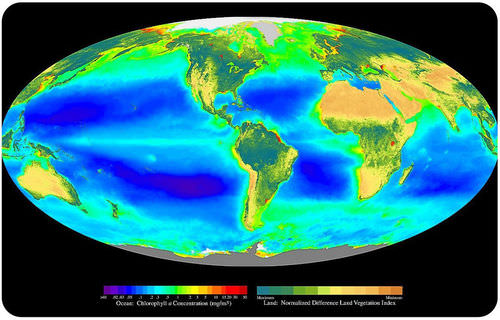
How is respiration similar to and different from photosynthesis? They are approximately the reverse of each other. In photosynthesis, CO2 is converted to O2 and in respiration, O2 is converted to CO2 (Figurebelow).
Chlorophyll indicates the presence of photosynthesizing plants as does the vegetation index.
Crucial Part of the Water Cycle
As part of the hydrologic cycle, water spends a lot of time in the atmosphere, mostly as water vapor. The atmosphere is an important reservoir for water.
Ozone Makes Life on Earth Possible
Ozone is a molecule composed of three oxygen atoms, (O3). Ozone in the upper atmosphere absorbs high-energy ultraviolet (UV) radiation coming from the Sun. This protects living things on Earth’s surface from the Sun’s most harmful rays. Without ozone for protection, only the simplest life forms would be able to live on Earth. The highest concentration of ozone is in the ozone layer in the lower stratosphere.
Keeps Earth’s Temperature Moderate
Along with the oceans, the atmosphere keeps Earth's temperatures within an acceptable range. Without an atmosphere, Earth's temperatures would be frigid at night and scorching during the day. If the 12-year-old in the scenario above asked why, she would find out. Greenhouse gases trap heat in the atmosphere. Important greenhouse gases include carbon dioxide, methane, water vapor, and ozone.
Provides the Substance for Waves to Travel Through
The atmosphere is made of gases that take up space and transmit energy. Sound waves are among the types of energy that travel though the atmosphere. Without an atmosphere, we could not hear a single sound. Earth would be as silent as outer space (explosions in movies about space should be silent). Of course, no insect, bird, or airplane would be able to fly, because there would be no atmosphere to hold it up.
Summary
The atmosphere is made of gases that are essential for photosynthesis and respiration, among other life activities.
The atmosphere is a crucial part of the water cycle. It is an important reservoir for water and the source of precipitation.
The atmosphere moderates Earth's temperature because greenhouse gases absorb heat.
Review
What gases are used and expelled by photosynthesis and respiration?
Where is the largest concentration of ozone and what value does it have?
How does the atmosphere keep Earth's temperature moderate?
NOTES / HIGHLIGHTS
Please Sign In to create your own Highlights / Notes
Vocabulary
termdefinition
atmospheremixture of gases that surrounds a planet such as Earth.
photosynthesisprocess in which cells use carbon dioxide, water, and light energy to make oxygen and glucose, an energy-storing sugar.
respirationexchange of oxygen and carbon dioxide between the body and the outside air.
Notes/Highlights
Color
Highlighted Text
Notes
Please Sign In to create your own Highlights / Notes

 FlexiA FREE Digital Tutor for Every Student
 FlexBooks 2.0Customizable, digital textbooks in a new, interactive platform
 FlexBooksCustomizable, digital textbooks
 SchoolsFlexBooks from schools and districts near you
 Study GuidesQuick review with key information for each concept
 Adaptive PracticeBuilding knowledge at each student’s skill level
 SimulationsInteractive Physics & Chemistry Simulations
 PLIXPlay. Learn. Interact. eXplore.
 CCSS MathConcepts and FlexBooks aligned to Common Core
 NGSSConcepts aligned to Next Generation Science Standards
 Certified EducatorStand out as an educator. Become CK-12 Certified.
 WebinarsLive and archived sessions to learn about CK-12