Did life evolve to match the atmosphere or is the fit just coincidence?
Life as we know it would not survive if there were no ozone layer to protect it from high energy ultraviolet radiation. Most life needs oxygen to survive. Nitrogen is also needed, albeit in a different form from that found in the atmosphere. Greenhouse gases keep the temperature moderate so that organisms can live around the planet. Life evolved to match the conditions that were available and to some extent changed the atmosphere to suit its needs.
Composition of Air
Several properties of the atmosphere change with altitude, but the composition of the natural gases does not. The proportions of gases in the atmosphere are everywhere the same, with one exception. At about 20 km to 40 km above the surface, there is a greater concentration of ozone molecules than in other portions of the atmosphere. This is called the ozone layer.
Nitrogen and Oxygen
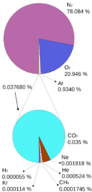
Nitrogen and oxygen together make up 99% of the planet’s atmosphere. Nitrogen makes up the bulk of the atmosphere, but is not involved in geological or biological processes in its gaseous form. Nitrogen fixing is described in the chapter Life on Earth. Oxygen is extremely important because it is needed by animals for respiration. The rest of the gases are minor components but sometimes are very important (Figurebelow).
Nitrogen and oxygen make up 99% of the atmosphere; carbon dioxide is a very important minor component.
Water Vapor
Humidity is the amount of water vapor in the air. Humidity varies from place to place and season to season. This fact is obvious if you compare a summer day in Atlanta, Georgia, where humidity is high, with a winter day in Phoenix, Arizona, where humidity is low. When the air is very humid, it feels heavy or sticky. Dry air usually feels more comfortable. When humidity is high, water vapor makes up only about 4% of the atmosphere.
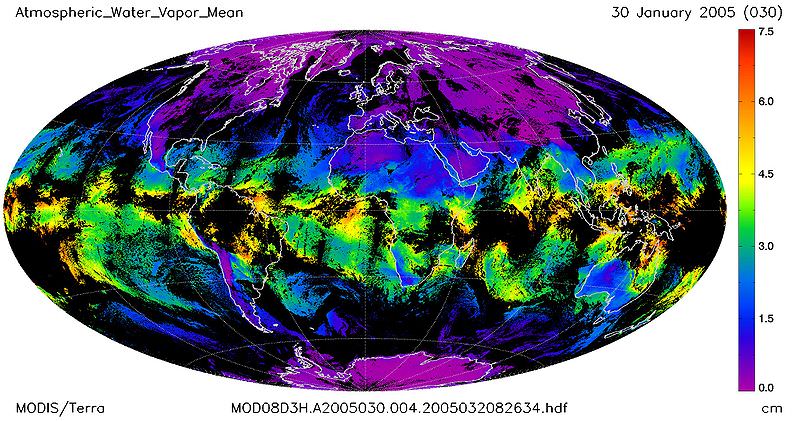
Where around the globe is mean atmospheric water vapor higher and where is it lower (Figurebelow)? Why? Higher humidity is found around the equatorial regions because air temperatures are higher and warm air can hold more moisture than cooler air. Of course, humidity is lower near the polar regions because air temperature is lower.
Mean winter atmospheric water vapor in the Northern Hemisphere when temperature and humidity are lower than they would be in summer.
Greenhouse Gases
Remember that greenhouse gases trap heat in the atmosphere. Important natural greenhouse gases include carbon dioxide, methane, water vapor, and ozone. CFCs and some other man-made compounds are also greenhouse gases.
Particulates
Some of what is in the atmosphere is not gas. Particles of dust, soil, fecal matter, metals, salt, smoke, ash, and other solids make up a small percentage of the atmosphere and are called particulates. Particles provide starting points (or nuclei) for water vapor to condense on and form raindrops. Some particles are pollutants.
Summary
The major atmospheric gases are nitrogen and oxygen. The atmosphere also contains minor amounts of other gases, including carbon dioxide.
Greenhouse gases trap heat in the atmosphere and include carbon dioxide, methane, water vapor, and ozone.
Not everything in the atmosphere is gas; particulates are particles that are important as the nucleus of raindrops and snowflakes.
Review
What are the two major atmospheric gases and what roles do they play?
What are the important greenhouse gases?
What is humidity? If the humidity is 95% does that mean 95% of the air is water vapor?
Explore More
Use this resource to answer the questions that follow.
What do we do with the nitrogen we breathe from the air around us?
What is the percent of each of the two most abundant gases in the atmosphere?
What is the most abundant gas in the remaining 1%? What are some of the other gases present?
Why is carbon dioxide important even though there is so little of it in the atmosphere?
How does oxygen get into the atmosphere?
What happens to the oxygen that is taken up in cellular respiration?
Vocabulary
termdefinition
humiditythe amount of water vapor held in the air.
ozone layera layer of the stratosphere where ozone gas is more highly concentrated.
Notes/Highlights
Color
Highlighted Text
Notes
Please Sign In to create your own Highlights / Notes
 AI Teacher Tools

 FlexiA FREE Digital Tutor for Every Student
 FlexBooks 2.0Customizable, digital textbooks in a new, interactive platform
 FlexBooksCustomizable, digital textbooks
 SchoolsFlexBooks from schools and districts near you
 Study GuidesQuick review with key information for each concept
 Adaptive PracticeBuilding knowledge at each student’s skill level
 SimulationsInteractive Physics & Chemistry Simulations
 PLIXPlay. Learn. Interact. eXplore.
 CCSS MathConcepts and FlexBooks aligned to Common Core
 NGSSConcepts aligned to Next Generation Science Standards
 Certified EducatorStand out as an educator. Become CK-12 Certified.
 WebinarsLive and archived sessions to learn about CK-12