16.14Evolution of Eukaryotes to Multicellular Life
Difficulty Level: At Grade | Created by: CK-12
Last Modified: Aug 02, 2016
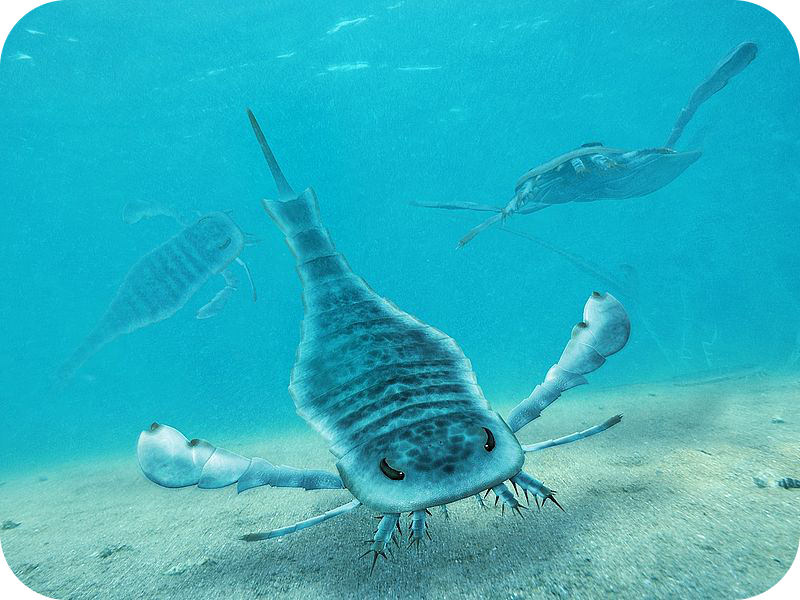
Is this an ancestor of modern life? How can we tell?
No one knows quite how to categorize these organisms. Some scientists think that they are the ancestors of organisms that came later. Others think that the Ediacara fauna died out and that the organisms that took over during the Cambrian were a different group. It may not be possible to know the solution to this problem.
Evolution of Eukaryotes
About 2 billion years ago, eukaryotes evolved. Eukaryotic cells have a nucleus that encloses their DNA and RNA. All complex cells and nearly all multicellular animals are eukaryotic.
The evolution of eukaryotes from prokaryotes is an interesting subject in the study of early life. Scientists think that small prokaryotic cells began to live together in a symbiotic relationship; that is, different types of small cells were beneficial to each other and none harmed the others. The small cell types each took on a specialized function and became the organelles within a larger cell. Organelles supplied energy, broke down wastes, or did other jobs that were needed for cells to become more complex.
What is thought to be the oldest eukaryote fossil found so far is 2.1 billion years old. Eukaryotic cells were much better able to live and replicate themselves, so they continued to evolve and became the dominant life form over prokaryotic cells.
Multicellular Life
Prokaryotes and eukaryotes can both be multicellular. The first multicellular organisms were probably prokaryotic cyanobacteria. Multicellularity may have evolved more than once in Earth's history, likely at least once for plants and once for animals.
Early multicellular organisms were soft bodied and did not fossilize well, so little remains of their existence.
Ediacara Fauna
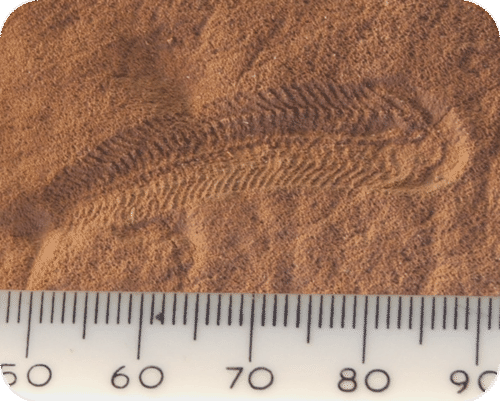
Although the explosion in the number and type of life forms did not come until the beginning of the Cambrian, life at the end of the Precambrian became more complex. Paleontologists find worldwide evidence of a group of extremely diverse multicellular organisms toward the end of the Precambrian (580-542 million years ago). The organism in the introduction is a member of the Ediacara fauna. These organisms have a variety of forms of symmetry, range from soft to rigid, and they take the form of discs, bags, or even “quilted mattresses” (Figurebelow). The organisms seem to have appeared as Earth defrosted from a worldwide glaciation.
An example of an Ediacara organism.
Why So Long?
Why did it take 4 billion years for organisms as complex as the Ediacara biota to evolve? Scientists do not really know, although there are many possible explanations:
Evolutionary processes are slow and it took a long time for complexity to evolve.
There was no evolutionary advantage to being larger and more complex.
Atmospheric oxygen was limited, so complex organisms could not evolve.
The planet was too cold for complex life.
Complex life evolved but was wiped out by the massive global glaciations.
Why Did They Die Out?
Scientists do not know for sure whether the Edicara organisms died out, but most think that they did. If they did die out, the scientists don't know why. Some possibilities include:
The evolution of predators with skeletons in the Cambrian.
Competition from more advanced Cambrian organisms.
Changes in environmental conditions caused by supercontinent breakups, including rising sea level, limited nutrients, or changing atmospheric and oceanic chemistry.
The existence of the Ediacaran fauna does show that a diversity of life forms existed before the Cambrian.
Summary
Eukaryotic cells may have evolved from a symbiotic relationship between specialized prokaryotic cells.
There are many reasons why complex life may have taken so long to evolve, including the rate of evolutionary processes, the lack of an evolutionary advantage, unfavorable environmental conditions, or mass extinctions.
Ediacara organisms probably went extinct due to advances in predators, competition, or changes in environmental conditions.
Review
How did eukaryotes evolve from prokaryotes?
What are some possible reasons that it took so long for multicellular, complex organisms to evolve?
If the Edicara fauna died out, who are the ancestors of life on Earth?
Explore More
Use this resource to answer the questions that follow.
What are the two major groups of cells and what are their characteristics?
What does endosymbiosis mean?
Before the evolution of eukaryotic cells: What were aerobic bacteria doing? (2) What were cyanobacteria doing?
What happened next in the evolution of eukaryotes? What happened to the aerobic bacteria and the cyanobacteria?
How does symbiosis work in coral?
What evidence is there that mitochondria came from bacteria?
Where are mitochondria in the cell?
Where do you get your mitochondria from?
Vocabulary
termdefinition
eukaryoteorganism that has cells containing a nucleus and other membrane-bound organelles.
Notes/Highlights
Color
Highlighted Text
Notes
Please Sign In to create your own Highlights / Notes


 FlexiA FREE Digital Tutor for Every Student
 FlexBooks 2.0Customizable, digital textbooks in a new, interactive platform
 FlexBooksCustomizable, digital textbooks
 SchoolsFlexBooks from schools and districts near you
 Study GuidesQuick review with key information for each concept
 Adaptive PracticeBuilding knowledge at each student’s skill level
 SimulationsInteractive Physics & Chemistry Simulations
 PLIXPlay. Learn. Interact. eXplore.
 CCSS MathConcepts and FlexBooks aligned to Common Core
 NGSSConcepts aligned to Next Generation Science Standards
 Certified EducatorStand out as an educator. Become CK-12 Certified.
 WebinarsLive and archived sessions to learn about CK-12