If you woke up and found yourself in the Paleozoic, would you recognize the planet?
Probably not. You'd see things like this bizarre soft-bodied animal. The creature had five eyes, and a long nose like a vacuum cleaner hose. This creature was found as a fossil in the Burgess shale.
Paleozoic Life
The Paleozoic saw the evolution a tremendous diversity of life throughout the seas and onto land.
Cambrian Explosion
The Cambrian began with the most rapid and far-reaching evolution of life forms ever in Earth's history. Evolving to inhabit so many different habitats resulted in a tremendous diversification of life forms. Shallow seas covered the lands, so every major marine organism group, including nearly all invertebrate animal phyla, evolved during this time. With the evolution of hard body parts, fossils are much more abundant and better preserved from this period than from the Precambrian.
The Burgess shale formation in the Rocky Mountains of British Columbia, Canada, contains an amazing diversity of middle Cambrian life forms, from about 505 million years ago. Paleontologists do not agree on whether the Burgess shale fossils can all be classified into modern groups of organisms or whether many represent lines that have gone completely extinct.
Paleozoic Evolution
Throughout the Paleozoic, seas transgressed and regressed. When continental areas were covered with shallow seas, the number and diversity of marine organisms increased. During regressions the number shrank. Arthropods, fish, amphibians and reptiles all originated in the Paleozoic.
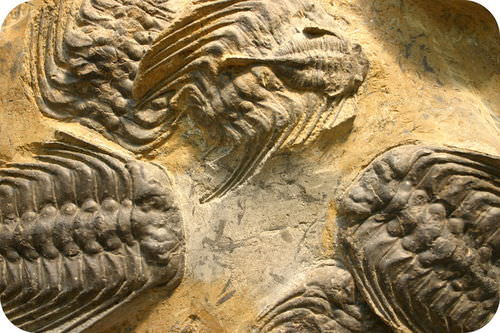
Trilobites were shallow marine animals that flourished during the lower Paleozoic.
Simple plants began to colonize the land during the Ordovician, but land plants really flourished when seeds evolved during the Carboniferous (Figurebelow). The abundant swamps became the coal and petroleum deposits that are the source of much of our fossil fuels today. During the later part of the Paleozoic, land animals and insects greatly increased in numbers and diversity.
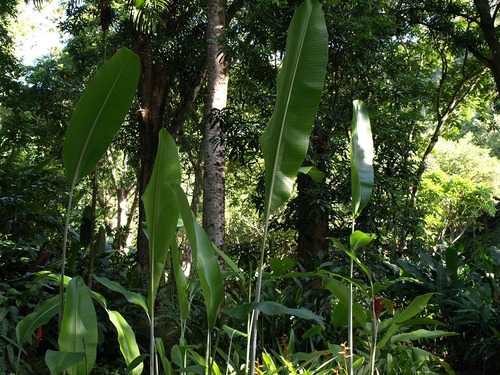
A modern rainforest has many seed-bearing plants that are similar to those that were common during the Carboniferous.
Mass Extinctions
Large extinction events separate the periods of the Paleozoic. After extinctions, new life forms evolved (Figure ). For example, after the extinction at the end of the Ordovician, fish and the first tetrapod animals appeared. Tetrapods are four legged vertebrates, but the earliest ones did not leave shallow, brackish water.
Permian Extinction
The largest mass extinction in Earth's history occurred at the end of the Permian period, about 250 million years ago. In this catastrophe, it is estimated that more than 95% of marine species on Earth went extinct. Marine species with calcium carbonate shells and skeletons suffered worst. About 70% of terrestrial vertebrate species (land animals) suffered the same fate. This was the only known mass extinction of insects.
This mass extinction appears to have taken place in three pulses, with three separate causes. Gradual environmental change, an asteroid impact, intense volcanism, or changes in the composition of the atmosphere may all have played a role.
Summary
During the Cambrian explosion many more life forms evolved than at any other time in Earth's history.
Today's fossil fuels originated in the tremendous number of plants that spread over the land during the Carboniferous.
The major periods of the Paleozoic are separated by extinction events, the largest of which brought the end of the Paleozoic.
Review
Give two reasons that the Cambrian is significant for the evolution of life.
How did extinctions during the Paleozoic lead to changes in life forms?
What brought about the Permian extinction?
Explore More
Use this resource to answer the questions that follow.
What were the first creatures to dominate the land?
What happened 250 million years ago?
What is a flood basalt eruption? What was the Siberian eruption like?
What happened to the Earth's temperature during this extinction? Why did this happen?
What occurs when the Earth's temperature raises 4-5 degrees?
Why didn't Peter Ward think that the Siberian Traps eruption was the sole reason for the Permian mass extinctions?
When and where did the extinction event begin?
When and where did the marine extinction phase begin?
What are the characteristics of the third phase of the extinction?
What is methane hydrate?
What caused the increase of carbon-12?
Why was it important for the Permian Mass Extinction to take place in the history of life on Earth?
NOTES / HIGHLIGHTS
Please Sign In to create your own Highlights / Notes
Notes/Highlights
Color
Highlighted Text
Notes
Please Sign In to create your own Highlights / Notes


 FlexiA FREE Digital Tutor for Every Student
 FlexBooks 2.0Customizable, digital textbooks in a new, interactive platform
 FlexBooksCustomizable, digital textbooks
 SchoolsFlexBooks from schools and districts near you
 Study GuidesQuick review with key information for each concept
 Adaptive PracticeBuilding knowledge at each student’s skill level
 SimulationsInteractive Physics & Chemistry Simulations
 PLIXPlay. Learn. Interact. eXplore.
 CCSS MathConcepts and FlexBooks aligned to Common Core
 NGSSConcepts aligned to Next Generation Science Standards
 Certified EducatorStand out as an educator. Become CK-12 Certified.
 WebinarsLive and archived sessions to learn about CK-12