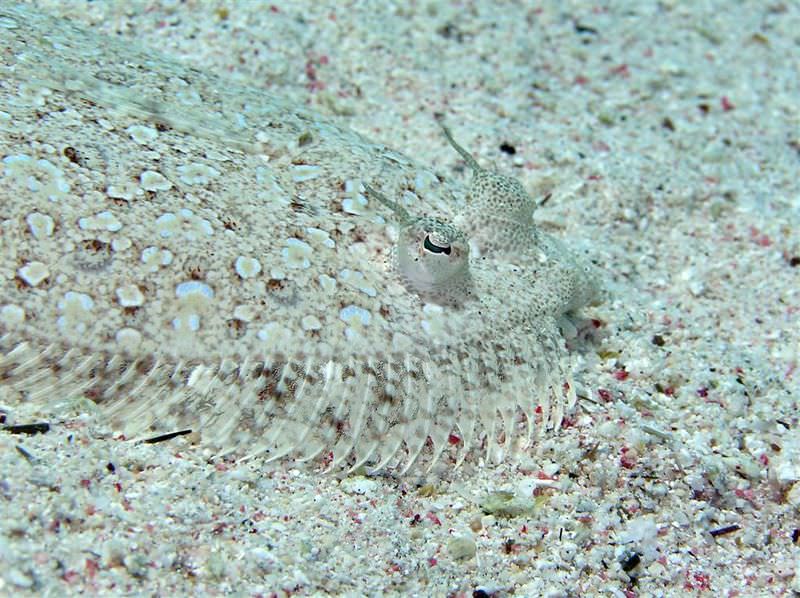
Why would an organism match its background? Wouldn't it be better to stand out?
An organism that blends with its background is more likely to avoid predators. If it survives, it is more likely to have offspring. Those offspring are more likely to blend into their backgrounds.
Adaptation
The characteristics of an organism that help it to survive in a given environment are called adaptations. Adaptations are traits that an organism inherits from its parents. Within a population of organisms are genes coding for a certain number of traits. For example, a human population may have genes for eyes that are blue, green, hazel, or brown, but as far as we know, not purple or lime green.
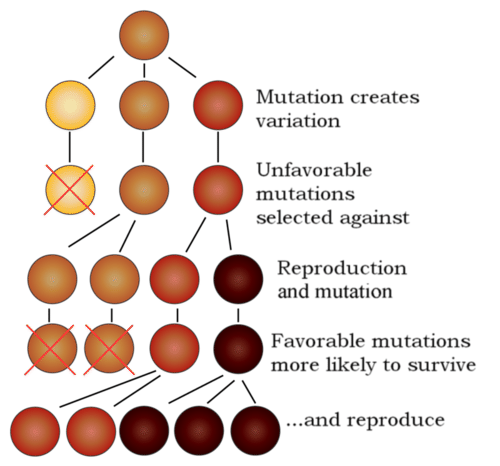
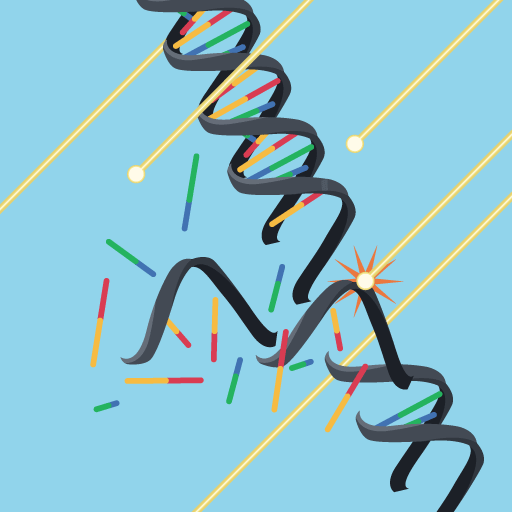
Adaptations develop when certain variations or differences in a population help some members survive better than others (Figurebelow). The variation may already exist within the population, but often the variation comes from a mutation, or a random change in an organism’s genes. Some mutations are harmful and the organism dies; in that case, the variation will not remain in the population. Many mutations are neutral and remain in the population. If the environment changes, the mutation may be beneficial and it may help the organism adapt to the environment. The organisms that survive pass this favorable trait on to their offspring.
Biological Evolution
Many changes in the genetic makeup of a species may accumulate over time, especially if the environment is changing. Eventually the descendants will be very different from their ancestors and may become a whole new species. Changes in the genetic makeup of a species over time are known as biological evolution.
Natural Selection
The mechanism for evolution is natural selection. Traits become more or less common in a population depending on whether they are beneficial or harmful. An example of evolution by natural selection can be found in the deer mouse, species Peromyscus maniculatus. In Nebraska this mouse is typically brown, but after glaciers carried lighter sand over the darker soil in the Sand Hills, predators could more easily spot the dark mice. Natural selection favored the light mice, and over time, the population became light colored.
An explanation of how adaptations develop.
Summary
A population has genetic variations, possibly due to mutations. Favorable variations may allow an organism to be better adapted to its environment and survive to reproduce.
Beneficial traits are favored in a population so that they may become better represented.
Changes in the genetic makeup of a species may result in a new species; this is biological evolution.
Review
The Grand Canyon was carved, separating what had once been a single population of squirrel into two separate populations. What do you think happened to those populations over time?
How does natural selection work?
How does biological evolution work?
What will cause evolution to proceed rapidly?
Explore More
Use these resources to answer the questions that follow.
What is an adaptation? What does an adaptation do?
What adaptation does the rock pocket mouse have for living over desert sand and gravel? What adaptation does it have for living over lava?
How could bacteria become resistant to antibiotics.
As climate warms what may happen to polar bears?
How does natural selection change the rock pocket mouse population from brown to black?
How do new species form?
What are the four factors of natural selection so that a species is better adapted to its environment?
What is adaptation? What is the mechanism?
NOTES / HIGHLIGHTS
Please Sign In to create your own Highlights / Notes
Vocabulary
termdefinition
mutationa change in the genetic makeup of a population of organisms that can be beneficial, harmful, or neutral.
natural selectionevolutionary process in which organisms best suited to their environment are more likely to survive and pass on their traits to future generations.
variationhaving many differences.
Notes/Highlights
Color
Highlighted Text
Notes
Please Sign In to create your own Highlights / Notes


 FlexiA FREE Digital Tutor for Every Student
 FlexBooks 2.0Customizable, digital textbooks in a new, interactive platform
 FlexBooksCustomizable, digital textbooks
 SchoolsFlexBooks from schools and districts near you
 Study GuidesQuick review with key information for each concept
 Adaptive PracticeBuilding knowledge at each student’s skill level
 SimulationsInteractive Physics & Chemistry Simulations
 PLIXPlay. Learn. Interact. eXplore.
 CCSS MathConcepts and FlexBooks aligned to Common Core
 NGSSConcepts aligned to Next Generation Science Standards
 Certified EducatorStand out as an educator. Become CK-12 Certified.
 WebinarsLive and archived sessions to learn about CK-12