On the one hand, you hear fish is good for you. On the other, you hear that you're not supposed to eat too much of some types of fish, like tuna. How can something that's supposed to be good for you be harmful to your health?
Mercury Pollution
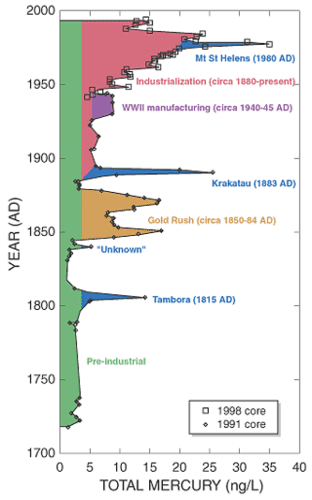
Mercury can be released into the atmosphere from natural sources, like volcanoes, or human-caused sources such as mining and the burning of coal (Figure below). In the atmosphere, the mercury can be transported long distances before it forms small droplets that are deposited in water or sediments.
Historic increases of mercury in the atmosphere: blue is volcanic eruptions; brown, purple, and pink are human-caused.
Bioaccumulation
Do you know why you are supposed to eat large predatory fish like tuna infrequently? It is because of the bioaccumulation of mercury in those species.
Some pollutants remain in an organism throughout its life, a phenomenon called bioaccumulation. In this process, an organism accumulates the entire amount of a toxic compound that it consumes over its lifetime. Not all substances bioaccumulate. Can you name one that does not? Aspirin does not bioaccumulate; if it did, a person would quickly accumulate a toxic amount in her body. Compounds that bioaccumulate are usually stored in the organism’s fat.
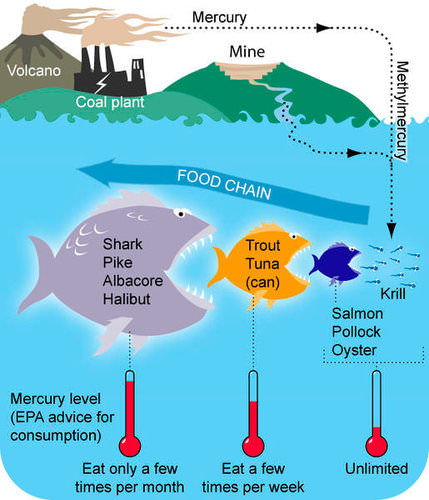
In the sediments, bacteria convert the droplets to the hazardous compound methyl mercury. Bacteria and plankton store all of the mercury from all of the seawater they ingest (Figure below). A small fish that eats bacteria and plankton accumulates all of the mercury from all of the tiny creatures it eats over its lifetime. A big fish accumulates all of the mercury from all of the small fish it eats over its lifetime. For a tuna at the top of the food chain, that’s a lot of mercury.
Methyl mercury bioaccumulates up the food chain.
So tuna pose a health hazard to anything that eats them because their bodies are so high in mercury. This is why the government recommends limits on the amount of tuna that people eat. Limiting intake of large predatory fish is especially important for children and pregnant women. If the mercury just stayed in a person’s fat, it would not be harmful, but that fat is used when a woman is pregnant or nursing a baby. A person will also get the mercury into her system when she (or he) burns the fat while losing weight.
Mad As a Hatter
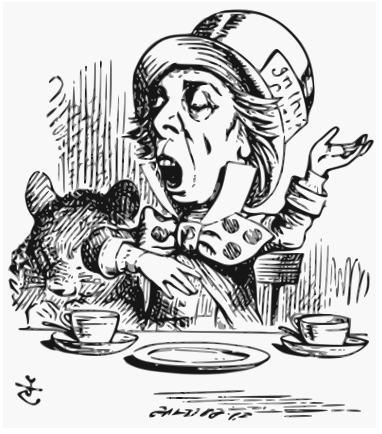
Methyl mercury poisoning can cause nervous system or brain damage, especially in infants and children. Children may experience brain damage or developmental delays. The phrase “mad as a hatter” was common when Lewis Carroll wrote his Alice in Wonderland stories. It was based on symptoms suffered by hatters who were exposed to mercury and experienced mercury poisoning while using the metal to make hats (Figure below). Like mercury, other metals and VOCS can bioaccumulate, causing harm to animals and people high on the food chain.
The Mad Hatter.
Mercury, a potent neurotoxin, has been flowing into the San Francisco Bay since the Gold Rush Era. It has settled in the bay's mud and made its way up the food chain, endangering wildlife and making many fish unsafe to eat. Now a multi-billion-dollar plan aims to clean it up.
Summary
Burning coal releases mercury into the atmosphere. It falls into sediments and is converted into methyl mercury by bacteria.
Creatures ingest the methyl mercury and store it. Then, larger creatures eat them and store all of that methyl mercury, on up the food chain.
Mercury poisoning causes nervous system damage.
Review
What is bioaccumulation?
How does mercury change from something benign to something harmful?
Why should you restrict your intake of tuna and other large predatory fish but continue to eat or even increase your consumption of small fish that are low on the food chain, like anchovies?
Explore More
Use this resource to answer the questions that follow.
What is a natural source of mercury in the air?
What the are the human-made sources of mercury?
Where does mercury come from relative to the location of Acadia National Park?
Why is Acadia National Park concerned about mercury?
How is mercury an example of biomagnification?
What are the toxic effects of mercury?
Where does mercury enter the park ecosystem from?
How much mercury is deposited relative to the amount scientists think existed before industrialization?
Explain what people can do to reduce mercury in the environment.
Vocabulary
termdefinition
bioaccumulationthe accumulation, or gathering, of toxic substances within organisms so that the concentrations increase up the food web.
Notes/Highlights
Color
Highlighted Text
Notes
Please Sign In to create your own Highlights / Notes


 FlexiA FREE Digital Tutor for Every Student
 FlexBooks 2.0Customizable, digital textbooks in a new, interactive platform
 FlexBooksCustomizable, digital textbooks
 SchoolsFlexBooks from schools and districts near you
 Study GuidesQuick review with key information for each concept
 Adaptive PracticeBuilding knowledge at each student’s skill level
 SimulationsInteractive Physics & Chemistry Simulations
 PLIXPlay. Learn. Interact. eXplore.
 CCSS MathConcepts and FlexBooks aligned to Common Core
 NGSSConcepts aligned to Next Generation Science Standards
 Certified EducatorStand out as an educator. Become CK-12 Certified.
 WebinarsLive and archived sessions to learn about CK-12