Of course not. In Greek mythology, Icarus, got too close and his wax wings melted. Today, we have other ways to see the Sun. Spacecraft take photos and some have instruments that allow us to study the interior. Unlike Icarus, we don't need to worry about our wax wings melting.
Layers of the Sun
The Sun is a sphere, composed almost entirely of the elements hydrogen and helium. The Sun is not solid, nor is it a typical gas. Most atoms in the Sun exist as plasma, a fourth state of matter made up of superheated gas with a positive electrical charge.
Internal Structure
Because the Sun is not solid, it does not have a defined outer boundary. It does, however, have a definite internal structure with identifiable layers (Figurebelow). From inward to outward they are:
The layers of the Sun.
The Sun’s central core is plasma with a temperature of around 27 million °C. At such high temperatures hydrogen combines to form helium by nuclear fusion, a process that releases vast amounts of energy. This energy moves outward, towards the outer layers of the Sun.
The radiative zone, just outside the core, has a temperature of about 7 million °C. The energy released in the core travels extremely slowly through the radiative zone. A particle of light, called a photon, travels only a few millimeters before it hits another particle. The photon is absorbed and then released again. A photon may take as long as 50 million years to travel all the way through the radiative zone.
In the convection zone, hot material from near the radiative zone rises, cools at the Sun’s surface, and then plunges back downward to the radiative zone. Convective movement helps to create solar flares and sunspots.
The Outer Layers
The next three layers make up the Sun’s atmosphere. Since there are no solid layers to any part of the Sun, these boundaries are fuzzy and indistinct.
The photosphere is the visible surface of the Sun, the region that emits sunlight. The photosphere is relatively cool — only about 6,700 °C. The photosphere has several different colors, including oranges, yellow and reds. This characteristic gives it a grainy appearance.
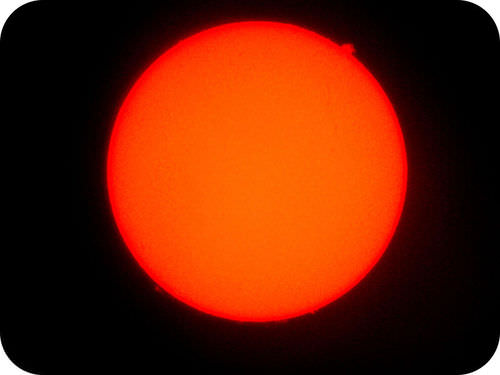
The chromosphere is a thin zone, about 2,000 km thick, that glows red as it is heated by energy from the photosphere (Figurebelow). Temperatures in the chromosphere range from about 4,000 °C to about 10,000 °C. Jets of gas fire up through the chromosphere at speeds up to 72,000 km per hour, reaching heights as high as 10,000 km.
The chromosphere as seen through a filter.
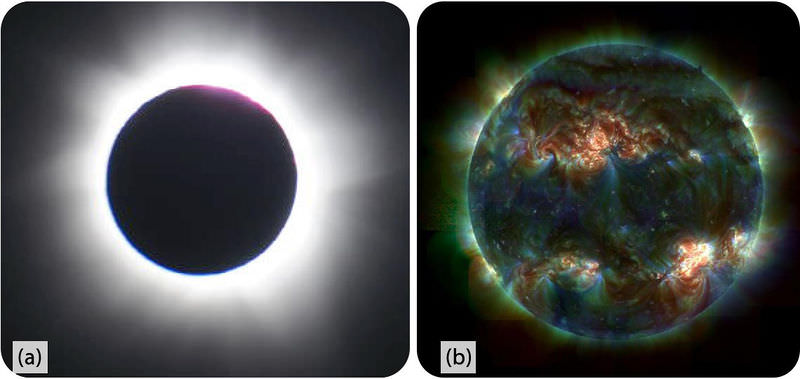
The corona is the outermost plasma layer. It is the Sun’s halo or "crown." The corona’s temperature of 2 to 5 million °C is much hotter than the photosphere (Figurebelow).
(a) During a solar eclipse, the Sun’s corona is visible extending millions of kilometers into space. (b) The corona and coronal loops in the lower solar atmosphere taken by the TRACE space telescope.
Summary
The Sun is made mostly of plasma, a fourth state of matter made up of superheated gas with a positive electrical charge.
At the Sun's center is plasma, where nuclear fusion takes place. The radiative zone is outside the core. The convection zone, where convection takes place, is located outward from that.
The photosphere is the visible surface of the Sun, where sunlight is emitted from. The reddish chromosphere is heated by the photosphere and the outer corona is the Sun's crown.
Review
The Sun is very dense, so is there solid matter at the center? Why or why not?
What are the inner layers of the Sun and what are their characteristics?
What are the outer layers of the Sun and what are their characteristics?
What powers the Sun?
Explore More
Use this resource to answer the questions that follow.
What is the Sun? What are the stars?
What is happening in the Sun's core?
What keeps the Sun from exploding or collapsing?
How far is Earth from the Sun; what is that equal to in astronomical units?
What are the layers of the Sun from inside to outside?
What is the photosphere?
How does the temperature of the Sun change from the center to the surface? Where is the density highest?
Which direction does heat flow?
How does energy move near the center of the Sun? What zone is that?
How is energy moving in the convection zone?
What is the temperature structure of the atmosphere from inner to outer? why does this happen?
What is the chromosphere? What interesting features does it contain?
What is the corona?
NOTES / HIGHLIGHTS
Please Sign In to create your own Highlights / Notes
Vocabulary
termdefinition
chromospherethin layer of the Sun’s atmosphere that lies directly above the photosphere; this layer glows red.
convection zonelayer of the Sun that surrounds the radiative zone where energy moves as flowing cells of gas.
coronaoutermost layer of the Sun; a plasma that extends millions of kilometers into space.
nuclear fusiona process in which low-mass nuclei (ex. H or He) combine to form a heavier and more stable nucleus, releasing an enormous amount of energy; most of the Sun's energy comes from nuclear fusion.
photona particle of electromagnetic radiation (light) that has zero mass and carries a quantum of energy.
photospherethe visible surface of the Sun.
plasmaa high energy, high temperature form of matter; electrons are removed from atoms, leaving each atom with a positive electrical charge.
radiative zonelayer of the Sun immediately surrounding the core where energy moves atom to atom as electromagnetic waves.
Notes/Highlights
Color
Highlighted Text
Notes
Please Sign In to create your own Highlights / Notes
Credit:(a) Courtesy of NASA/Cirtain; (b) Courtesy of NASA;By Granules2.jpg: created by NASAderivative work: Hans Dunkelberg (talk) - Granules2.jpg, Public Domain, https://commons.wikimedia.org/w/index.php?curid=12751001;By Coronal_Hole_Magnetic_Field_Lines.svg: Sebman81Sun_in_X-Ray.png: NASA Goddard Laboratory for AtmospheresCelestia_sun.jpg: NikoLangderivative work: Aza (talk) - Coronal_Hole_Magnetic_Field_Lines.svgSun_in_X-Ray.pngCelestia_sun.jpg, CC BY-SA 3.0, https://commons.wikimedia.org/w/index.php?curid=8258519 Source: (a) http://www.flickr.com/photos/gsfc/8187623375/; (b) http://commons.wikimedia.org/wiki/File:Tracemosaic.jpg;By Granules2.jpg: created by NASAderivative work: Hans Dunkelberg (talk) - Granules2.jpg, Public Domain, https://commons.wikimedia.org/w/index.php?curid=12751001;By Coronal_Hole_Magnetic_Field_Lines.svg: Sebman81Sun_in_X-Ray.png: NASA Goddard Laboratory for AtmospheresCelestia_sun.jpg: NikoLangderivative work: Aza (talk) - Coronal_Hole_Magnetic_Field_Lines.svgSun_in_X-Ray.pngCelestia_sun.jpg, CC BY-SA 3.0, https://commons.wikimedia.org/w/index.php?curid=8258519 License:(A) CC BY 2.0; (B) Public Domain
 AI Teacher Tools

 FlexiA FREE Digital Tutor for Every Student
 FlexBooks 2.0Customizable, digital textbooks in a new, interactive platform
 FlexBooksCustomizable, digital textbooks
 SchoolsFlexBooks from schools and districts near you
 Study GuidesQuick review with key information for each concept
 Adaptive PracticeBuilding knowledge at each student’s skill level
 SimulationsInteractive Physics & Chemistry Simulations
 PLIXPlay. Learn. Interact. eXplore.
 CCSS MathConcepts and FlexBooks aligned to Common Core
 NGSSConcepts aligned to Next Generation Science Standards
 Certified EducatorStand out as an educator. Become CK-12 Certified.
 WebinarsLive and archived sessions to learn about CK-12