Large explosions on the Sun's surface can disrupt the high-precision GPS systems that are used by airlines. Radars and long-range radio communications may also be temporarily lost.
Surface Features
The Sun’s surface features are quite visible, but only with special equipment. For example, sunspots are only visible with special light-filtering lenses.
Sunspots
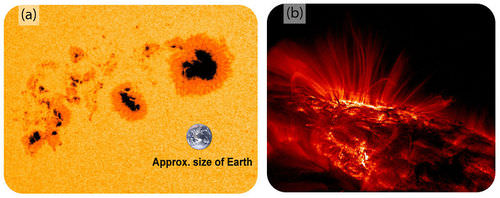
The most noticeable surface features of the Sun are cooler, darker areas known as sunspots (Figurebelow). Sunspots are located where loops of the Sun’s magnetic field break through the surface and disrupt the smooth transfer of heat from lower layers of the Sun, making them cooler, darker, and marked by intense magnetic activity. Sunspots usually occur in pairs. When a loop of the Sun’s magnetic field breaks through the surface, a sunspot is created where the loop comes out and where it goes back in again. Sunspots usually occur in 11-year cycles, increasing from a minimum number to a maximum number and then gradually decreasing to a minimum number again.
(a) Sunspots. (b) A close-up of a sunspot taken in ultraviolet light.
Solar Flares
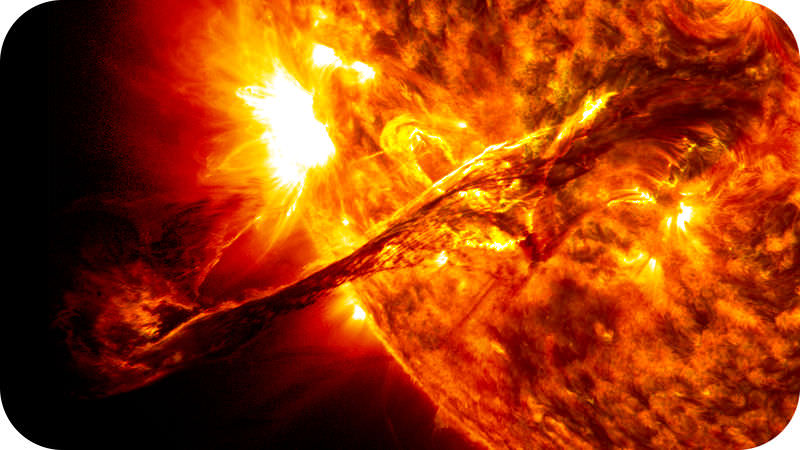
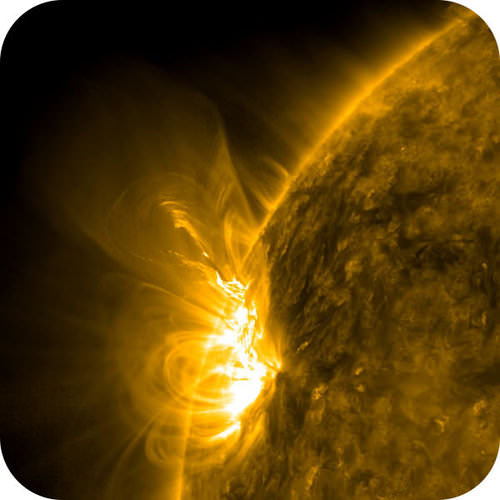
There are other types of interruptions of the Sun's magnetic energy. If a loop of the Sun's magnetic field snaps and breaks, it creates solar flares, which are violent explosions that release huge amounts of energy (Figurebelow).
Magnetic activity leads up to a small solar flare.
A strong solar flare can turn into a coronal mass ejection. A solar flare or coronal mass ejection releases streams of highly energetic particles that make up the solar wind. The solar wind can be dangerous to spacecraft and astronauts because it sends out large amounts of radiation that can harm the human body. Solar flares have knocked out entire power grids and disturbed radio, satellite, and cell phone communications.
Solar Prominences
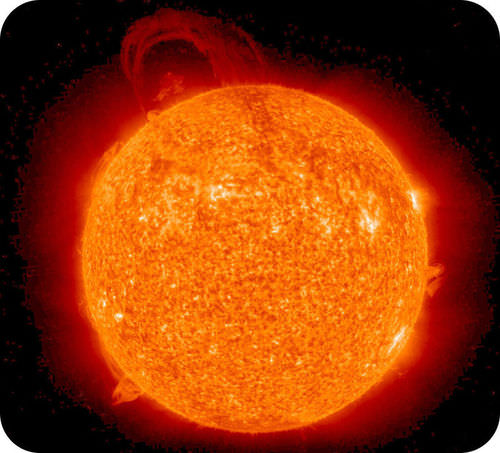
A solar prominence.
Another highly visible feature on the Sun are solar prominences. If plasma flows along a loop of the Sun’s magnetic field from sunspot to sunspot, it forms a glowing arch that reaches thousands of kilometers into the Sun’s atmosphere. Prominences can last lengths of time ranging from a day to several months. Prominences are also visible during a total solar eclipse.
Most of the imagery comes from SDO's AIA instrument; different colors represent different temperatures, a common technique for observing solar features. SDO sees the entire disk of the Sun in extremely high spatial and temporal resolution, allowing scientists to zoom in on notable events such as flares, waves, and sunspots.
Solar Dynamics Observatory
The video above was taken from the SDO, the most advanced spacecraft ever designed to study the Sun. During its five-year mission, SDO will examine the Sun's magnetic field and also provide a better understanding of the role the Sun plays in Earth's atmospheric chemistry and climate. Since just after its launch on February 11, 2010, SDO is providing images with clarity 10 times better than high-definition television and will return more comprehensive science data faster than any other solar-observing spacecraft.
The Solar Dynamics Observatory is a NASA spacecraft launched in early 2010 is obtaining IMAX-like images of the Sun every second of the day, generating more data than any NASA mission in history. The data will allow researchers to learn about solar storms and other phenomena that can cause blackouts and harm astronauts.
Summary
Sunspots occur in pairs because each is one side of a loop of the Sun's magnetic field that reaches the Sun's surface. These spots are cooler and darker than the rest of the Sun's surface and they are marked by intense magnetic activity.
Solar prominences are the plasma loops that connect two sunspots.
Solar flares and coronal mass ejections are eruptions of highly energetic particles that can erupt from the Sun's surface and cause problems with power grids and communications on Earth.
Explore More
Use these resources to answer the questions that follow.
What are sunspots?
What about the Sun interests scientists?
How is the sunspot related to convection in the sun?
How does the temperature of a sunspot compare to the rest of the Sun's surface?
How can solar flares affect the Earth?
What is the solar cycle?
What is a solar flare?
What causes solar flares?
When was the largest solar flare recorded? What was its rating?
Who monitors the Sun? Why is this important?
Review
What are sunspots and what is a sunspot cycle?
How are solar prominences related to sunspots?
What is being learned from the Solar Dynamics Observatory?
Resources
Vocabulary
termdefinition
solar flarea violent explosion on the Sun’s surface.
solar prominenceplasma loop flowing between sunspots.
sunspotcool, dark area on the Sun’s surface that have lower temperatures than surrounding areas; sunspots usually occur in pairs and come and go on an 11-year cycle.
Notes/Highlights
Color
Highlighted Text
Notes
Please Sign In to create your own Highlights / Notes


 FlexiA FREE Digital Tutor for Every Student
 FlexBooks 2.0Customizable, digital textbooks in a new, interactive platform
 FlexBooksCustomizable, digital textbooks
 SchoolsFlexBooks from schools and districts near you
 Study GuidesQuick review with key information for each concept
 Adaptive PracticeBuilding knowledge at each student’s skill level
 SimulationsInteractive Physics & Chemistry Simulations
 PLIXPlay. Learn. Interact. eXplore.
 CCSS MathConcepts and FlexBooks aligned to Common Core
 NGSSConcepts aligned to Next Generation Science Standards
 Certified EducatorStand out as an educator. Become CK-12 Certified.
 WebinarsLive and archived sessions to learn about CK-12