"What Jupiter? Do not trifle. There is no Jupiter." — Aristophanes
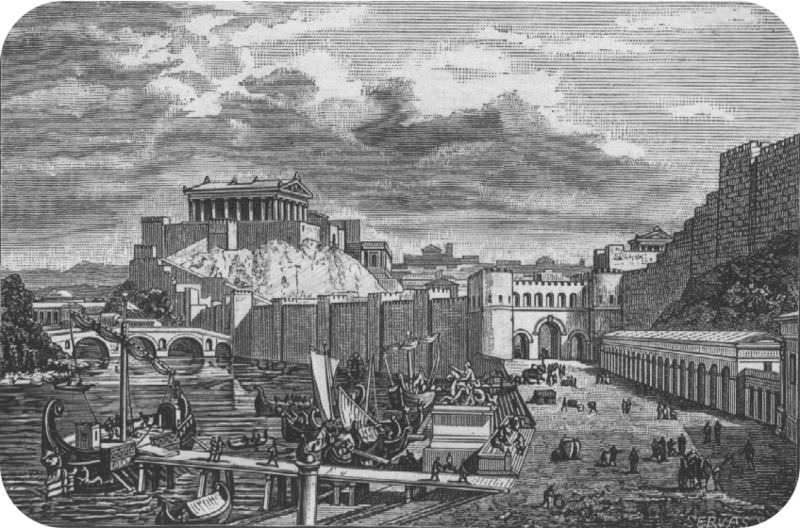
The Romans named the largest planet for their most important god. They followed the tradition of the Greeks, who had similarly named the planet Zeus. They built a temple to Jupiter on the hill. Was Aristophanes denying the existence of the most important Roman god?
Characteristics
Jupiter is enormous, the largest object in the solar system besides the Sun. Although Jupiter is over 1,300 times Earth’s volume, it has only 318 times the mass of Earth. Like the other gas giants, it is much less dense than Earth.
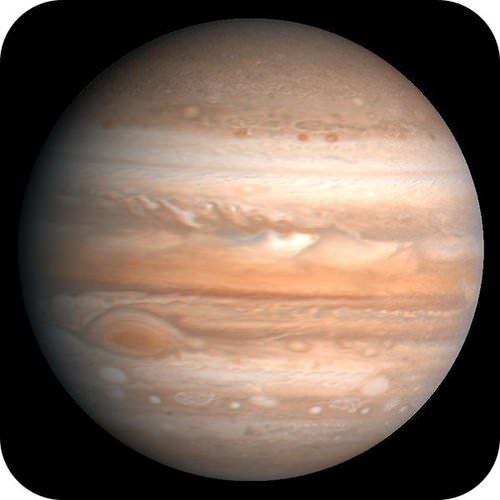
Because Jupiter is so large, it reflects a lot of sunlight. Jupiter is extremely bright in the night sky; only the Moon and Venus are brighter (Figurebelow). This brightness is all the more impressive because Jupiter is quite far from the Earth — 5.20 AUs away. It takes Jupiter about 12 Earth years to orbit once around the Sun.
This image of Jupiter was taken by Voyager 2 in 1979. The colors were later enhanced to bring out more details.
A Ball of Gas and Liquid
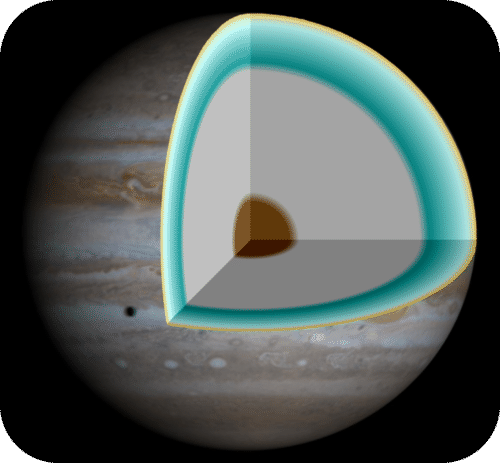
Astronauts trying to land a spaceship on the surface of Jupiter would find that there is no solid surface at all! Jupiter is made mostly of hydrogen, with some helium, and small amounts of other elements (Figurebelow). Jupiter's atmosphere is composed of hydrogen and helium. Deeper within the planet, pressure compresses the gases into a liquid. Some evidence suggests that Jupiter may have a small rocky core of heavier elements at its center.
Jupiter's structure.
A Stormy Atmosphere
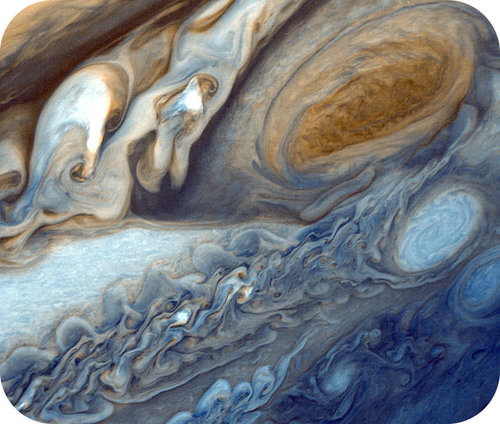
The upper layer of Jupiter’s atmosphere contains clouds of ammonia (NH3) in bands of different colors. These bands rotate around the planet, but also swirl around in turbulent storms. The Great Red Spot (Figurebelow) is an enormous, oval-shaped storm found south of Jupiter’s equator. This storm is more than three times as wide as the entire Earth. Clouds in the storm rotate in a counterclockwise direction, making one complete turn every six days or so. The Great Red Spot has been on Jupiter for at least 300 years, since astronomers could first see the storm through telescopes. Do you think the Great Red Spot is a permanent feature on Jupiter? How could you know?
This image of Jupiter’s Great Red Spot (upper right of image) was taken by the Voyager 1 spacecraft. The white storm just below the Great Red Spot is about the same diameter as Earth.
Jupiter’s Moons and Rings
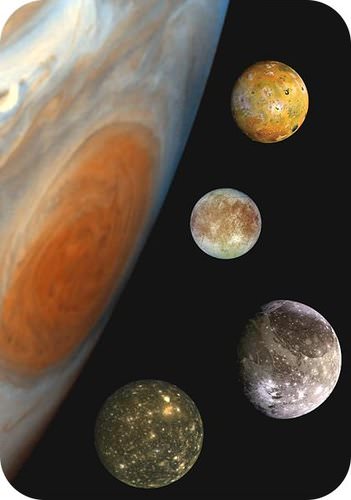
Jupiter has a very large number of moons — 63 have been discovered so far. Four are big enough and bright enough to be seen from Earth, using no more than a pair of binoculars. These moons — Io, Europa, Ganymede, and Callisto — were first discovered by Galileo in 1610, so they are sometimes referred to as the Galilean moons (Figurebelow). The Galilean moons are larger than the dwarf planets Pluto, Ceres, and Eris. Ganymede is not only the biggest moon in the solar system; it is even larger than the planet Mercury!
This composite image shows the four Galilean moons and their sizes relative to the Great Red Spot. From top to bottom, the moons are Io, Europa, Ganymede, and Callisto. Jupiter’s Great Red Spot is in the background. Sizes are to scale.
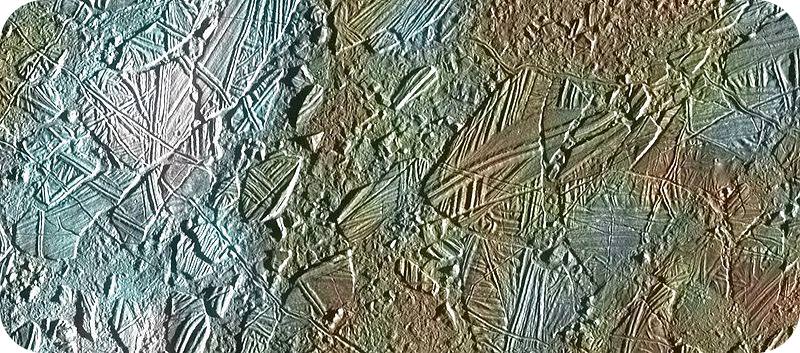
Scientists are particularly interested in Europa because it may be a place to find extraterrestrial life. What features might make a satellite so far from the Sun a candidate for life? Although the surface of Europa is a smooth layer of ice, there is evidence that there is an ocean of liquid water underneath (Figurebelow). Europa also has a continual source of energy — it is heated as it is stretched and squashed by tidal forces from Jupiter. Numerous missions have been planned to explore Europa, including plans to drill through the ice and send a probe into the ocean. However, no such mission has yet been attempted.
An enhanced color image of a portion of Europa’s icy surface. The surface ice may have motions similar to plate tectonics on Earth.
In 1979, two spacecraft — Voyager 1 and Voyager 2 — visited Jupiter and its moons. Photos from the Voyager missions showed that Jupiter has a ring system. This ring system is very faint, so it is difficult to observe from Earth.
Summary
Jupiter is mostly hydrogen with some helium, and may contain a small rocky core.
Jupiter has a thick atmosphere containing the Great Red Spot, a storm that has been going for at least 300 years.
One of Jupiter's moons, Europa, appears to have a liquid ocean beneath the surface due to tidal forces from the massive planet; this ocean could be a place for life.
Review
Why is the Great Red Spot thought to be a storm?
What is Jupiter made of?
Why is Europa one of the few locations in the solar system where scientists think there could possibly be life?
What is the source of heat on Europa?
Vocabulary
termdefinition
Great Red Spotan enormous, oval-shaped, long-lived storm on Jupiter.
Notes/Highlights
Color
Highlighted Text
Notes
Please Sign In to create your own Highlights / Notes


 FlexiA FREE Digital Tutor for Every Student
 FlexBooks 2.0Customizable, digital textbooks in a new, interactive platform
 FlexBooksCustomizable, digital textbooks
 SchoolsFlexBooks from schools and districts near you
 Study GuidesQuick review with key information for each concept
 Adaptive PracticeBuilding knowledge at each student’s skill level
 SimulationsInteractive Physics & Chemistry Simulations
 PLIXPlay. Learn. Interact. eXplore.
 CCSS MathConcepts and FlexBooks aligned to Common Core
 NGSSConcepts aligned to Next Generation Science Standards
 Certified EducatorStand out as an educator. Become CK-12 Certified.
 WebinarsLive and archived sessions to learn about CK-12