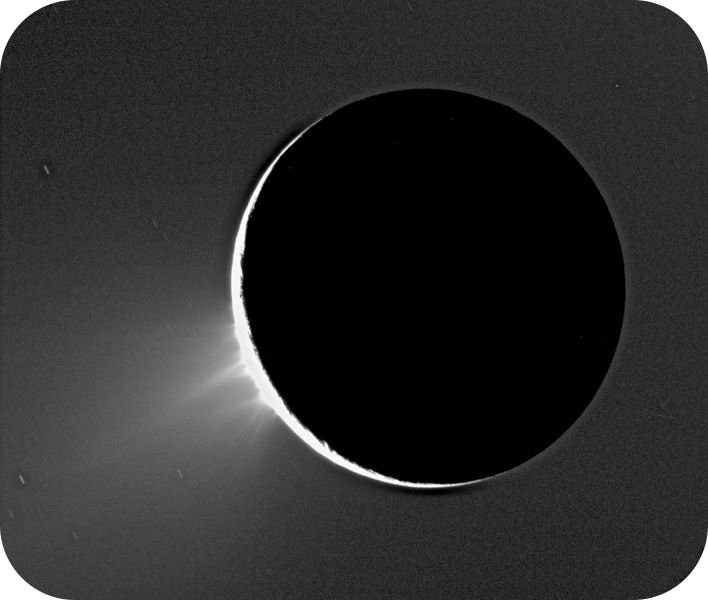
Saturn's moon, Enceladus, may be the most habitable spot in the solar system, other than Earth, for life as we know it. These plumes indicate the presence of water and the internal heat to create liquid water. Is there life? No one knows yet.
Saturn
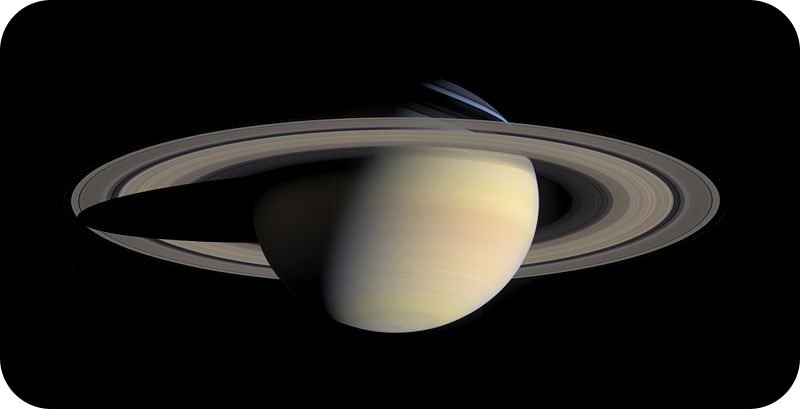
Saturn, shown in Figurebelow, is famous for its beautiful rings. Although all the gas giants have rings, only Saturn’s can be easily seen from Earth. In Roman mythology, Saturn was the father of Jupiter.
Saturn’s mass is about 95 times the mass of Earth, and its volume is 755 times Earth’s volume, making it the second largest planet in the solar system. Saturn is also the least dense planet in the solar system. It is less dense than water. What would happen if you had a large enough bathtub to put Saturn in? Saturn would float! Saturn orbits the Sun once about every 30 Earth years.
This image of Saturn and its rings is a composite of pictures taken by the Cassini orbiter in 2008
Like Jupiter, Saturn is made mostly of hydrogen and helium gases in the outer layers and liquids at greater depths. The upper atmosphere has clouds in bands of different colors. These rotate rapidly around the planet, but there seems to be less turbulence and fewer storms on Saturn than on Jupiter. One interesting phenomenon that has been observed in the storms on Saturn is the presence of thunder and lightning (see video, below). The planet likely has a small rocky and metallic core.
Saturn’s Rings
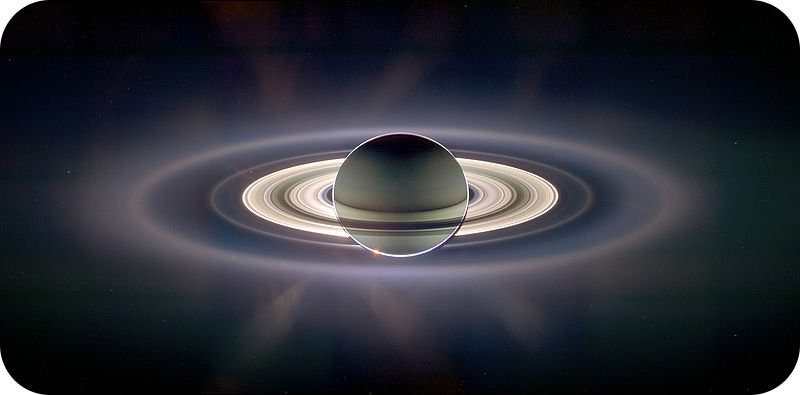
In 1610, Galileo first observed Saturn’s rings with his telescope, but he thought they might be two large moons, one on either side of the planet. In 1659, the Dutch astronomer Christian Huygens realized that the features were rings (Figurebelow).
Saturn’s rings circle the planet’s equator and appear tilted because Saturn itself is tilted about 27 degrees. The rings do not touch the planet.
A color-exaggerated mosaic of Saturn and its rings taken by Cassini as Saturn eclipses the Sun.
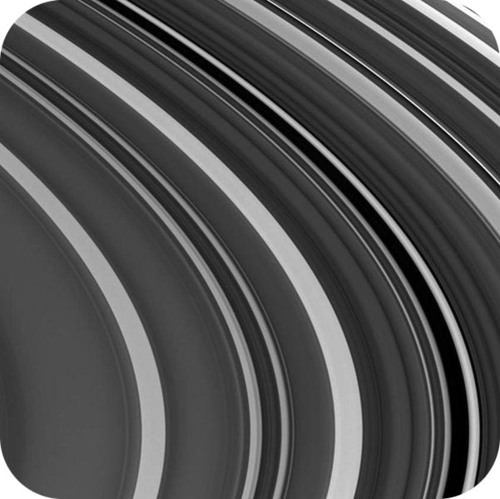
The Voyager 1 and 2 spacecraft in 1980 and 1981 sent back detailed pictures of Saturn, its rings, and some of its moons. Saturn’s rings are made of particles of water and ice, with some dust and rocks (Figurebelow). There are several gaps in the rings that scientists think have originated because the material was cleared out by the gravitational pull within the rings, or by the gravitational forces of Saturn and of moons outside the rings.
A close-up of Saturn’s outer C ring showing areas with higher particle concentration and gaps.
The rings were likely formed by the breakup of one of Saturn’s moons or from material that never accreted into the planet when Saturn originally formed.
Saturn’s Moons
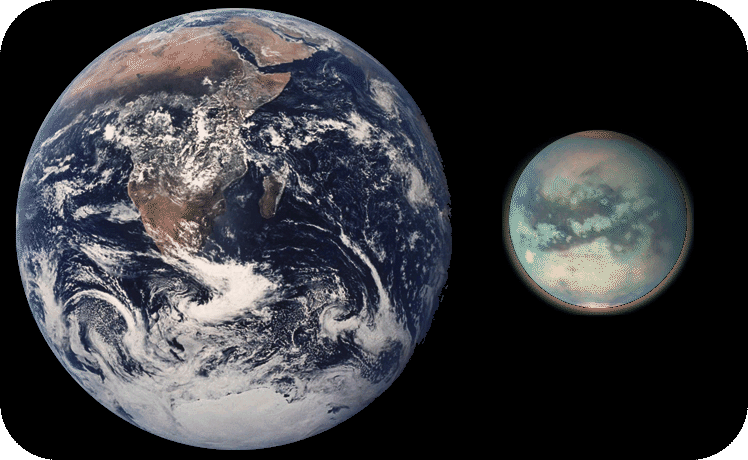
Most of Saturn’s moons are very small, and only seven are large enough for gravity to have made them spherical. Only Titan is larger than Earth’s Moon at about 1.5 times its size. Titan is even larger than the planet Mercury.
Scientists are interested in Titan because its atmosphere is similar to what Earth’s was like before life developed. Nitrogen is dominant and methane is the second most abundant gas. Titan may have a layer of liquid water and ammonia under a layer of surface ice. Lakes of liquid methane (CH4) and ethane (C2H6) are found on Titan’s surface. Although conditions are similar enough to those of early Earth for scientists to speculate that extremely primitive life may exist on Titan, the extreme cold and lack of carbon dioxide make it unlikely (Figurebelow).
This composite image compares Saturn’s largest moon, Titan (right) to Earth (left).
Summary
Like Jupiter, Saturn is made of hydrogen and helium.
Saturn's rings are composed of water and ice, with some dust and rock.
Titan has an atmosphere dominated by nitrogen and methane, and may have liquid water beneath the ice.
Review
What features of Enceladus lead scientists to think that the moon could have life?
What caused Saturn's rings to form?
What features of Titan make it a possible location for life, but why do scientists think that this is unlikely?
Resources
Notes/Highlights
Color
Highlighted Text
Notes
Please Sign In to create your own Highlights / Notes


 FlexiA FREE Digital Tutor for Every Student
 FlexBooks 2.0Customizable, digital textbooks in a new, interactive platform
 FlexBooksCustomizable, digital textbooks
 SchoolsFlexBooks from schools and districts near you
 Study GuidesQuick review with key information for each concept
 Adaptive PracticeBuilding knowledge at each student’s skill level
 SimulationsInteractive Physics & Chemistry Simulations
 PLIXPlay. Learn. Interact. eXplore.
 CCSS MathConcepts and FlexBooks aligned to Common Core
 NGSSConcepts aligned to Next Generation Science Standards
 Certified EducatorStand out as an educator. Become CK-12 Certified.
 WebinarsLive and archived sessions to learn about CK-12